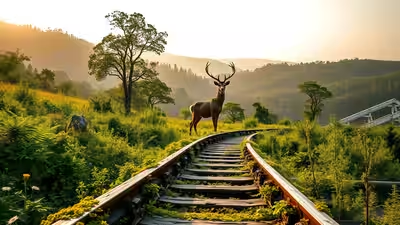
Deep in the driftless hills of southwestern Wisconsin lies a railway corridor that has not carried a train since 1964, yet it remains one of the busiest routes in the region, only now the traffic moves on hooves, wings and two feet rather than steel wheels. The Elroy Sparta line once formed part of the Chicago and North Western Railway’s main route linking Chicago with the Twin Cities, cutting through three hand-dug tunnels and past small farming towns along the way. When a more efficient bypass made the old route redundant, the railway slowly fell out of use before being abandoned altogether. What followed was a quiet transformation, as prairies, wetlands and forest crept back over the corridor, turning an old industrial route into a green passage for the wildlife that now calls it home.
Why the Elroy Sparta railway line was abandoned in the 1960s
The corridor between Elroy and Sparta was originally built as part of the Chicago and North Western Railway’s push through Wisconsin during the 1870s, cutting straight through the hilly, unglaciated terrain of the state’s driftless region. In the early twentieth century, the railway company constructed a bypass with gentler grades and no tunnels, which pushed the older route into a secondary role it never fully recovered from. Traffic on the line kept declining for decades until the railway finally stopped running trains in 1964, leaving 32.5 miles of graded corridor, three stone tunnels and a scattering of small depot buildings with no active rail use at all.
How the corridor became the country’s first rail-to-trail conversion
Rather than let the abandoned right of way sit idle, the state of Wisconsin purchased the corridor and set out to turn it into a public trail, a project that the Wisconsin Department of Natural Resources now describes as the first rail-to-trail conversion in the United States. The trail opened to the public in 1967, following the old Chicago and North Western grade through the towns of Kendall, Wilton and Norwalk before ending in Sparta, and it earned a National Recreation Trail designation in 1971. According to the department’s own overview of Wisconsin’s state trail system, the success of the Elroy Sparta corridor helped launch a much larger movement, with the state going on to develop dozens more rail trails and inspiring a national push that has since converted over 25,000 miles of former railroad corridors into recreational trails across the country.
What happens to a landscape once trains stop running
Once rail traffic stopped and maintenance crews moved on, the corridor’s cleared, gravelly surface gradually gave way to the surrounding ecology. Grasses and wildflowers spread across the old rail bed, while the wooded slopes on either side crept closer, filling in what had once been kept clear for passing trains. The corridor today winds through a mix of prairie, wetland and farmland, a patchwork of habitats that would otherwise sit disconnected from one another across the surrounding agricultural landscape. That kind of stitched-together, uninterrupted strip of vegetation is exactly what makes an old rail line valuable to wildlife, since many animals rely on continuous cover to move safely between feeding grounds, nesting sites and water sources without crossing open, exposed farmland.
Why researchers say rail trails work as genuine wildlife corridors
A peer-reviewed study titled From Right-of-Way to Greenway: Parameters for the Ecological Function of Midwestern Rail-Trail Corridors, published in the journal Fábos Conference on Landscape and Greenway Planning, examined former rail corridors across Iowa’s Corn Belt region to understand how well these converted trails actually function as wildlife habitat. The researchers noted that large tracts of public conservation land are scarce across the intensively farmed Midwest, which makes long, connected strips of vegetation like former rail corridors unusually valuable for helping species move through an otherwise fragmented landscape. Using GIS mapping and drone photography, the study’s authors examined the structural characteristics of several rail trail corridors to assess how effectively they could be managed not just as recreational paths but as genuine green infrastructure supporting wildlife movement and habitat.
How wildlife corridors fit into wider conservation efforts
The value of connected habitat corridors extends well beyond old railway lines, and federal agencies have increasingly recognised their importance for helping animals move safely across a landscape shaped by roads, farms and development. The United States Fish and Wildlife Service notes that wild animals need functioning routes to complete their life cycles, whether that means a narrow strip of vegetation connecting two patches of forest or a much larger corridor spanning hundreds of miles for migrating elk, deer and pronghorn. Old rail corridors like the Elroy Sparta line offer a smaller but no less useful version of that same principle, threading continuous cover through farmland that would otherwise leave little room for animals to move between habitats.
What the corridor looks like today
More than half a century after the last train passed through, the Elroy Sparta corridor now sees close to 60,000 visitors a year, drawn by its crushed limestone surface, quiet river crossings and the three cool, dark tunnels that once guided locomotives through the hills. Yet its role as a functioning ecological corridor has quietly outlasted its role as a recreational trail, offering continuous cover for the birds, deer and smaller mammals that move along its length largely unnoticed by the cyclists and hikers passing through. What began as a stretch of abandoned industrial infrastructure has become something closer to a long, narrow nature reserve, proof that a landscape given enough time and room can find its own way back to something resembling wilderness, even along a route humans built for an entirely different purpose.