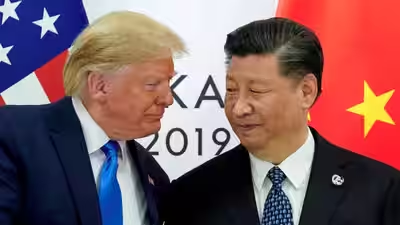
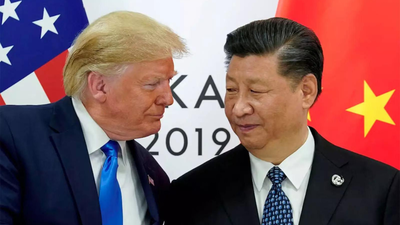
TOI correspondent from Washington: Donald Trump has spent years telling Americans that China has been eating America’s lunch. On Wednesday, he will go to the airport to welcome the man who owns the restaurant.In an unprecedented spectacle, Trump will schlep where no US President has gone before – travel to Andrews Air Force Base outside Washington, DC, to personally receive Chinese President Xi Jinping as he arrives for a three-day state visit, briefly transforming himself from an imperious tariff overlord to a deferential tarmac man.The optics will be hard to miss. Xi’s airbase reception is to be followed by an elaborate ceremonial welcome at the White House the following day, including a 479-member military honour guard, a presidential salute and military review in the Rose Garden, and a flyover featuring a B-2 Spirit bomber escorted by four F-22 Raptors in a show aimed at impressing a country that appears to have passed the stage of being impressed.Diplomatic scholars are already weighing in, noting that the last US Presidents to go to the airport to receive a foreign dignitary were Obama and Bush, who went to Andrews AFB to receive Pope Francis and Pope Benedict, respectively.Xi did not go to the airport to welcome the US President when Trump went on a state visit in May and instead sent his Vice President Han Zheng and other officials.“Xi wasn’t waiting for him, there were no flyovers, and there was no meeting of the first ladies…the asymmetry in pageantry reflects a broader asymmetry in the relationship: Beijing believes rare earths tamed Washington, and Washington at times seems to agree,” noted Rush Doshi, a former NSC official whose remit in the Biden administration included China and Taiwan.Trump has spent years portraying China as the villain in America’s economic travails — stealer of American jobs, manipulator of trade, technological predator and beneficiary of what he has repeatedly described as an unfair trading relationship. He launched a tariff war designed to force Beijing to bend, but Doshi sees China emerging as a peer instead.“Beijing’s ability to turn back US tariffs marked an inflexion point that established China as a true peer of the US, albeit one ahead on some metrics of power and behind on others,” he wrote in a preview of the summit.Having flexed its rare earths muscle, China doesn’t seem too impressed either by Trump rolling out US corporate power — or American oligarchy in the eyes of some critics.Jeff Bezos, Elon Musk, Jensen Huang, Sam Altman, Tim Cook, Jane Fraser, and Michael Dell are among those slated to attend a Trump-Xi meeting, a powerlist topped by two Indian-Americans – Google’s Sundar Pichai and Microsoft’s Satya Nadella.Xi conspicuously is not bringing any notable Chinese executives with him.Trade and tariffs are expected to dominate the agenda, with an extension of the fragile trade truce, possible reciprocal tariff reductions, agricultural purchases and mechanisms for managing bilateral commerce up for discussion.The leaders are also expected to discuss rare earths and critical minerals, semiconductor export controls, artificial intelligence, intellectual property and technology restrictions.Then there are the geopolitical files – Taiwan, Iran, the Strait of Hormuz and Ukraine – where the two sides are locked in indirect conflict. While neither side is calling it a G-2, it is increasingly starting to look like that, to much consternation in India, which has benefited from American efforts to diversify supply chains away from China.While a prolonged technology confrontation has encouraged manufacturers to consider India as an alternative production base, a US-Chinese accommodation could reduce some of that strategic pressure on Beijing.At the same time, Indian mandarins say New Delhi has no interest in seeing Washington and Beijing stumble into confrontation over Taiwan, rare earths or the South China Sea. Nor does it want the global economy repeatedly held hostage by tariff exchanges between its two largest external economic partners.The Indian calculation, therefore, is less about choosing Washington over Beijing than ensuring that an emerging G2 does not become a condominium over Asia.