

CHENNAI: Disbursements by Small Finance Banks (SFB) for microfinance are on the decline. It is the fallout of stress in the microfinance sector over the past two years, which impacted net profit of several SFBs last year. Now, these institutions are diversifying their portfolios to de-risk the loan book.ESAF Small Finance Bank reported a 65% YoY (Rs 4,844 crore (Q2 FY26) vs Rs 1,704 crore (Q2 FY27)) and 28% QoQ (Rs 2,366 crore Q1 FY27) decrease in its microfinance portfolio comprising group loans. Its executive director George K John said the stress experienced by the microfinance sector over the past two-and-a-half years has reinforced the need for a more calibrated, responsible and sustainable approach to lending. “We have responded by strengthening credit underwriting, enhancing collection efficiency, monitoring household indebtedness more closely and reassessing the overall composition of our loan portfolio.“However, the reduction in our traditional group-based microfinance portfolio is not merely a response to sectoral stress. It is also part of a conscious strategic transformation of our lending model. We are progressively transitioning eligible customers who have demonstrated satisfactory repayment behaviour and have moved beyond traditional microfinance requirements into our emerging household (EHL) lending segment,” he told TOI.
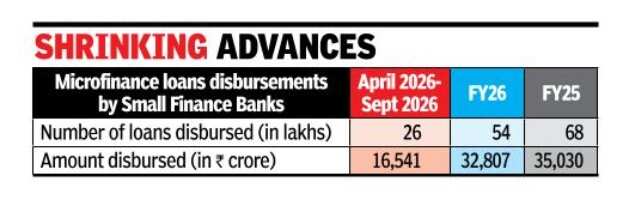
Shrinking advances
EHL caters to various categories of borrowers including individuals, small entrepreneurs and farming households. While unsecured lending within this segment is restricted to individual loans, other categories are predominantly secured.Another leading SFB player, Equitas Small Finance Bank, has brought down its microfinance exposure sharply from 20% to 12% of the total advances over the past one year. Its microfinance and micro loan advances stood at Rs 6,331 crore as of Sept 30, 2026. During an interaction three weeks ago (Nov 2, 2026), its former MD & CEO P N Vasudevan said microfinance is under control this year. “Now, about 90% of our loan book is secured,” he added.Data sourced from Sa-Dhan, an association of impact finance institutions and an RBI-recognised self-regulatory organisation (SRO) for microfinance institutions (MFIs), show that the volume of loans disbursed by SFBs has reduced by 6% YoY from Rs 35,030 crore (FY25) to Rs 32,807 crore (FY26).It stood at Rs 16,541 crore in H1 FY27. Jiji Mammen, ED & CEO, Sa-Dhan, said the share of SFBs in the total microfinance portfolio remains 15% to 16%. “The only change is that their share in securitised assets is rising in percentage terms, which is also a regulatory requirement,” he said. Noting that SFBs still have the same absolute microfinance portfolio size, though their percentage share must have come down, he said, “Some of these SFBs are also actively supporting MFIs through term loans or as BC partners. So, I do not see any major challenge in this.”Mammen further said the stress experienced in the microfinance sector during FY25 and FY26 is a thing of the past.