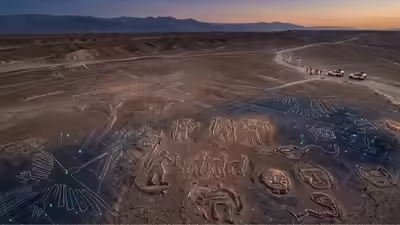
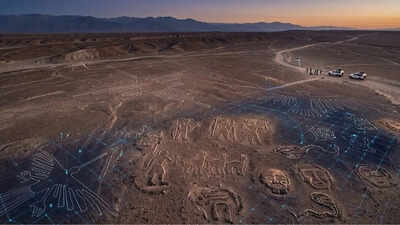
Researchers have now used artificial intelligence to overcome the challenges faced by traditional human survey methods. The team from Yamagata University and IBM Research employed deep-learning models to analyse large areas of the Nazca Pampa, a job that would have required decades using conventional aerial observation techniques. Remarkably, the AI (artificial intelligence) managed to identify 303 new relief-type geoglyphs within just half a year, nearly doubling the catalogue of known figures as noted in the study published on PNAS. These newly found artworks mainly show human shapes, domesticated animals, and severed heads. This offers profound insights into both the ritualistic and everyday lives of the Nazca people who created them over 2,000 years ago.
303 hidden geoglyphs identified by AI and high-tech scans in Peru
Nazca research presents a significant challenge due to the vastness of the desert and how small geoglyphs, like those with relief, erode over time. Scientists made a breakthrough by using deep-learning AI to analyse existing data. This allowed them to review high-resolution satellite images with remarkable accuracy; the AI (artificial intelligence) identified potential sites at speeds 20 times faster than human experts could achieve. It efficiently filtered out irrelevant data and honed on patterns that suggested human-made structures. As a result, this blend of technology and historical study transformed what would have taken a century into work completed in just one season.
Why scale matters in Nazca
Archaeologists have categorised these figures into two main categories. One includes the famous linear geoglyphs, massive images that often represent birds or whales. The other category is the smaller relief geoglyphs. Interestingly, most of the 303 recent discoveries fall into the relief category. They were made by removing dark stones to expose lighter sand in detailed, small designs, as noted in the research published on PNAS. These are usually found along old footpaths rather than on wide open plains. This suggests they were meant for travellers passing by on foot, not for viewing from above.
Why new figures feature ‘human’ themes
The 303 geoglyphs present imagery that stands apart from what we have seen before. Typically, large linear shapes depict animals, but these smaller relief carvings lean towards ‘human-related’ themes. Among them, researchers discovered many images showing people in ceremonial attire, domesticated llamas, and even macabre depictions with severed heads. This variation hints at a different social role for these relief geoglyphs. It seems they might have been used for rituals or to define territorial boundaries within local communities.
AI’s role in conservation and urban mitigation
According to the study published on PNAS, AI (artificial intelligence) plays a crucial role in preserving UNESCO World Heritage sites, offering more than just the excitement of discovery. The Nazca Pampa faces threats like urban sprawl, mining activities, and environmental changes. Researchers can swiftly map and document 303 new sites, providing the Peruvian government with precise coordinates to create protection zones. This digital record remains available for future generations even if the physical sites deteriorate.