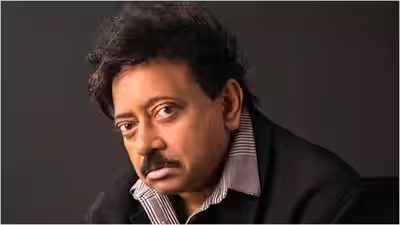
Filmmaker Ram Gopal Varma has claimed that Bollywood only embraced accountability and financial discipline after the COVID-19 pandemic, following years of box office failures that allowed South Indian cinema to dominate nationally. Comparing the Hindi film industry’s corporate-style structure with Telugu cinema’s producer-driven model, Varma argued that fixed budgets, strict accountability, and shared financial risk have helped Bollywood become more disciplined, while the Telugu industry continues to face recurring financial challenges.
How Bollywood’s corporate structure works
Speaking to Great Andhra, Ram Gopal Varma explained that the Hindi film industry has now adopted a corporate-style structure. Budgets are locked in advance, directors are held personally accountable for cost overruns, and no one can hold onto dates and burn through hundreds of crores without producing results within a set timeframe.Varma clearly distinguished how the two film industries operate. “The only thing about Bombay is there’s a bit more of a corporate culture, so accountability and discipline are definitely stronger here, like 100 percent,” he said. He then contrasted this with the Telugu film industry, pointing out that neither the hero nor the director is held responsible for the money spent or the time taken to finish a film. Describing how things work in the Telugu industry, he said, “The business model works because of accountability. If we give the hero dates, they just sit back, and if the director agrees, that’s it. Just spending hundreds of crores on a fancy video and taking three or four years doesn’t guarantee a good movie.”
Ram Gopal Varma says failure forced Bollywood to change
According to Ram, Bollywood wasn’t always known for this level of discipline, and the change came about only as a result of repeated failure. “Bollywood, especially when it comes to accountability and discipline, has started following many processes only in the last two or three years, post-COVID,” he said. “Before that, it was mostly all flops for years, and South Indian cinema basically took over Indian films. That’s even been covered in national media.” Explaining the corporate model that now runs Bollywood, Ram Gopal Varma said it functions on a straightforward rule, the fixed budget is final, and any expense beyond it becomes the director’s own liability. “Whatever budget they set, that’s the natural max,” he said. “Whatever you take beyond that, you have to keep it from your own pocket.”He added that such a system would never work in Telugu cinema in its current form, since independent producers there lack both the authority and the willingness to enforce similar limits. In Bollywood, however, the corporate structure ensures someone is always answerable for the figures, he said. “They need to see the balance sheet. How much you made and why. It’s all about accountability,” he said.
Ram Gopal Varma on how losses are handled differently
Ram also highlighted how the fallout of a flop plays out very differently across the two industries. Since Bollywood’s corporate companies are publicly listed, he explained, the losses from a failed film get absorbed across the business rather than falling on any single person. “Whatever failure happens here, no one really suffers from it because these are corporate companies, and they’re public. The losses get spread out,” he said. “You never hear about who actually takes the loss, in Hindi cinema or Hollywood, because the risk gets shared.”
Why Telugu cinema keeps facing financial trouble?
Telugu cinema works differently; the independent producer ends up absorbing the full financial hit, frequently with little real control over the expenditure that led to it. The filmmaker cited this disparity as the key reason why the Telugu industry keeps running into money troubles, even as Bollywood, despite its own creative shortcomings, has succeeded in keeping its cost structures in check.
More about Ram Gopal Varma on the work front
‘Police Station Mein Bhoot’ is a forthcoming horror comedy helmed by Ram Gopal Varma, featuring Manoj Bajpayee in the lead role alongside Genelia D’Souza and Ramya Krishnan. Though the storyline is being kept under wraps for now, the film is expected to combine supernatural elements with humour, signalling Varma’s return to a genre he has previously tackled with success, now approached with a fresh perspective.