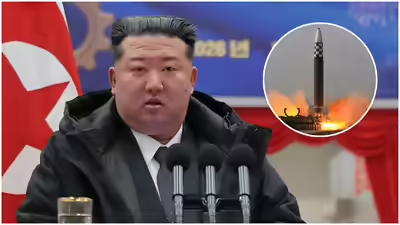
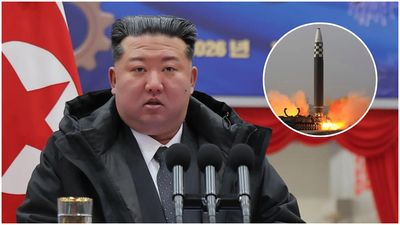
North Korea is showing a “very serious increase” in its ability to produce nuclear weapons, the head of the International Atomic Energy Agency (IAEA) has said, pointing to heightened activity at key facilities.IAEA chief Rafael Grossi, speaking during a visit to Seoul on Wednesday, said monitoring indicates a “rapid increase in the operations” at the Yongbyon nuclear complex, a central hub of Pyongyang’s atomic programme.“In our periodic assessments, we have been able to confirm that there’s a rapid increase in the operations” of the reactor at Yongbyon, Grossi said, warning that all signs point to an expansion in North Korea’s weapons production capability.
Rising activity at Yongbyon raises alarm
According to news AFP, the UN watchdog has observed increased activity not only at the five-megawatt reactor but also at Yongbyon’s reprocessing unit and light-water reactor. Grossi added that the activation of additional facilities further underlines the scale of expansion.“All that points to a very serious increase in the capabilities of (the) DPRK in the area of nuclear weapons production,” he said, noting that the programme is now estimated at “a few dozen warheads.”The agency has detected the construction of a new uranium enrichment facility similar to existing ones, suggesting a significant boost in production capacity. Satellite imagery cited by the Centre for Strategic and International Studies supports this assessment, indicating the likely completion of a plant capable of producing weapons-grade material.
Enrichment push and global concerns
Enriching uranium offers North Korea an alternative and potentially more effective route to weapons-grade material, alongside plutonium reprocessing, experts say, according to Reuters.Grossi noted that while direct inspection is not possible—since Pyongyang expelled IAEA inspectors in 2009—external analysis of facilities indicates “a significant increase in the enrichment capacity” of the country.Despite concerns over growing ties between Moscow and Pyongyang, Grossi said the agency has not observed “anything in particular” suggesting Russian assistance in North Korea’s nuclear weapons programme.North Korea, which conducted its first nuclear test in 2006, remains under heavy UN sanctions and has repeatedly stated it will not give up its nuclear arsenal, raising ongoing concerns about regional security and global nuclear proliferation.