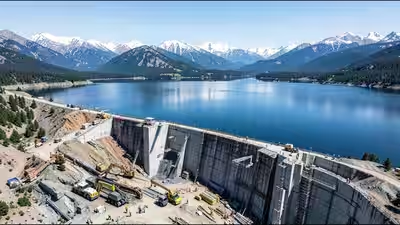
Lake Moraine in Madison County, New York, remains at a reduced water level while the state carries out a major rehabilitation of the dam that once helped supply a 19th-century canal. Built in 1836, Madison Reservoir Dam was designed to impound water from Madison Brook, also known as Payne Brook, for the Chenango Canal. Now, 190 years later, the New York State Canal Corporation is replacing key parts of the ageing structure and improving its earthen embankments. The reservoir reached its target level in early May 2026, leaving the water 10 feet below the crest of the existing spillway. The water level is expected to remain low through the end of 2027, while construction activities are scheduled to continue into 2028. The Canal Corporation says the dam is not in imminent danger of failure, but extensive work is needed to protect its long-term safety and integrity.
Madison Reservoir Dam history : how an 1836 structure helped supply the Chenango Canal
The dam’s original purpose was to help maintain the water supply for the Chenango Canal, which connected Binghamton and Utica. According to the National Park Service’s historic documentation of the Chenango Canal, the canal stretched 97 miles and opened in 1837. It was abandoned as a navigation canal in 1878. Keeping the canal navigable required more than digging a channel. The historic documentation describes a network of reservoirs and feeder canals that helped maintain sufficient water levels, particularly around the canal’s summit. Madison Reservoir Dam was part of that system. The dam is now managed by the New York State Canal Corporation, which owns the structure in the Town of Madison. Although the reservoir and dam are no longer used as part of the state’s canal system, the corporation continues to manage water levels for seasonal recreation and to accommodate inspections and maintenance.Today, the reservoir is known as Lake Moraine. The New York State Department of Environmental Conservation describes Lake Moraine as a “highly developed water body” near Madison and Hamilton. Fishing is a popular activity, with largemouth bass and chain pickerel among the species anglers pursue. The planned drawdown is therefore significant not only for the construction team but also for people who use the lake. Although some state environmental information describes Madison Reservoir as having supplied the Erie Canal, the Canal Corporation and National Register documentation identify its original role as a feeder for the Chenango Canal. The Chenango’s reservoir and feeder network was later repurposed to help supply the Erie Canal.
Lake Moraine drawdown in 2026: why the water level is 10 feet lower
The lower water level is a deliberate part of the rehabilitation plan. The Canal Corporation says the drawdown will make construction safer and more efficient while helping crews manage water flowing through the reservoir. The target is to keep the reservoir approximately 10 feet below the crest of the existing spillway. The corporation lists the spillway crest at elevation 1,211 Barge Canal Datum (BCD), with the drawdown target at 1,201 BCD. BCD is the local elevation reference used by the agency at the site.The drawdown began in the final week of March 2026 and reached the target level by the first week of May. The Canal Corporation says the reservoir is expected to remain at the reduced level through the end of 2027, covering the main construction period. The agency expects project activities to continue into 2028. The agency notified surrounding property owners ahead of the reduction. It also held public information sessions at Colgate University on July 23, 2024, and October 8, 2025. The project website provides a drawdown map, a bathymetry map showing underwater contours, and a tool for tracking the reservoir’s level. The state Department of Environmental Conservation has warned that the lower water level can make launching trailered motorboats more difficult. A temporary extension was installed at the existing Lake Moraine boat launch to allow launching in 6 feet of water, but boaters are advised to use caution during the drawdown.
Madison Reservoir Dam rehabilitation: new spillway, siphon outlet and embankment improvements
The rehabilitation is planned in 2 main phases. First, crews will construct a new low-level outlet system. The second phase will focus on replacing the existing concrete spillway. The reservoir is expected to remain lowered throughout both phases of major construction. The current spillway will be demolished and replaced with a larger concrete labyrinth spillway. The existing low-level outlet system will also be decommissioned and replaced with a new siphon outlet. These structures are important to controlling water levels and managing flow through the reservoir.The work will also address the earthen embankments. Plans call for raising the dam crest by less than 1 foot in limited areas, reinforcing and reshaping the embankment slopes, and installing drainage systems. New access roads and other site improvements are also included. The Canal Corporation says the dam has not undergone a significant rehabilitation since 1983, although it has been inspected and repaired as needed. The state’s Department of Environmental Conservation classifies it as a high-hazard Class C dam, a designation indicating that a failure could cause severe damage or loss of life in downstream communities. The Canal Corporation says there is no imminent danger of failure but stresses that extensive repairs are necessary to maintain the dam’s long-term safety and integrity. The rehabilitation is intended to bring the structure in line with current standards and extend its useful life. Updates, project documents and construction information are being published on the Canal Corporation’s website as work progresses.