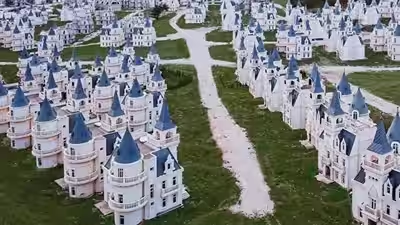
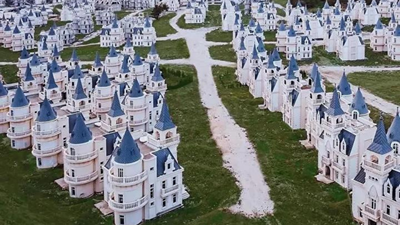
Rows of identical Disney-style castles rise from the hills near the Turkish town of Mudurnu, creating a scene that looks more like a fantasy film set than a real housing development. Known as Burj Al Babas, the ambitious project was envisioned as a luxury village for wealthy international buyers, particularly from the Middle East. Around 587 château-inspired villas were partially built as part of a development expected to feature more than 700 homes and high-end amenities. Valued at about $200 million, the project came to a sudden halt in 2018 after its developer ran into financial trouble, leaving behind one of the world’s most unusual abandoned real estate developments.
How a $200 million castle village became a ghost town
Construction on Burj Al Babas began in 2014 under the Turkish developer Sarot Group. The company planned to build 732 European-inspired villas, each featuring ornate towers, balconies and decorative façades resembling French châteaux. The homes were priced between $370,000 and $530,000 and were marketed primarily as holiday residences for affluent buyers from Gulf countries. The master plan also included shopping areas, restaurants, Turkish baths, spas, sports facilities and entertainment spaces, aiming to create an exclusive luxury community rather than just another housing estate.
Why the developers invested in fairy-tale castles
The project’s distinctive architecture was designed to stand out in the international luxury property market. Developers believed wealthy overseas buyers would be drawn to homes that combined European castle-inspired exteriors with modern interiors and resort-style amenities. Located within driving distance of Istanbul and surrounded by forests and mountains, Mudurnu offered a quieter alternative to Turkey’s crowded coastal destinations. The vision was to create a premium holiday destination that blended luxury living with natural surroundings.
What caused the $200 million project to collapse?
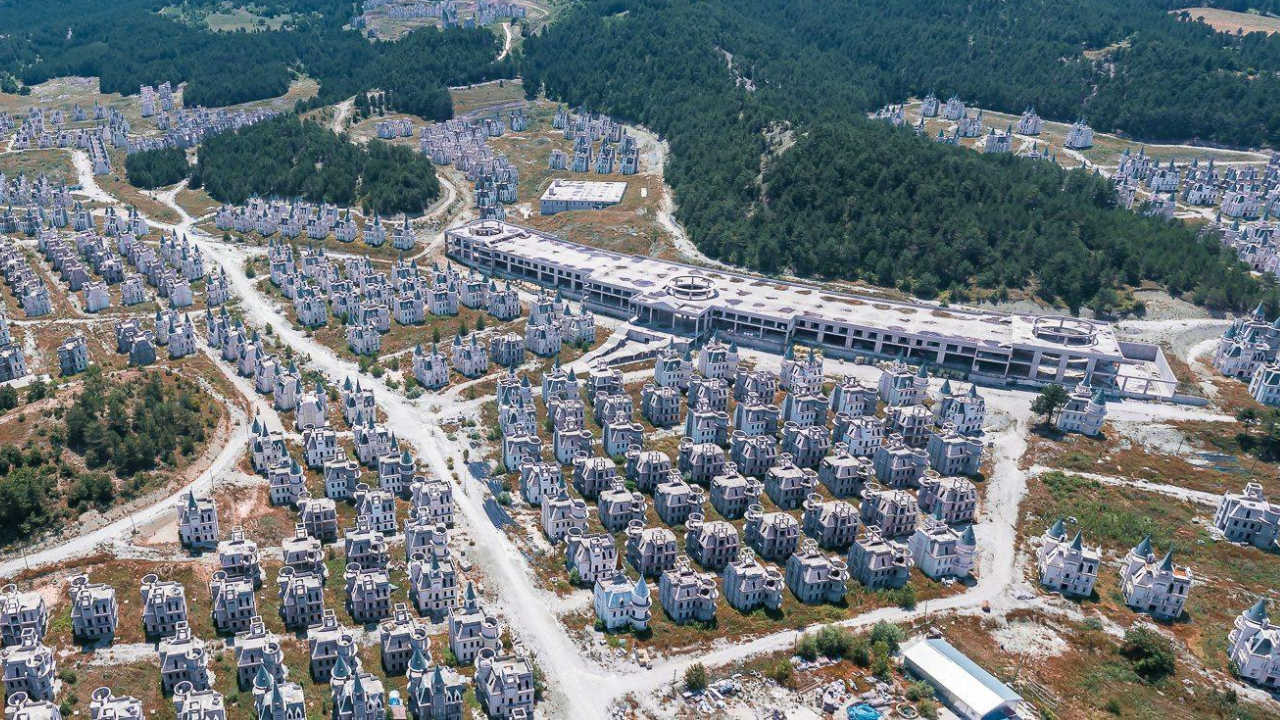
Despite reportedly selling around 350 villas before construction was completed, the project soon encountered severe financial difficulties. Turkey’s economic slowdown, currency instability and declining demand from foreign investors placed enormous pressure on the developer. Sarot Group also accumulated substantial debts while construction costs continued to rise. In 2018, work across the site stopped, and the company sought bankruptcy protection, leaving hundreds of partially completed villas without buyers or residents.
Why nobody ever moved into the castles
One of the biggest misconceptions about Burj Al Babas is that residents mysteriously abandoned the village overnight. In reality, the homes were never completed or fully occupied. Although many villas had exterior structures in place, large numbers lacked finished interiors, utilities and essential infrastructure. Because construction stopped before the development was ready for habitation, the castle-like homes remained empty from the beginning, gradually creating the ghost-town appearance that now attracts global attention.
What remains at Burj Al Babas today
Today, visitors encounter long rows of nearly identical white castles stretching across the landscape. Many buildings still have unfinished interiors, exposed construction materials and empty rooms waiting for work that never resumed. Roads and pathways run between the villas, but the planned shopping centre, spa facilities and other community spaces were never fully realised. The abandoned development has since become a popular destination for photographers, drone filmmakers and urban explorers fascinated by its surreal appearance.
Can the abandoned village still be revived?
Following the bankruptcy proceedings, representatives linked to the developer expressed hope that parts of the project could eventually be completed under a financial restructuring plan. While discussions about reviving the development have surfaced periodically, large sections of Burj Al Babas remain unfinished and unoccupied. Whether the village is eventually completed, redeveloped or preserved as a reminder of an ambitious real estate failure remains uncertain.
Why Burj Al Babas continues to fascinate people
Burj Al Babas has become one of the internet’s most recognisable abandoned developments because it combines extravagant architecture with the story of a failed investment. Images of hundreds of identical castle-like villas standing empty have fuelled countless travel features, documentaries and social media posts. Beyond its striking appearance, the project also serves as a reminder of how rapidly changing economic conditions can transform even the most ambitious developments into modern ghost towns.