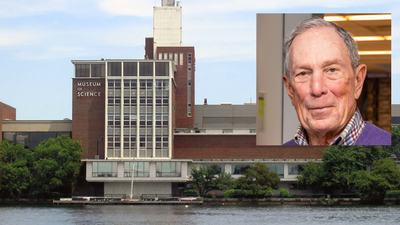
Billionaire philanthropist Michael Bloomberg is giving $155 million to Boston’s Museum of Science, an institution he visited as a child and credits with sparking his lifelong love of learning. Announced in August 2026 through Bloomberg Philanthropies, the gift is the largest in the museum’s history and supports a new 10,000-square-foot public science venue named the William and Charlotte Bloomberg Public Science Common, after his late parents. Opened to the public on October 10, the space is designed to bring scientists, creators and audiences together through immersive experiences and public events exploring artificial intelligence, climate change, public health and space exploration. For Bloomberg, the project connects a personal childhood memory with an effort to make scientific discovery more accessible to future generations.
Michael Bloomberg’s childhood connection to the museum
Growing up in Medford, Massachusetts, just outside Boston, Bloomberg visited the Museum of Science as a child. He has credited those visits with helping develop his curiosity, love of learning and interest in problem-solving.His parents, William and Charlotte Bloomberg, played an important role in encouraging that curiosity. Bloomberg has described them as the most important teachers he and his sister, Marjorie Tiven, had.The new facility carries their names as a tribute to their influence. Speaking about the project, Bloomberg said the space would help more young people experience the kind of discovery that shaped his own childhood.The gift also continues a longstanding relationship between Bloomberg and the museum. His previous support helped fund the renovation of its Charles Hayden Planetarium in 2011 and the establishment of the William and Charlotte Bloomberg Science Education Center in 2016.
A $155 million gift to transform public science education
The donation from Bloomberg Philanthropies is the largest in the Museum of Science’s history. It supports the William and Charlotte Bloomberg Public Science Common, a 10,000-square-foot venue designed to make science more interactive and bring scientific discussions to wider audiences.The space features floor-to-ceiling glass overlooking the Charles River, with panoramic views of the Boston skyline. Its flexible layout includes movable walls and retractable seating, allowing the venue to accommodate school programmes, smaller discussions, conferences, performances and larger public gatherings.The facility also incorporates advanced display technology, spatial audio and livestreaming capabilities. These features are intended to make scientific subjects more engaging while allowing selected events to reach audiences beyond Boston.According to the museum, the space will connect scientists and other experts with the public through conversations, conferences, symposia and immersive experiences.
From artificial intelligence to space exploration
The new venue is designed to explore scientific developments and challenges that affect everyday life. Its programming includes artificial intelligence, climate change, public health and space exploration.Artificial intelligence and robotics demonstrations are intended to help audiences understand emerging technologies and consider their wider implications. Public discussions can also provide opportunities to explore questions about innovation, ethics and the role of technology in society.Climate science and public health will form another part of the programme. Planned events include discussions about wildfire smoke and its health effects, alongside conversations about how scientific evidence informs public understanding and decision-making.Space exploration will also feature in the immersive experiences. The venue’s projection systems can take audiences on visual journeys through places such as Mars and the deep ocean, or into the microscopic world of living cells.The aim is to present scientific information in ways that encourage curiosity and discussion rather than relying solely on conventional exhibitions or lectures.
A high-tech venue designed to reach audiences beyond Boston
One of the facility’s distinguishing features is its ability to combine immersive presentations with live events and digital broadcasting.The space incorporates large LED displays, high-resolution projections, spatial audio and real-time data visualisation. Its Deep Space projection system, developed by Ars Electronica, can transform the walls and floor into large-scale visual environments.The museum also plans to use production and livestreaming technology to share selected events with people who cannot attend in person. This gives the project the potential to reach schools, families and science enthusiasts beyond the Boston area.The museum has set an ambition to reach one billion people online annually by 2030, alongside targets for visitors attending in person and learners participating through schools. These are broader institutional goals, rather than results already achieved by the new venue.
Bloomberg’s wider commitment to education and philanthropy
The donation forms part of Bloomberg’s broader philanthropic work through Bloomberg Philanthropies, which supports initiatives in education, public health, the environment, the arts and government innovation.Bloomberg built his fortune after founding financial information and media company Bloomberg LP in 1981. He later served three terms as mayor of New York City and became one of the world’s most prominent philanthropists.His education-related giving includes a $1.8 billion donation to Johns Hopkins University in 2018 to support need-blind undergraduate admissions, helping ensure that students’ ability to pay would not determine whether they could be admitted.In 2024, he announced a further $1 billion gift to Johns Hopkins to expand financial aid for medical, nursing, public health and other graduate students.His support for institutions in the Boston area also reflects his personal connection to the region where he grew up. Beyond the Museum of Science, Bloomberg Philanthropies has supported local schools, cultural organisations and civic initiatives.By naming the space after William and Charlotte Bloomberg, the project recognises their role in encouraging learning and discovery. At the same time, its public programmes are intended to give future generations opportunities to engage with science, ask questions and encounter new ideas