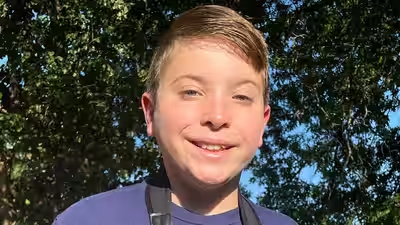
A 12-year-old boy has gained millions of views on social media by copying the calls of more than 100 bird species using only his throat, tongue and hands. Samuel Henderson, a middle school student from the United States, began practicing bird calls as a hobby in his family’s garden. Videos of his bird imitations have attracted widespread attention on social media and digital news platforms, including coverage from Yahoo News. His collection of calls includes common backyard birds such as mourning doves, northern cardinals and American robins, as well as birds of prey such as red-tailed hawks, barred owls and bald eagles. Without using whistles or other tools, Henderson copies their pitches, trills and rhythmic calls so accurately that wild birds often respond to him in real time.
Early interest and vocal technique
Henderson’s interest in copying birds grew from his wider love of nature and wildlife. According to reports from Yahoo News, he spent hours listening to recordings of different birds, memorizing their sounds and testing his own voice to match their pitch and tone. Bird sounds are generally divided into two main groups: songs and calls. Songs are often more complex and are mainly used by male birds to mark territory and attract mates. Calls are usually shorter and can be used to warn of danger or keep birds in contact with each other. Henderson learned to copy both by controlling his throat muscles, tongue position and the way he uses his hands to change the amount of air and the tone of his voice.In a video interview featured by Yahoo News, Henderson explained how he learns a new and difficult bird sound. “I listen to the call over and over again until I can hear the different notes in my head,” Henderson said. “Then I try to figure out where in my throat or mouth that sound comes from. Some need a lot of air from the chest, while others are just small clicks with the tongue.”
Recognition and social media attention
Many young nature enthusiasts learn to identify birds using books and field guides. Henderson, however, gained wider attention because he can copy bird calls well enough to get real wild birds to respond. His family began sharing short videos of his performances online. The clips show him in forests and gardens calling to wild birds, which often fly to nearby branches and answer him. According to analytics mentioned in Yahoo News broadcasts, the videos have received millions of views across social media and video platforms. The attention has also given Henderson opportunities to perform at local community centers, wildlife conservation events and school assemblies. During these appearances, he uses his talent to teach people about local birds and the importance of protecting their habitats.
Scientific context behind bird mimicry
Human bird mimicry depends on controlling the larynx and vocal cords to reproduce sounds that birds make using a different organ. Birds produce their sounds through a specialized vocal organ called the syrinx, which is located at the base of the trachea. The syrinx allows birds to produce two separate sounds at the same time. Humans have a larynx rather than a syrinx, so accurately copying bird calls requires strong breath control and flexible vocal skills. Nature experts cited in regional reports say that while some people can learn simple calls, such as those of bobwhite quail or screech owls, it is extremely unusual for a young amateur to master more than 100 different calls without mechanical tools. Henderson’s collection includes difficult sounds such as the rhythmic hoot of the barred owl and the sharp call of the red-tailed hawk. His ability to quickly move between calls from different species during live performances has earned praise from local birdwatching groups and wildlife educators.
Future plans in wildlife conservation
Despite his growing popularity online, Henderson remains interested in learning more about wildlife conservation and environmental science. In statements broadcast by Yahoo News, Henderson said he hopes to use his growing platform to encourage other children to spend more time outdoors and notice the natural world around them. “I just want people to look up and listen when they walk outside,” Henderson said during his Yahoo News interview. “There are so many cool birds around us every day that people don’t even notice, and if my calls help people care more about protecting them, then that’s the best part.” Henderson plans to continue studying ornithology and environmental science. His long-term goal is to build a career in wildlife biology and forest conservation.