
NEW DELHI: During the players’ group photoshoot before the Total Chess Pilot event in Budapest, Hungary, five-time world champion and current World No. 1 Magnus Carlsen was one of the last to arrive, climbing a couple of stairs to sneak into the group photo from the back and finding his place beside Kazakh Grandmaster Bibisara Assaubayeva.Soon, cutouts and clips of the two standing together started doing the rounds, captioned along the lines of “no weak characters” and “imagine the number of World Championships they share between them” — 23 in total, Carlsen alone accounting for 20.

Magnus Carlsen and Bibisara Assaubayeva during the players’ group photoshoot (Photo by Total Chess)
Little did anyone know that both would end up sitting across the board in a match to decide 17th-21st place in this pilot event, and that one of them choosing not to show up for the day’s final game would put them at the centre of a heated debate.
What happened?
Carlsen had already sealed the match before a single Fast Classical move was played. He beat Assaubayeva 3-0 in Blitz with one draw, and 2-0 in Rapid, putting the score at 11.5-0.5. The match was decided, regardless of what happened next.Before the Fast Classical round began, Carlsen walked out of the playing hall. Asked why by Norwegian media outlet TV2, he said, “There will be no classical game as I understood, the match is over. The only consequence of not showing up is that you will lose a totally useless game. I think that if you play a World Championship and it counts for points and such, I can understand. But this is not a show tournament. If the match is done, it’s done. In the end, if you play games after, it shall not be rated because it’s always been like that. And if they want to do things differently here… yeah. This is my decision on this topic.”After the mandatory 15-minute default period, Assaubayeva walked out too, awarded the win on forfeit. Day 1 of the semifinal closed 11.5-8.5 in Carlsen’s favour. The game, which was supposed to count towards FIDE ratings, went unplayed and therefore had no impact on either player’s classical rating.
Do you agree with Magnus Carlsen’s decision to forfeit the final game?
3k+ users shared opinion today
5k+ users already voted today
3k+ users shared opinion today
What the rules say
Chief arbiter Anastasia Sorokina, speaking to ChessBase India at the venue, confirmed that any further penalties for the forfeit would be at the organisers’ discretion.“The result is minus-plus because Magnus didn’t appear for the game. From our perspective as arbiters, there are no extra penalties for this, except the game is minus-plus, of course,” she said.“There is a point about the possible fees that organisers could apply, but it’s not directly connected to the game. So it depends on the situation, organisers will decide.”Under FIDE’s regulations, forfeited games don’t count toward classical ratings, which is precisely what made the decision rational for Carlsen.He’d had a torn group stage in the Fast Classical format, failing to win any of his 10 games, drawing nine and losing one to Armenia’s Haik Martirosyan, a run that cost him 21.8 Elo points and pushed his live rating down to 2801.2, uncomfortably close to Hikaru Nakamura and Fabiano Caruana overtaking him as World No. 1.A draw against Assaubayeva would have cost him 3.5 more rating points, a defeat 8.5. By forfeiting, he avoided both, since an unplayed game carries no rating consequence at all.
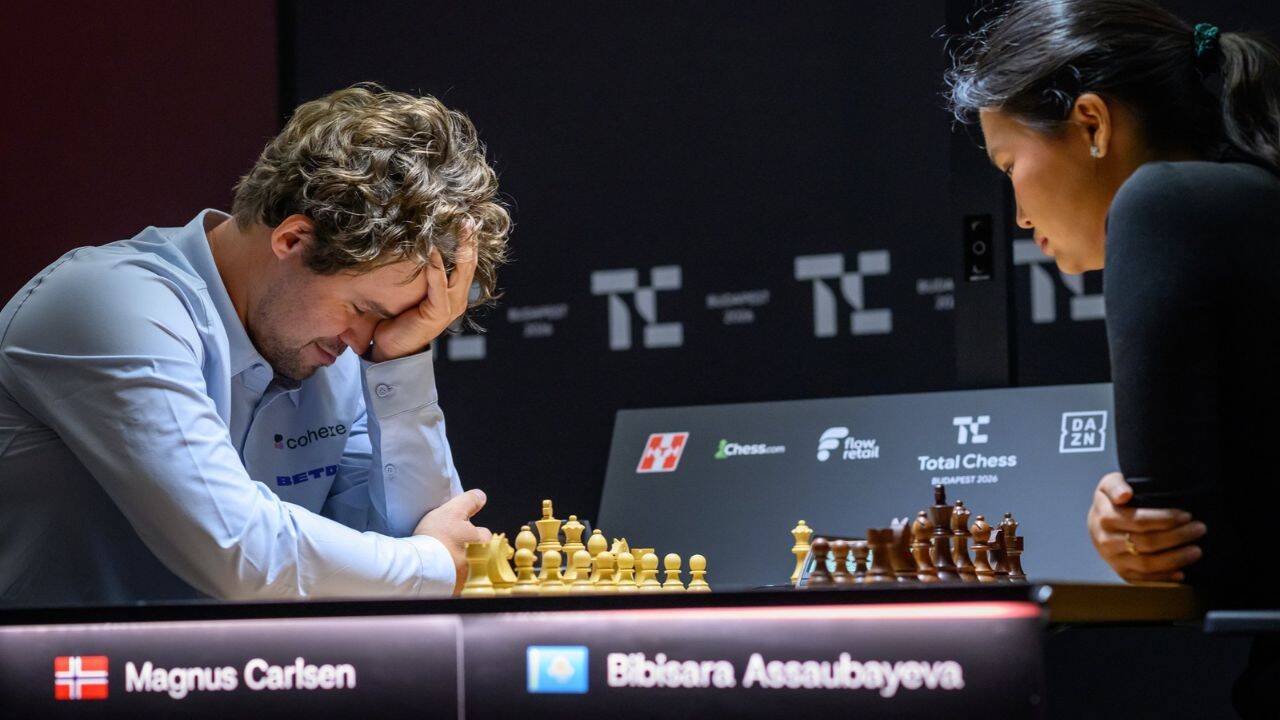
Magnus Carlsen vs Bibisara Assaubayeva (Photo by Michal Walusza for Total Chess)
What the organisers say
Total Chess founder and CEO Kjell Madland also shared his view on the situation.“He (Carlsen) was there and discussed it with the arbiter team. The system is to win the day, and he had already won enough points to win the day. So then he didn’t want to play the last game, and he didn’t need to do it,” he told ChessBase India.On whether Assaubayeva was informed beforehand, he replied, “No, because he could play if he wanted to play. We of course didn’t discuss this with Bibisara before, that was not necessary.”Pressed on whether the rules might change after this forfeit, Madland added, “The rules are the same for everyone. We can’t do any differences between the players. It’s the same for everyone. So if that happens tomorrow with someone else, it happened.”Calling Budapest “an important learning exercise” ahead of the tour’s inaugural edition in March 2027, the organisers stressed they weren’t approaching the feedback “with a predetermined view that the rules need to change”.
The argument of morality
Whatever the rules allowed, there was a simpler courtesy Carlsen could have extended and chose not to. By his own account, and the organisers’, he had already decided against playing and discussed the matter with the arbiter team before the round began. The decision, therefore, had been made well before Assaubayeva took her seat at the board.However, with no prior communication, Assaubayeva was left waiting through the full 15-minute default period for an opponent who had no intention of showing up.The rulebook may have little to say about such omissions, governing forfeits rather than the courtesy of forewarning, but it is difficult to separate the question of sportsmanship from the technicalities of the regulations.A simple two-line message through the arbiters would have cost Carlsen nothing and spared Assaubayeva an entirely unnecessary wait.That it never came makes this less a question of what the rules required and more one of the basic consideration an opponent deserves.
What the players say
American Grandmaster Hans Niemann took to social media to voice his concerns. “It was already known that we have to play all the games, we talked about it in the technical meeting,” he wrote on X.“It’s incredibly disappointing to see continued favouritism towards one player. Let’s not forget the jeans, and ‘Co World Champion’ saga. All rules must be applied equally, regardless of the player.”Alireza Firouzja noted the same technical meeting had addressed it directly, though Norwegian outlet TV2 reported Carlsen wasn’t present for that meeting.Wesley So, on the other hand, saw little wrong with the logic.“I think Magnus’ decision was understandable. He already won the match, and if he lost to Bibi, he loses 9 points and the No. 1 spot. I don’t see yet why Magnus was wrong,” he wrote on X.
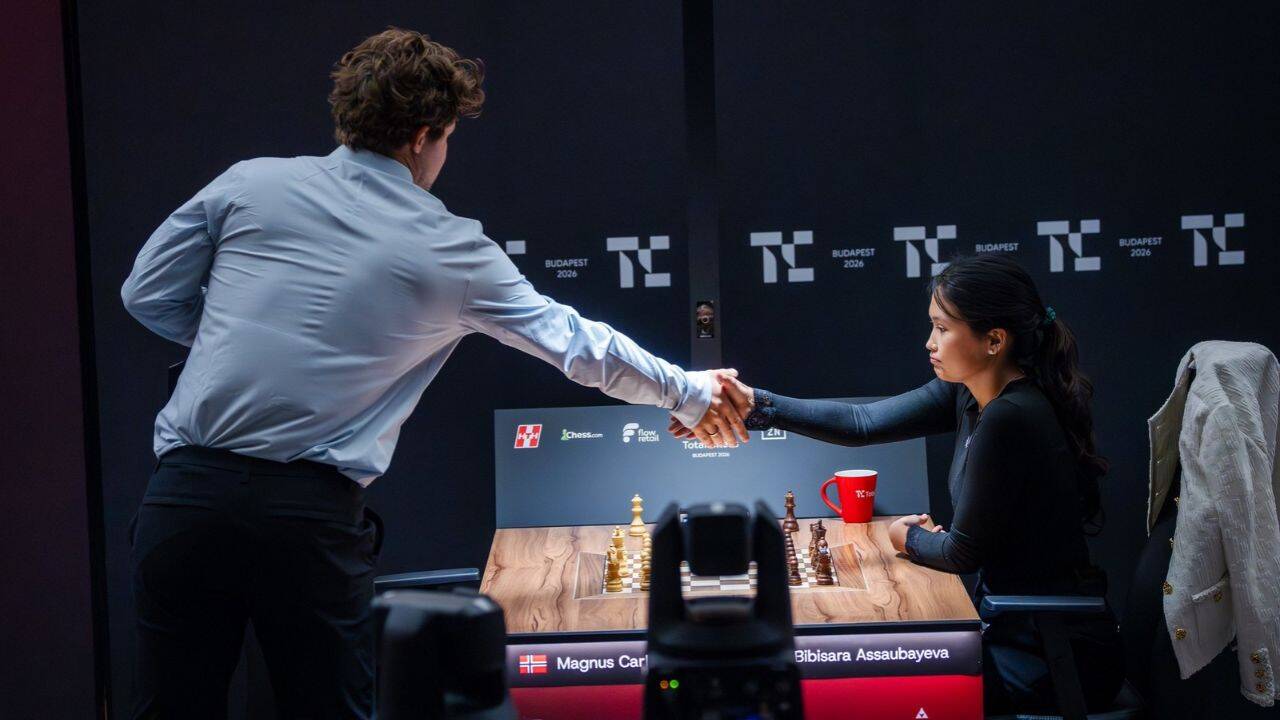
Magnus Carlsen vs Bibisara Assaubayeva (Photo by Maria Emelianova for Total Chess)
What it leaves the organisers with
Every answer in this saga is technically correct, and that’s precisely the problem. The rules allowed it, the arbiters applied them without penalty, and Carlsen broke no regulation in walking out.But a pilot event exists to surface exactly this kind of gap, between what the rulebook permits and what the field considers fair, before it hardens into precedent.India’s Rameshbabu Praggnanandhaa, who lost 19.3 rating points of his own in this pilot event, raised a broader gripe about dead-rubber games.“It doesn’t matter if you finish sixth in the group stage, you still have to play, which is kind of, honestly, sad,” he said in an interview with Total Chess. “By that point the player has already started thinking about the next tournament, but he still has to play a game.”With the inaugural Total Chess World Championship Tour arriving in March 2027, the organisation now has a concrete decision to make: whether a dead-rubber game, once a match is mathematically settled, should exist at all, or whether, if it does, every player is held to showing up regardless of stakes.Leaving that ambiguous is what turned one player’s rational choice into a credibility question for the format itself.It also calls for a separate conversation about the structure of a tournament like this, with some players seemingly unhappy with the number of games scheduled each day across the different formats.“I just felt envious that you can solve the sports part in Rapid and Blitz portion and then have a nice evening without chess, which is understandable because we have five days in a row with two rounds every day,” Russian Grandmaster Ian Nepomniachtchi told ChessBase India. “Of course, there was a rest day, but it was overall a bit tiring.”