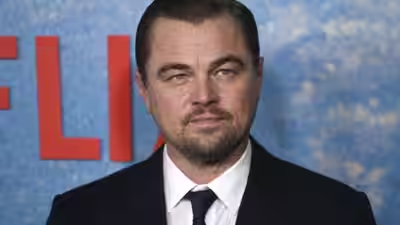
Leonardo DiCaprio Foundation was among the private funders that backed a deal helping Seychelles use debt financing for ocean conservation. The deal helped the island nation increase the area of its ocean under protection from just 0.04% of its Exclusive Economic Zone to 30% by 2020.The arrangement worked by converting foreign debt into money for long-term conservation in Seychelles, according to The Nature Conservancy. As part of the deal, $21.6 million in foreign debt was paid in exchange for funding for conservation work inside the country. Seychelles also agreed to create a marine spatial plan to decide how its ocean would be protected and used.The result was a much larger protected area. By 2020, Seychelles had finalised Marine Protection Areas covering 410,000 square kilometres of ocean. The Nature Conservancy said this was an area larger than Germany.Seychelles depends heavily on marine resources, with fishing and tourism providing jobs for more than one-third of its workforce. So the country divided the protected waters into different zones, allowing some activities to continue while giving stronger protection to areas with high biodiversity.
Why Seychelles needed the plan
Seychelles is an island nation about 1,600 kilometres off the coast of East Africa. Its economy and local livelihoods are closely linked to the sea.That dependence also makes protecting marine resources important for the country’s future. The Nature Conservancy said Seychelles and other ocean nations are among those most vulnerable to climate change.The country faces warming and rising waters, as well as ocean acidification. At the same time, it needs fishing and tourism to continue supporting people and businesses.The debt conversion offered a way to address both needs. Seychelles could use the financing for conservation while planning where marine resources could be protected and where sustainable activities could continue.The government and The Nature Conservancy co-designed the deal, which the conservancy described as the world’s first ocean debt conversion. The arrangement also created a long-term funding system for conservation projects.
What the protected areas allow
The new Marine Protection Areas were divided into two zones. The first, called the High Biodiversity Protection Area or Zone 1, has strict limits on human activity.Almost all activities are restricted in Zone 1, apart from non-extractive uses such as tourism. It includes 201,235 square kilometres of waters around the remote islands of the Aldabra Group.The Aldabra Group contains the world’s second-largest raised coral atoll, which is also a UNESCO World Heritage Site. The area is home to the dugong, described by The Nature Conservancy as the most endangered animal in the western Indian Ocean.It is also home to 100,000 rare giant tortoises. Protecting these areas was therefore a major part of the wider effort to conserve Seychelles’ biodiversity.The second zone is the Medium Biodiversity Protection and Sustainable Use Area, or Zone 2. Unlike Zone 1, it allows some economic activities while still protecting natural ecosystems.Catch-and-release fishing, tourism charters and renewable energy are among the activities allowed there. Zone 2 covers 217,548 square kilometres around the Amirantes Group and Mahé Plateau.The area is important for seagrass beds and tuna and also supports the local economy. The idea is to protect marine species and habitats without removing activities that people depend on.
How the debt deal funded conservation
The debt conversion was supported by several private funders, including the Leonardo DiCaprio Foundation. Other private funders listed by The Nature Conservancy included the Jeremy and Hannelore Grantham Environmental Trust, Lyda Hill Foundation, Oak Foundation, Oceans 5, Turnbull Bernstein Family Charitable Fund and Waitt Foundation.Governments and international organisations were also involved in the wider initiative. These included Belgium, France, Italy, South Africa and the United Kingdom, along with the United Nations Development Programme, Global Environment Facility and Global Island Partnership.The deal also led to the creation of the Seychelles Conservation and Climate Adaptation Trust, known as SeyCCAT. It was formed in 2016 as an independent private trust.SeyCCAT distributes blue grants funded through the debt conversion and other financing opportunities in Seychelles. The money supports ocean conservation and work linked to the marine spatial plan.One project supported through this system was run by the Green Islands Foundation. It worked with artisanal fishers to identify fish species that were declining and develop ways to manage those populations over the long term.
Planning how the ocean would be used
The marine spatial plan was another major part of the deal. The plan covers all 1.4 million square kilometres of Seychelles’ territory. It is the second-largest area of ocean in the world to be covered by such a plan.The Seychelles government led the process, while The Nature Conservancy provided planning, science and facilitation support. The GOS-UNDP-GEF Programme Coordinating Unit also supported the work.The plan was developed through discussions with people and groups connected to Seychelles’ marine resources. More than 200 stakeholders were consulted over six years.The process included at least 210 meetings, consultations and workshops. Fifty-two of these took place in 2019 alone.Their views helped shape decisions about which activities should be allowed and where. The plan was also meant to protect Seychelles’ ecological assets while allowing its “Blue Economy” to continue.