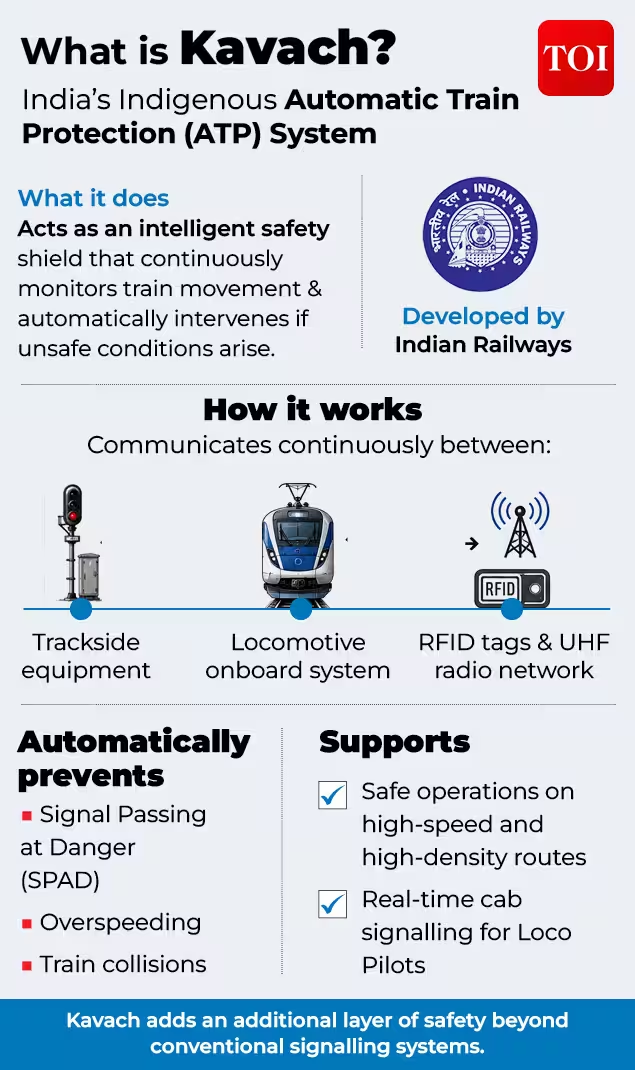
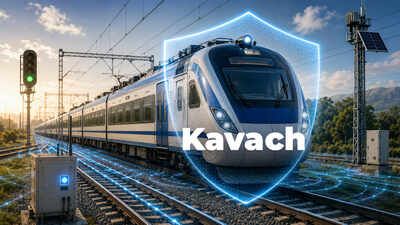
Kavach acts as a shield for train operations. Essentially it is an Automatic Train Protection (ATP) system which has been indigenously designed.
Can a train stop itself before it meets with an accident? For decades, railway safety has relied largely on human judgement. Today, Indian Railways’ homegrown Kavach is helping put advanced world-class signalling technology in the driver’s seat – and without taking the driver out of it.As the same suggests Kavach acts as a shield for train operations. Essentially it is an Automatic Train Protection (ATP) system which has been indigenously designed and developed by Research Designs & Standards Organization (RDSO) of Indian Railways.The system adds an extra layer of protection against any incidents that may arise out of human error, operational constraints or even equipment failures.Passenger train trials for Kavach first began in 2016. A decade later the system has modernised and Kavach 4.0 is being implemented across key high-density railway routes. According to Indian Railways, Kavach was adopted as National Automatic Train Protection System in July, 2020.After extensive trials, Kavach 4.0 has been successfully commissioned on 2,633 route kilometres. The routes cover Delhi- Mumbai and Delhi-Howrah sections.Indian Railways is prioritising Kavach deployment on high-density and highly used network routes, which carry nearly 96% of railway traffic. Now, the next-generation Kavach 5.0 is being developed for suburban rail operations with an aim to support higher train frequencies.So what does Kavach do? How is it comparable to global systems, and what are the challenges to the project? We take a look:
What is Kavach & how does it work?
Kavach provides the locopilots with real-time signalling information inside the locomotive. Key aspects such as target speed, distance, signal aspects and the authority to move forward are all provided. This is particularly helpful at higher speeds of above 120 kmph when sudden braking in case of an emergency is crucial.According to Indian Railways, Kavach is intended to prevent: Signal Passing at Danger (SPAD), overspeeding and train collisions.The aim is to combine continuous monitoring with automated intervention so that overall safety across India’s busy high-density and high-speed railway network is strengthened.
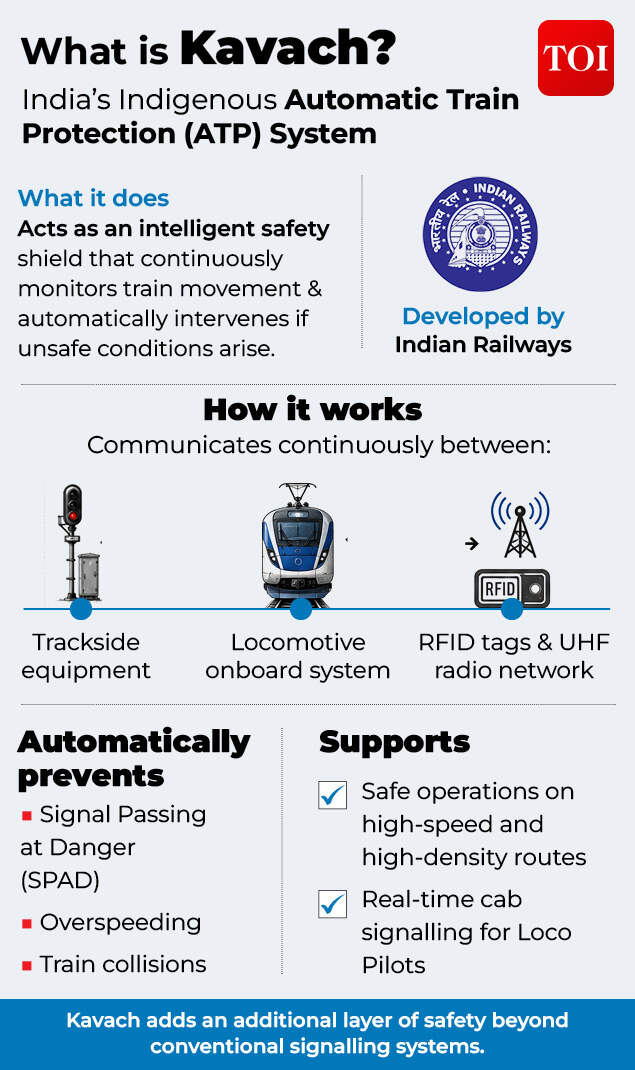
What is Kavach? India’s Indigenous Automatic Train Protection System
So, how does Kavach work?The system requires several pegs to be in place. According to Indian Railways, Kavach operates through continuous real-time communication between trackside systems and locomotives. This is done by making use of secure Ultra High Frequency radio antennas and track-mounted RFID tags.What these tags do is they provide the precise location of the train. There are several wayside units that are installed to transmit the signals and collect the live data from stations to understand the interlocking systems such as point positions, signal aspects, whether the track is occupied and what is the route status.This requires the locomotives or loco cabins (in case of trainsets like Vande Bharat) to be equipped with Kavach so that they can continuously communicate with the trains nearby, the trackside systems etc. The RFID tags help share the location of the train while the track side equipment gathers real-time information on signals, routes, track occupancy and point positions. Using this information, the safe distance that a train can travel at a particular speed is calculated and communicated in real time to the locomotive.
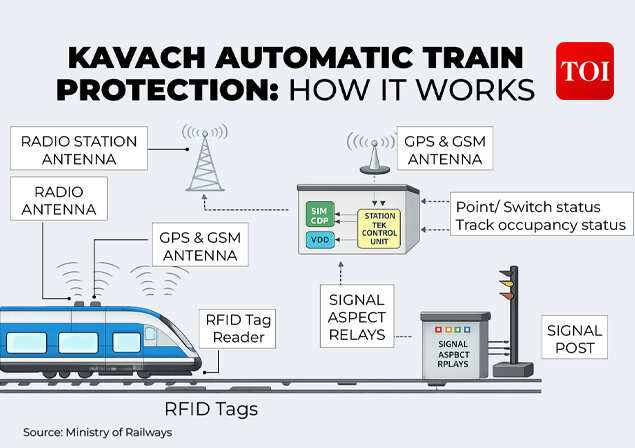
How Kavach works
Even as the information is displayed real time for the loco pilot to see, the system doesn’t rely on human intervention to prevent any accident. If the train crosses a red signal, goes above the permitted speed or even enters a conflicting route, Kavach automatically applies the brakes. If two trains are detected to be headed for a possible collision, Kavach sends an automatic stop-on-sight or SoS command to both.
Global benchmarks, cost advantage & other benefits
Why the need for Kavach? Because train movement on Indian Railways has depended largely on trackside signals and manual operation.Several advances in interlocking technology have enhanced overall safety, but the responsibility for observing line-side signals and controlling train speed rests primarily with the loco pilot. Such dependence on human judgement creates inherent risks.Kavach aims to address operational gaps by delivering continuous real-time situational awareness and more importantly, automatically enforcing the critical safety parameters.
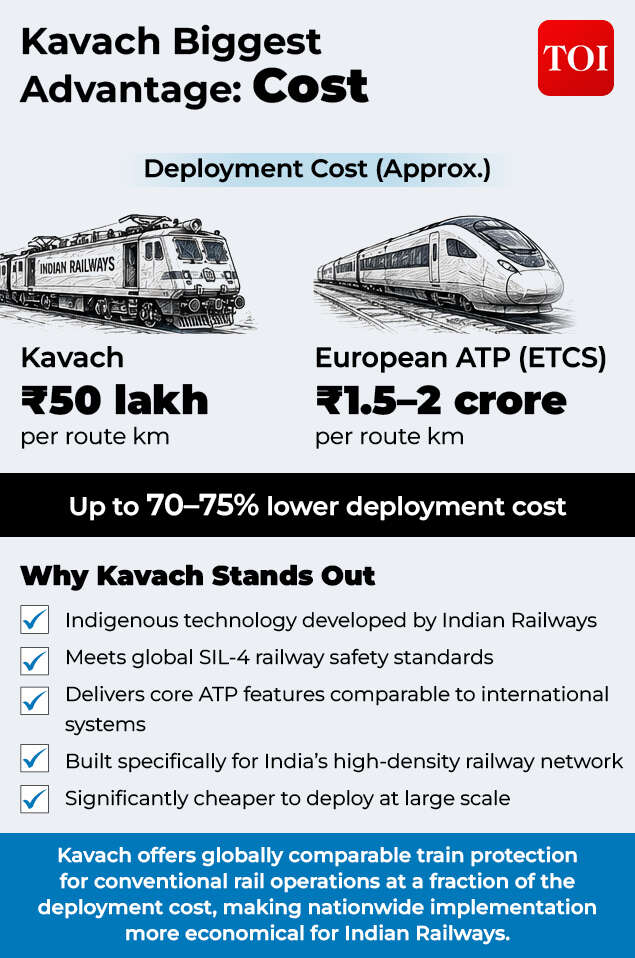
Cost Advantage of Kavach
What Kavach essentially does is it adds an automated safety layer over human operations.It prevents signal-passing-at-danger, enforces speed restrictions, and applies brakes if the loco pilot does not respond.India’s Kavach has been certified to Safety Integrity Level 4 (SIL-4), which Indian Railways says is one of the highest internationally recognised safety standards for railway signalling.According to Anshuman Chauhan, Director, Crisil Intelligence Kavach helps address the human-factor incidents that have historically been hardest to eliminate on a network of India’s density.Experts note that another big advantage lies in its cost. Comparable global systems like the ETCS-2 or European Train Control System cost around four times more. Indian Railways has estimated that the rollout cost for Kavach is around Rs 50 lakh per kilometre, while that for ETCS is around Rs 1.5-2 crore per kilometre.Santosh Misra, Partner at PwC India sees Kavach as a strategic safety platform that can significantly reduce accident risks arising from human error while enabling faster and more efficient train operations across India’s increasingly congested railway network.For the PwC expert the global lesson is clear: successful railway systems invest in ATP technologies that are adapted to local operating realities. Kavach is India’s world-class, indigenous safety solution at scale. Its open architecture aligns with India’s focus on building DPI for the world.
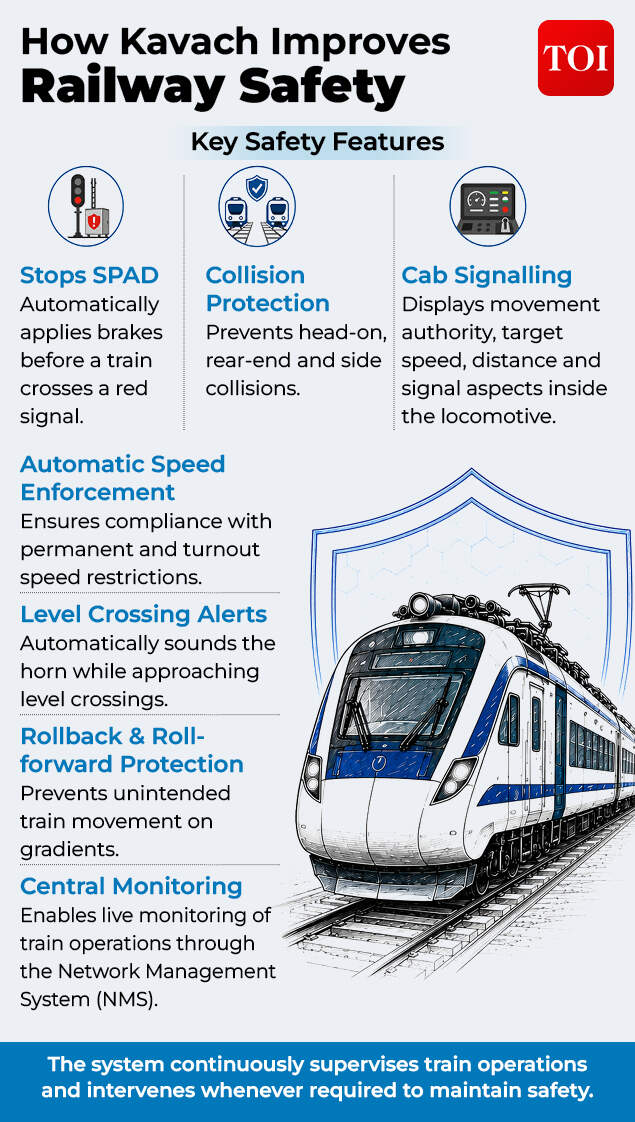
How Kavach Improves Railway Safety
Challenges to roll out
Even as it offers several benefits, the project is not without its execution challenges – the biggest of which is the sheer scale of it.To cover every kilometre of even the high density routes involves several elements to be in place simultaneously. The technology can only work if each component is in place along any particular length of the network. While modern train sets that are being rolled out come equipped with Kavach, the length of the route that the trains cover etc. all have to be Kavach enabled.Experts say that Kavach will deliver its full benefit only once both the trackside and locomotive fitments are in place across the entire route.Sudhanshu Mani, retired ICF GM and the architect of Vande Bharat trains sees Kavach as a commendable indigenous achievement, but believes Indian Railways should eye faster rollout timelines.“People often misunderstand the scope of Kavach – it is not just a system that avoids train collisions. It is a comprehensive signalling system that has the potential to be a game-changer for Indian Railways, bigger than even Vande Bharat,” he tells TOI.But, gaps in rollout, and lack of targeted execution have delayed full gains that can be realised from the project, he says.“The project requires faster execution so that some important sections of the network with full ground installation have at least 75%, if not more, coverage on rolling stock plying on it as well,” he adds.Anshuman Chauhan of Crisil Intelligence explains this: Every kilometre of Kavach deployment requires optical fibre connectivity, telecom towers and RFID tags. Every station and every locomotive needs its own unit fitment.“Building vendor capacity that can service requirements as large as those of Indian Railways takes time, which is currently a major challenge for efficient rollout of Kavach. Progress has accelerated over the past few years, with Kavach 4.0 now commissioned on the Delhi–Mumbai and Delhi–Howrah corridors. The priority now should be to sustain and grow manufacturing capacity through a well-defined, long term order book,” Chauhan tells TOI.“Hence, Kavach driven safety dividend will start being more visible once network penetration deepens,” he adds.Santosh Misra, Partner at PwC India believes that the pace of deployment will depend on broad basing the supply chains and vendor ecosystem, accelerating approvals, strengthening skilled manpower, and mobilising investments required for implementation across thousands of route kilometers and locomotives.Anshuman Chauhan of Crisil Intelligence points out that every major railway that has attempted automatic train protection has found it to be a long-cycle undertaking.“Europe’s ETCS remains at roughly 10 per cent of the trans-European network some three decades after the first specifications, largely because national systems are not fully interoperable. The United States mandated Positive Train Control in 2008 and completed it in December 2020, at an estimated cost of $14 billion,” he tells TOIThe lesson, he believes, is that standardisation and interoperability must be built in from the start, which is why steps like a universal braking algorithm across manufacturers and Safety Integrity Levels (SIL)-4 certification for Kavach 4.0 are the right foundations. Phased, corridor-first deployment is also an internationally proven good practice, which he says Indian Railways should follow.Schemes like ECMS and PLI can help make the supply chains resilient to global shocks, he advocates.As India takes leaps in world-class railway technology with Kavach, Vande Bharat trains, and even the bullet train manufacturing project, challenges will be plentiful. But as one of the largest economies in the world looks to become a developed country, Indian Railways will need to continue modernising with technology comparable to that available on other major networks around the world. Kavach is a step in that direction, and implementation challenges will need to be overcome to realise its full potential.