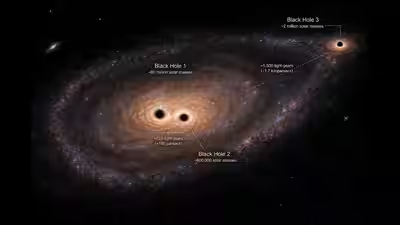
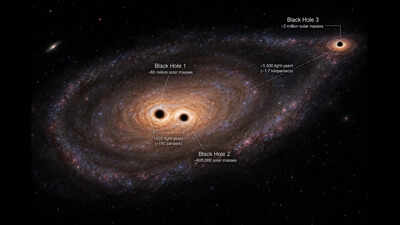
Light from a distant galaxy has travelled for more than 12.5 billion years to reach Earth, allowing astronomers to see the universe when it was only about 1.2 billion years old. At that remarkable stage in cosmic history, the galaxy was already home to ‘three actively feeding supermassive black holes.’ An international team led by researchers at the Max Planck Institute for Extraterrestrial Physics identified the three objects using observations from the James Webb Space Telescope. Two of the black holes are located close together near the centre of the galaxy, while a third lies farther out. According to the study published in Astronomy & Astrophysics, the finding provides a rare look at how black holes could grow and interact in the young Universe, when galaxies themselves were still taking shape.
Finding three black holes from an ancient galaxy
The discovery became possible because of the James Webb Space Telescope’s ability to separate light from different parts of a distant galaxy. The researchers used Webb’s Near-Infrared Spectrograph, or NIRSpec, in its integral-field spectroscopy mode. Rather than simply taking an ordinary picture, the instrument allows astronomers to examine how light changes across different locations within the galaxy. This was particularly important because the black holes are close together on the enormous scale of space.The researchers focused on broad emissions from hydrogen, especially a feature known as H-alpha. Such broad emission can come from gas moving at very high speeds around a feeding black hole. The study found separate regions showing this behaviour, providing evidence that the light was not coming from just one object. The analysis identified two distinct broad-line regions close to the galaxy’s centre and another in its outer region. The researchers also examined alternative explanations for the unusual emission, including phenomena such as stellar explosions, shocks and winds. Their analysis favoured the interpretation that the broad emission was coming from active black holes.
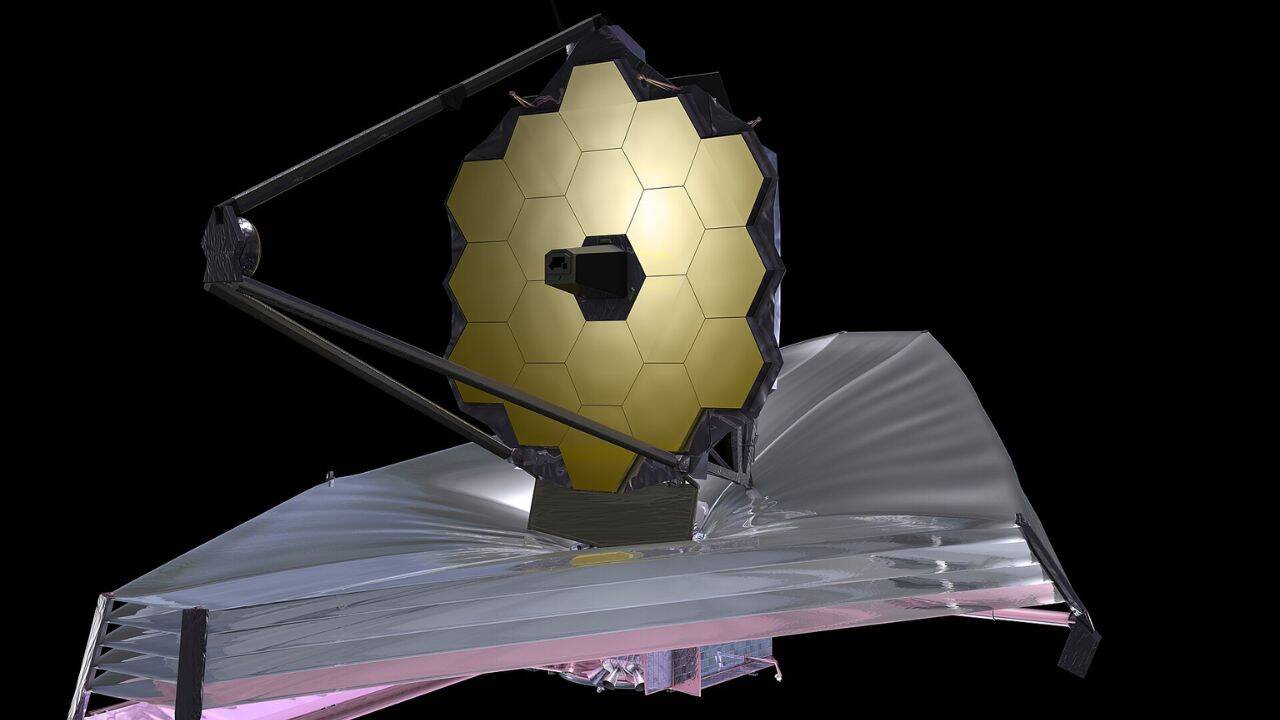
Illustration of the James Webb Space Telescope. Image Credit: Nasa
How far back in time does this galaxy take astronomers
J0148-4214 is an extraordinary target because of its enormous distance from Earth. The study reports a redshift of about 5.02, placing the galaxy more than 12.5 billion light-years away. Because light needs time to cross such a vast distance, the telescope is not seeing the galaxy as it appears today. Instead, it is receiving light that began its journey when the Universe was only around 1.2 billion years old. That makes the galaxy a window into the early Universe. At that time, the first generations of galaxies and supermassive black holes were still growing. Finding several actively feeding black holes within one young galaxy therefore gives astronomers an unusual opportunity to examine how these objects developed so early. The study, led by Hannah Übler and an international team, describes observational evidence for three massive, accreting black holes in J0148-4214. The researchers call the work ‘BlackTHUNDER.’
Location of three black holes inside the galaxy
The arrangement of the three objects makes the discovery particularly interesting. Two of the black holes are located near the centre of J0148-4214. In projection, they are separated by roughly 620 light-years, or about 190 parsecs. Although that distance sounds enormous from a human perspective, it is relatively close on the scale of a galaxy. The study estimates that the more massive central black hole has a mass of about 80 million times that of the Sun. The second central black hole is considerably smaller, with an estimated mass of around 600,000 Suns. The third black hole is located away from the centre, in the galaxy’s north-western outskirts. Its projected distance from the main black hole is about 1.7 kiloparsecs, equivalent to roughly 5,500 light-years. Its estimated mass is around two million times that of the Sun. All three are actively gathering matter. In simple terms, each black hole is surrounded by material that is being pulled towards it. As that material moves inward, it can become extremely hot and produce intense radiation, making the otherwise invisible black holes detectable.
Could the two central black holes eventually merge
The researchers argue that the pair could eventually merge as their interaction with the surrounding galaxy causes them to lose orbital energy and move closer together. The study gives a simple estimate suggesting that the process could occur on a timescale of less than roughly 700 million years. That is a relatively short period compared with the age of the Universe. Such mergers may help explain how some supermassive black holes became so large so quickly. If young galaxies repeatedly collided and brought their central black holes together, those mergers could have provided an important route towards building increasingly massive black holes. The third black hole adds another layer to the picture. Its position in the galaxy’s outskirts suggests that J0148-4214 may have experienced complicated interactions or mergers involving smaller galaxies.
What does the discovery reveal about the early Universe
According to the study, several actively growing massive black holes could exist within a single galaxy surprisingly early in cosmic history. Supermassive black holes are now known to sit at the centres of many large galaxies, but their origins remain an important question. Observations such as this one suggest that galaxy interactions and mergers may have helped accelerate their growth when the Universe was still young. J0148-4214 offers a snapshot of a galaxy in a particularly active stage. For astronomers, it is a glimpse of a period when galaxies were growing rapidly and the giant black holes inside them were already becoming powerful engines. The discovery suggests that the early Universe may have been far more crowded with interacting black holes than previously seen, and Webb is now giving researchers the tools to uncover those hidden systems.