Iran launched what it described as an “eye-for-an-eye” military operation against the United States on Monday, targeting American military facilities across the Gulf after fresh US strikes hit Iranian military infrastructure over the weekend. Iran’s Revolutionary Guards said they struck US military facilities in Bahrain and Kuwait, destroyed radar systems in Oman, and hit fuel and ammunition depots at Jordan’s Prince Hassan Air Base. The attacks came after the US military said it had targeted Iranian air defence systems, coastal radar sites, missile and drone capabilities, and naval assets on Sunday using aircraft, warships and drones.The renewed hostilities have also intensified the dispute over the Strait of Hormuz, with Tehran saying it has once again closed the strategic waterway, sending global oil prices higher and raising fresh concerns over energy supplies. The developments have cast doubt on last month’s interim US-Iran agreement aimed at reopening the strait and pursuing further negotiations.
Iran targets US military facilities across Gulf
The Revolutionary Guards said the operation was launched in direct retaliation for the latest US strikes, claiming to have attacked American military facilities in Bahrain and Kuwait while also targeting radar installations in Oman and military infrastructure in Jordan.The Guards claimed their aerospace forces destroyed fuel tanks, Patriot air defence systems at Kuwait’s Ali Al Salem Air Base and a strategic FPS radar at Ahmed Al Jaber Air Base.Over the weekend, Iran also claimed responsibility for attacks on US-linked military assets in Jordan, Kuwait, Oman and Qatar. Separately, Iran’s army said on Monday that its air defences shot down a US-made LUCAS one-way attack drone over Bandar Abbas, releasing footage that it said showed the interception.
US expands strikes on Iranian military assets
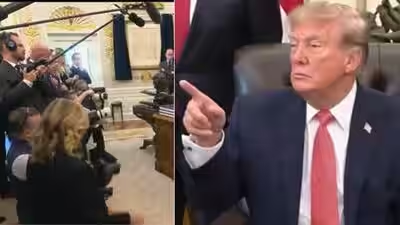
The US military said its latest operations targeted Iranian air defence systems, coastal radar sites, missile launch capabilities, drones and small naval vessels in an effort to reduce Tehran’s ability to threaten shipping in the Gulf.US central command earlier said American forces had struck around 140 Iranian military targets on Saturday alone, with more than 300 targets hit over three nights. Washington said the operations were aimed at degrading Iran’s capacity to attack commercial vessels and civilian shipping transiting the Strait of Hormuz.US President Donald Trump struck a defiant tone following the weekend attacks, saying, “We’re beating them up”, Reuters reported. Trump has also declared that the ceasefire is effectively over, though he said the door remains open for further negotiations.
Strait of Hormuz dispute deepens
The Strait of Hormuz has become the central flashpoint of the conflict. After announcing its closure on Saturday, Iran said passage through the waterway remained suspended and that permits would be issued only after “stability and calm” returned.Tehran has proposed a joint mechanism with Oman to regulate traffic through the strait, but Foreign Ministry spokesperson Esmaeil Baghaei accused the United States of pressuring Muscat and obstructing those discussions.The United States rejected Iran’s claims, insisting Tehran does not control the waterway and saying US forces remain deployed to safeguard freedom of navigation. American officials said about 20 vessels had been escorted through the strait in the previous 24 hours, although ship-tracking data indicated limited commercial traffic.
Oil prices jump amid shipping fears
The renewed tensions pushed Brent crude prices up by more than 3% on Monday as markets reacted to the possibility of prolonged disruptions in one of the world’s most critical energy corridors.Before the conflict escalated, the Strait of Hormuz handled roughly one-fifth of global oil and liquefied natural gas shipments. Iran warned that continued US military intervention in the waterway could trigger greater disruption to the global oil and gas sector.Higher energy prices are also emerging as a political challenge for Trump ahead of November’s congressional elections, particularly as rising gasoline prices fuel inflation concerns.
Iran vows vengeance after Khamenei killing
Iran also hardened its rhetoric over the killing of former Supreme Leader Ali Khamenei. Deputy secretary of the supreme national security council Ali Bagheri Kani called for action against those responsible, while foreign ministry spokesperson Baghaei said pursuing “justice and blood vengeance” had become a national duty.He said Iran would pursue international legal action over the attacks while continuing to document alleged US and Israeli violations.Meanwhile, Iranian officials said a US strike on a military site in Nain county in Isfahan province killed one person and injured seven others. According to provincial authorities, all of the injured were treated as outpatients.