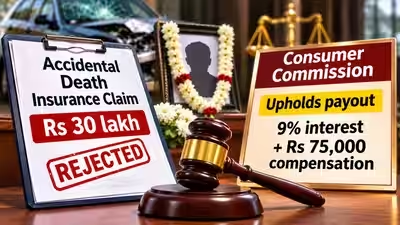
Insurance payouts can sometimes be tricky if the insurer denies claims. In one such case, a pensioner died following a road accident and his wife and two daughters turned to the accidental death insurance cover associated with his pension account for financial assistance.However, the insurer declined their claim, citing a policy clause excluding certain injuries linked to alcohol consumption. The family challenged the insurer’s decision and won relief.
What the case is about
A pensioner held coverage under a group personal accident/salary package/pension account policy issued by the insurer through the man’s bank account.The insurance policy covered the period from January 4, 2022, to January 3, 2023. On April 9, 2022, the man was involved in a motor accident and suffered severe head injuries. He was taken to a hospital, where he died on April 18, 2022.His wife and two daughters filed a claim for the insured amount of Rs 30 lakh on December 5, 2022. The insurer however, rejected their request on January 9, 2023, relying on a policy exclusion concerning injuries sustained under the influence of alcohol.“The insurer relied on the policy exclusion for being under the influence of intoxicating liquor or drugs or other intoxicants except where the insured is not directly responsible for the injury/accident though under influence of intoxication,” says Vishal Jain, Founder and Senior Partner at Ayaam Legal.The family contested the insurer’s decision before the District Consumer Commission, Vellore. They argued that it had repudiated the claim without presenting credible medical or scientific evidence to establish that the man was intoxicated at the time of the accident.The District Commission ruled in the family’s favour, directing the insurer to settle the insurance claim and pay interest and compensation for deficiency in service and mental agony. The insurer then appealed against the order before the Tamil Nadu State Consumer Disputes Redressal Commission.
Why did the family win the case against the insurer?
The State Commission upheld the District Commission’s order directing the insurer to settle the accidental death insurance claim of Rs 30 lakh.The insurer was also ordered to pay annual interest at 9% from September 1, 2023, until the date of the District Commission’s order. In addition, the family was awarded Rs 50,000 as compensation for deficiency in service and mental agony, along with Rs 25,000 towards litigation expenses.The Commission found several significant gaps in the evidence presented by the insurer.According to Vivek Kumar, Advocate, Delhi High Court, the insurer based its decision partly on a hospital death summary that stated that the deceased was under the influence of alcohol when the incident occurred.However, the Commission noted that the medical document did not clarify the basis for this statement. It was unclear whether the information came from the deceased himself, an accompanying person, the police or another medico-legal source, or an independent clinical assessment by the treating doctor.The Commission stressed that recording a patient’s history of alcohol consumption does not, by itself, establish that the person was under the influence of alcohol at the relevant time.The insurer also cited a reported plasma alcohol level of 106.1 mg/dL. However, the insurer did not submit the original laboratory report to establish the identity and nature of the blood specimen, when it had been collected, which laboratory had tested it, the relevant report or sample number, or whether the test result could be linked to the deceased.The Commission observed that a numerical reading, even when stated with precision, cannot automatically be accepted as scientifically established evidence unless its source and authenticity are demonstrated.Another important aspect of the ruling was the Commission’s examination of the two death summaries placed before it by the parties. One of the most significant inconsistencies concerned the date of death. The document relied upon by the insurer recorded April 11, 2022, as the date of death. However, the admitted facts and the medical record submitted by the complainants established that the man had died on April 18, 2022, Kumar told ET.According to the Commission, such discrepancies had a material bearing on the reliability of the documents, the identification of the records and their chronological traceability.The Commission also reiterated that an insurer seeking to reject a claim by invoking an exclusion clause must establish the factual circumstances required for that exclusion to apply. The burden was not on the family to explain or disprove every inconsistency left unresolved in the insurer’s documents.The Commission further referred to the Supreme Court’s judgment in IFFCO Tokio General Insurance Company Ltd. v. Pearl Beverages Ltd., AIR 2021 SC 2277. The ruling clarifies that an insurer is not required in every case to produce a breathalyser reading or a blood-alcohol test report to establish that an exclusion applies. The conclusion can instead be based on the totality of reliable circumstances, Kumar explains.However, this does not absolve an insurer of the responsibility to establish that the insured was actually under the influence of alcohol.