

A growing number of leaders from India-based global capability centres (GCCs) are making their way into the Fortune 500 C-suite, underscoring the rising strategic importance of these centres and the influence of their leadership.Recent examples include Kalyani Sekar, senior vice-president and chief data and AI officer at Verizon; Hari Vasudev, executive vice-president and CTO of Walmart US; Ambica Rajagopal, group chief data and AI officer at Michelin; Suresh Venkatarayalu, CTO of Honeywell; and Navneet Kapoor, executive vice-president at Maersk.
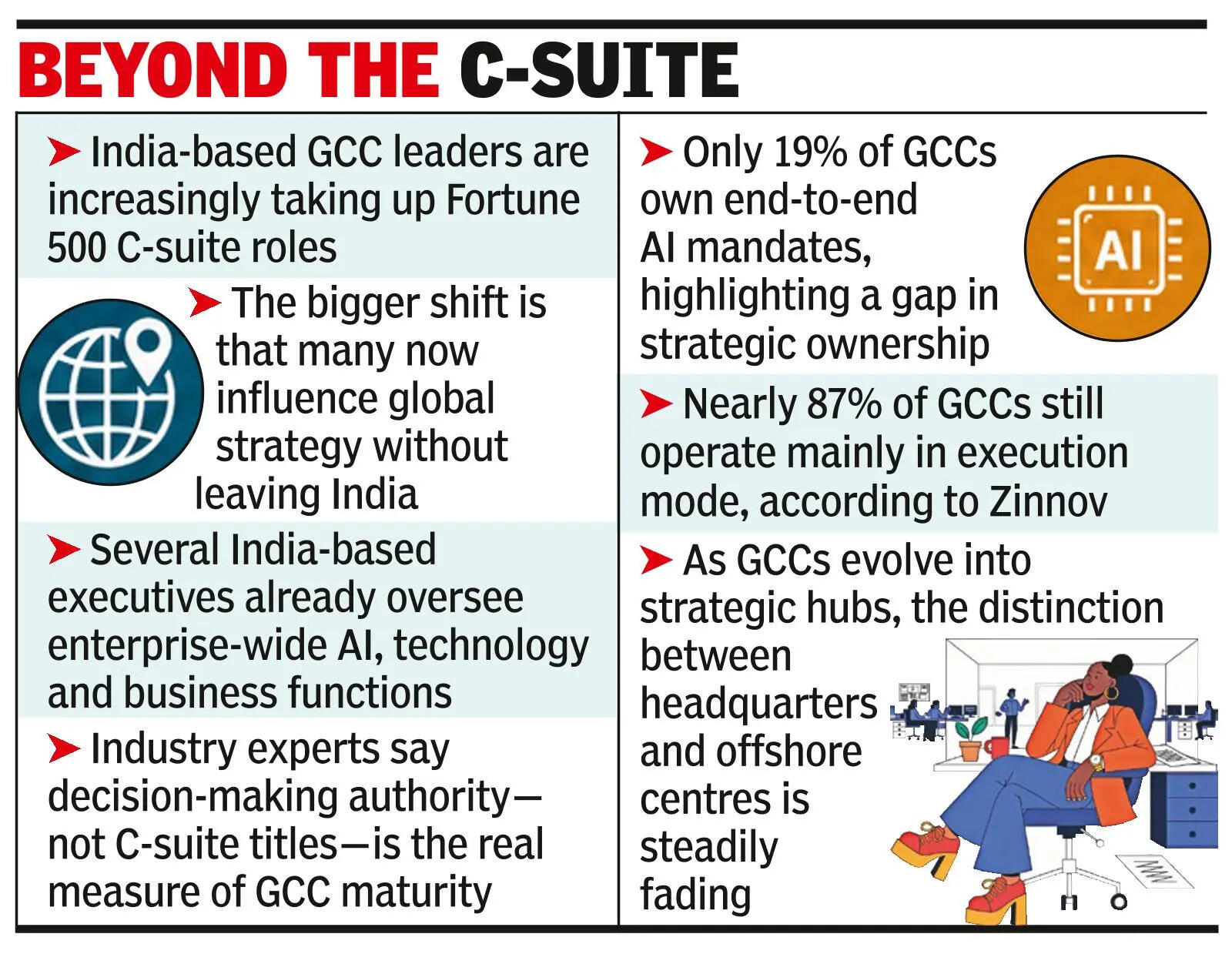
Beyond the G-suite
Yet industry experts argue that focusing solely on C-suite appointments misses the bigger transformation underway. The more significant shift, they say, is the growing number of India-based leaders who are shaping enterprise strategy, leading global technology and AI programmes, and owning business outcomes while remaining based in the country.A growing cadre of GCC executives now hold enterprise-wide responsibilities that extend well beyond managing local operations. Leaders such as Sarv Saravanan, chief customer officer at Commvault; Sunil Gopinath, CEO of Albertsons Companies India; Hariharan Ganesan, vice-president, data analytics and reporting at Rolls-Royce; Ankur Mittal, senior vice-president, CTO and managing director of Lowe’s India; and Vijai Kishan, India site lead and head of India enterprise technology at Fidelity Investments, oversee global customer, engineering, data, technology and AI functions from India.As GCCs evolve from delivery centres into strategic hubs, leadership itself is becoming geographically distributed. The distinction between headquarters and offshore centres is steadily blurring, with India emerging as an important node for enterprise-wide decision-making.“Indian GCC leaders reaching Fortune 500 C-suites is noteworthy, but it’s not the truest measure of progress,” said Pari Natarajan, CEO of Zinnov. “The real indicator of maturity is operating model ownership. Do these centres shape enterprise AI strategy or execute someone else’s vision? Do they control AI budgets and governance? Do they drive technology decisions?” Zinnov’s latest AI maturity study suggests that while GCCs have made significant progress, the transition from execution to ownership remains incomplete. Nearly 87% of GCCs continue to operate primarily in execution mode. Only one-third have dedicated AI leadership, two-thirds lack deep domain expertise, and just 19% own end-to-end AI mandates.“The pattern isn’t variation in capability. It’s systematic constraint in the operating model,” Natarajan said. “We see pilots, hackathons and experiments. But innovation pipelines often break before they scale. Without mandate clarity, budget authority and deep domain grounding, GCC leaders remain brilliant executors in someone else’s strategy, not architects of transformation.”