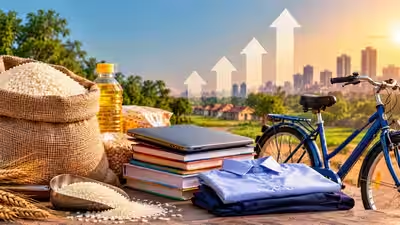

NEW DELHI: In-kind social transfers ranging from free foodgrains under the public distribution system (PDS) to laptops, bicycles and school uniforms have pushed nearly 22 crore people — comprising around 19% of rural population and 8.4% of those in urban areas — into higher consumption brackets, a new study in an NSO journal showed.Using the household consumption expenditure survey (HCES) 2022–23 unit-level data, the NSO study concluded that 15.8% of the population at the national level saw improvement in their level of living as they moved into higher monthly per capita consumption expenditure (MPCE) category once the monetary value of free goods was imputed.
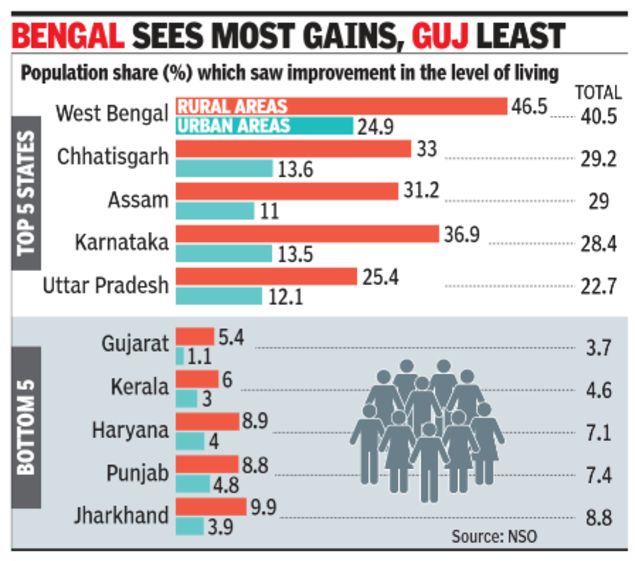
Which state saw most gains
Incorporating these welfare measures also reduced consumption inequality, measured by Gini coefficient, pointing to a boost in effective purchasing power as it freed up some cash that would have been allocated for buying some of these goods.The findings also highlighted a distinct regional divergence in welfare impact. West Bengal led with over 40% of its total population (46.5% rural and 24.9% urban) transitioning to higher consumption brackets due to in-kind transfers. This was followed by Chhattisgarh (29.2%), Assam (29%), Karnataka (28.4%), and Uttar Pradesh (22.7%). In contrast, industrialised and higher-baseline states reported significantly lower transition rates, with Gujarat seeing only 3.7% population transitioning to a higher consumption bracket, followed by Kerala (4.6%) and Haryana (7.1%).Despite concerns over several of such transfers being populist in nature, often announced ahead of elections, the study concluded that in-kind social welfare acted as a progressive measure as maximum upward mobility was concentrated at the bottom of the pyramid, indicating that welfare benefits effectively reach the targeted, lower-income households.Researchers, however, noted that the 22-crore figure was a conservative estimate as major public services, specifically free healthcare benefits under schemes such as Ayushman Bharat (PM-JAY) and free school education were excluded from the calculations due to survey design limitations. Factoring in the out-of-pocket savings from health and education would indicate an even broader elevation of living standards across Indian households, it said.