
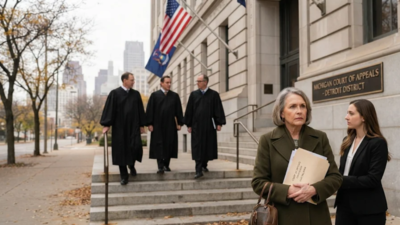
A Michigan woman who signed a $705,000 marital property agreement while under legal guardianship has lost her appeal for a larger share of her former husband’s wealth. She argued that an equal division of their assets should have given her nearly $1 million. However, an appeals court has upheld the original agreement signed in 2018. The Michigan Court of Appeals issued its decision on 16 November 2026, rejecting Cassandra Fameux’s challenge to the property settlement. The three-judge panel ruled that the original agreement was still legally binding. It also found that Fameux had not provided enough evidence to show that the agreement should be cancelled.The case involved her former husband, Paul Gregory St Claire, an anaesthesiologist who worked at the hospital where they first met. Fameux argued that the agreement was unfair because she was under a court-appointed guardianship when she signed it. She also questioned whether the legal protections required for someone in her situation had been properly followed. The appeals court rejected these arguments. It found that a lawyer had been appointed by the court to protect Fameux’s interests during the earlier case. It also noted that the trial judge had reviewed the agreement and decided that the settlement was fair. According to the opinion published by Justia, the case is listed as Paul Gregory St Claire v Cassandra Fameux, docket number 378410. The appeal came from the Ingham Circuit Court, case number 23-002394-DM. Presiding Judge Michael J. Kelly wrote the court’s per curiam opinion, which was also supported by Judges Michael J. Riordan and Michelle M. Rick.
A marriage, children and legal guardianship
St Claire and Fameux met in 2003 while working at the same hospital. He worked as an anaesthesiologist, while she was employed in the nutritional department. They married in 2009 after having two children together. During their marriage, Fameux was admitted to psychiatric hospitals several times. In 2015, her sister was appointed as her legal guardian. According to the Michigan Court of Appeals, Fameux testified that she remained close to her sister, including during the later divorce proceedings. In 2017, while Fameux was still under guardianship, St Claire filed a complaint for separate maintenance. This is a legal arrangement that allows married couples to live apart and settle their financial matters without ending their marriage. At the time, St Claire had obtained a personal protection order against Fameux. She violated the order before being admitted to hospital for a third time.St Claire told the court that Fameux had often said she wanted to divorce him. He said he chose to seek separate maintenance instead because it would allow her to remain on his health insurance. It would also help her qualify for his Social Security benefits after they had been married for another two years. He also raised concerns about the children’s safety when they were in her care and what he described as her excessive spending. Fameux gave a different account of what happened. She testified that St Claire had told her the separate maintenance agreement was only meant to protect the family’s finances. According to her, he assured her that it would not change their relationship and that they would continue living together as a family. After leaving hospital, she returned to the marital home. At the time, she was receiving long-acting antipsychotic injections for schizoaffective disorder. She claimed that her treatment was not appropriate and accused St Claire of deliberately giving her medication until she could no longer think clearly. St Claire denied the accusation.
The $705,000 agreement signed in 2018
During the separate maintenance case, both spouses had their own lawyers. Their legal teams agreed that Fameux needed additional protection. They arranged for attorney Melissa Leckie to represent Fameux’s best interests under a September 2017 court order. The order gave Leckie the title of “Attorney-Guardian Ad Litem”. The order instructed Leckie to protect Fameux’s interests, review settlement offers and the proposed judgment with her, and attend court hearings when required. The couple reached an agreement through mediation. Under the Judgment of Separate Maintenance (JOSM), Fameux would receive $130,000 in cash. Another $575,000 would be transferred into her retirement account. Together, these payments were worth $705,000. St Claire also agreed to pay spousal support that could be adjusted over a period of five years.St Claire, Fameux, their lawyers and Leckie all signed the agreement. There was also a space for Fameux’s sister to sign as her legal guardian. However, that signature line was crossed out after the lawyers agreed that her signature was not needed because Leckie had already been appointed to protect Fameux’s interests. At a December 2017 hearing, the trial court decided that the division of assets was fair and approved the agreement. Fameux later testified that she did not understand what she had signed. She said neither her lawyer nor Leckie had properly explained the agreement to her. She also claimed that St Claire threatened that she would not be allowed to see their children unless she signed it. Court records show that the couple later started living together again. However, they gave different accounts of the relationship after they resumed living under the same roof.
Woman argues she was pressured into signing
When Fameux later challenged the agreement, she argued that she had been pressured into signing it while heavily medicated. She said she was unable to understand what the document meant or what she was agreeing to. She told the trial court that she would never have given up most of the couple’s wealth if she had understood the agreement. She also blamed her legal representatives for failing to explain its terms properly. St Claire denied these claims. After hearing evidence from both sides, the trial judge rejected Fameux’s allegation that St Claire and her legal representatives had worked together to take away her rights to marital property. The judge ruled that the agreement worked as a legally binding contract that settled how the couple’s property would be divided. The court also rejected several requests to cancel the agreement.The trial court treated the division of property separately from future spousal support. The parties eventually agreed that Fameux could apply for additional support at a later date. The court also noted that St Claire had not followed every part of the agreement. However, Fameux had continued to benefit from using his credit cards. He had also made voluntary payments into her retirement account. The couple reached separate agreements on child custody and child support. These matters were settled without the court having to make a ruling.
Appeals court rejects claim for a larger share
In her appeal, Fameux argued that the 2018 agreement was unfair. She said an equal division of the couple’s marital assets would have given her $995,368.50 instead of the $705,000 she received under the agreement. The Michigan Court of Appeals ruled that Fameux had not provided enough evidence to prove that the original division of assets was legally unfair. The judges noted that she had not shown any mistake in how the couple’s assets were valued that would justify cancelling the agreement. The panel also considered the other benefits Fameux received under the deal. These included remaining on St Claire’s health insurance and being able to qualify for his Social Security benefits after another two years of marriage. The judges referred to an earlier Michigan court decision, Berger v Berger. They explained that a fair division of marital property does not have to mean that both spouses receive exactly the same amount. A significant difference between the shares can still be fair if there is a good reason for it. Fameux also argued that the couple’s decision to start living together again after signing the agreement should affect whether it remained valid.The appeals court disagreed. It referred to earlier decisions in Knapp v Knapp, Hagerty v Union Guardian Trust Co and Irvine v Irvine. These cases established that a couple getting back together does not automatically cancel every agreement they made while living apart. The judges explained that the 2018 agreement was designed to divide the couple’s assets while allowing them to remain married and continue living together. It was not an agreement made in preparation for a divorce. For that reason, their decision to resume living together did not automatically cancel it. The panel also referred to the 2025 decision in Johnson v Johnson. That ruling confirmed that a consent judgment of separate maintenance is a legally binding contract unless there is evidence of fraud, mistake, illegality or unconscionability.
Court upholds the original settlement
The appeals court also rejected Fameux’s argument that the original case did not provide the proper legal protections required because she was under guardianship. She questioned why Leckie had been given the title of “Attorney-Guardian Ad Litem” instead of simply being appointed as a guardian ad litem. Fameux also pointed out that her sister, who was her legal guardian, had not signed the agreement. The judges ruled that Leckie’s title did not change her main responsibilities. Her job was to protect Fameux’s interests, take part in mediation and represent her in court. The panel also found that Leckie’s failure to submit a separate written report did not make the agreement invalid. Her absence from the December 2017 court hearing did not invalidate it either. The judges noted that Leckie had signed the agreement.The court acknowledged that Fameux was under legal guardianship when she signed the agreement. It also did not assume that she personally understood every detail of the settlement. However, the judges pointed out that Fameux had not called Leckie, her former lawyer or her sister to give evidence in support of her claims. In its decision issued on 16 November 2026, the Michigan Court of Appeals upheld the trial court’s refusal to cancel the 2018 Judgment of Separate Maintenance. The panel also confirmed that the agreement could remain part of the couple’s divorce judgment. As a result, the original $705,000 settlement remains legally binding, and Fameux will not receive the larger share of the marital assets she had requested.