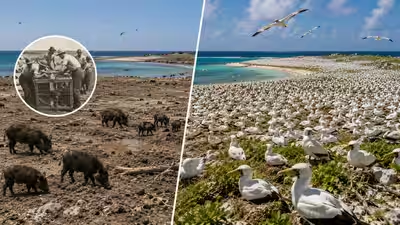
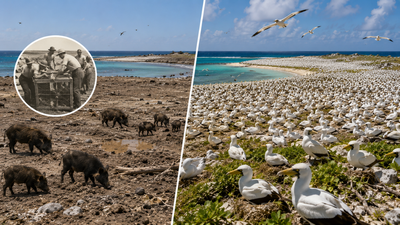
In 1958, Clipperton Island was a very different place from the huge seabird colony it would later become. The tiny Pacific atoll had once supported thousands of breeding birds, but decades of human occupation had left a heavy mark. Feral pigs, introduced when people settled on the island, had multiplied and were feeding on land crabs and disturbing nesting birds. When American ornithologist Kenneth Stager arrived, only about 650 Brown and Masked Boobies remained. He removed all 58 pigs from the island. The change that followed was gradual but striking. With the pigs gone, land crabs recovered, vegetation was kept in check, and the open ground favoured by the boobies remained available. By 2003, aerial photographs showed more than 137,000 Brown and Masked Boobies breeding on Clipperton, turning a story of ecological damage into one of the most striking seabird recoveries recorded on an isolated island.
How human settlement changed Clipperton Island’s natural ecosystem
Clipperton had been described by early explorers as a place crowded with tropical seabirds. The exposed land covers only about 1.6 square kilometres, and the landscape was largely barren. That changed after people settled there in the late 19th century to exploit its guano deposits. According to a 2005 paper published in Marine Ornithology titled ‘Clipperton Island: Pig sty, rat hole and booby prize’, the human occupation introduced two lasting changes: coconut palms were brought to an otherwise largely plant-free island, and pigs were released there. During the years that followed, the pigs became feral and began feeding heavily on the island’s large population of land crabs as well as affecting the ground-nesting birds.The consequences were already severe by the time Stager arrived. Pitman and his co-authors reported that thousands of Masked and Brown Boobies had once bred on Clipperton, but Stager’s 1958 visit found only 650 birds between the two species. The pigs had altered the island in ways that reached beyond the birds themselves.
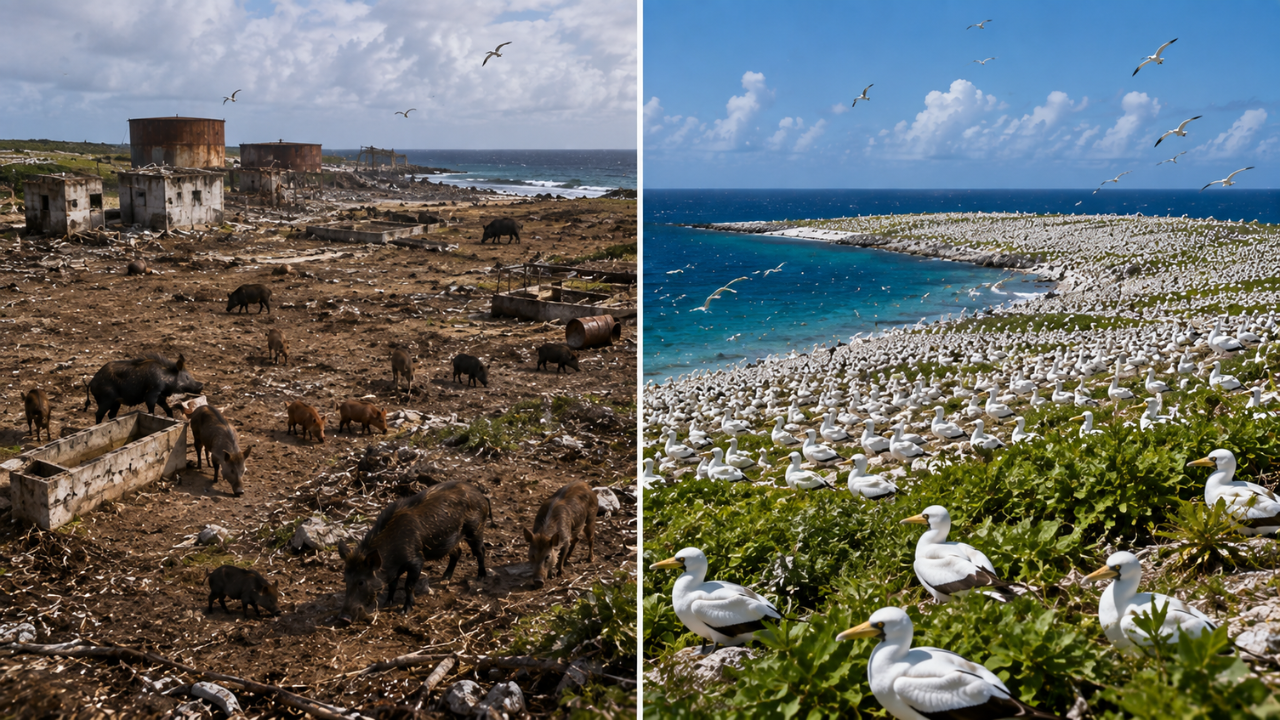
Image AI generated
How Kenneth Stager removed 58 feral pigs from Clipperton Island
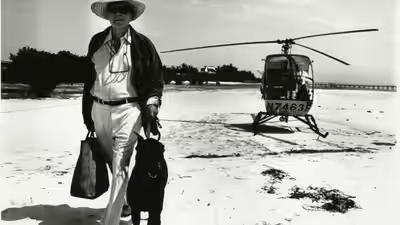
The solution was unusually direct. Stager, an ornithologist from the Los Angeles County Museum, killed all 58 feral pigs he found on the island. He arrived with a shotgun and removed the animals after seeing the damage they were causing to Clipperton’s wildlife. What happened afterwards was not simply a matter of removing a predator and waiting for birds to return. The pigs had been eating the island’s land crabs, and those crabs played an important part in controlling vegetation. With the pigs gone, the crab population recovered. The crabs then consumed much of the vegetation and young coconut palms, helping return Clipperton towards the sparse landscape that had existed before the human settlement.That relationship between pigs, crabs, plants and seabirds became an important part of the island’s ecological story. The pigs were not merely attacking birds. They were changing the food web around them, and those changes were affecting what the island could support.
How Clipperton Island went from 650 boobies in 1958 to more than 137,000
The scale of the recovery only became clear much later. Using aerial photographs taken in 2003, Pitman, Ballance and Bost counted at least 25,000 Brown Boobies and more than 112,000 Masked Boobies. Together, that put the two populations at more than 137,000 birds, compared with the approximately 650 recorded by Stager in 1958.The increase was especially striking for Masked Boobies. The authors described Clipperton as the world’s largest known colony of the species at the time and suggested that perhaps half of the global population might have been breeding on the tiny atoll. Their figures also placed Clipperton among the most important breeding sites known for Brown Boobies.There was another ecological change that helped explain why the island looked so different after the pigs disappeared. With land crabs no longer being suppressed by pigs, vegetation was again kept to relatively small areas. The crabs also consumed newly sprouting coconut palms, limiting the spread of trees across ground that the Masked Boobies used for nesting. It meant that removing one introduced animal had helped restore a much larger relationship between the island’s plants, crabs and birds.
Black Rats spread across Clipperton Island in the early 2000s
By the 1980s, Pitman and his colleagues were seeing an island where vegetation remained restricted largely to small lagoon islets and scattered coconut palms. Then another introduced species arrived. Two fishing boats wrecked on Clipperton between 1999 and 2000. During the following year, the researchers recorded the first Black Rats they had seen on the island. By 2003, the rats were common, and vegetation had begun spreading onto the main island for the first time in decades.When the researchers returned during a French expedition in 2005, they found rats feeding heavily on land crabs. As the crab population fell, previously bare coral areas began carrying dense patches of vegetation. New plant species appeared, and hundreds of coconut palms began to establish themselves.The shift was important because the rats were effectively pushing the island in the opposite ecological direction from the one that had followed the pig removal. Fewer crabs meant less grazing on vegetation, while more vegetation created additional habitat for rats. Pitman and his colleagues warned that this could become a self-reinforcing cycle.Rats began eating seabird eggs and chicks on Clipperton IslandThe rats were not only changing the landscape. They were beginning to affect the birds directly. On small lagoon islets where Sooty Terns bred, the researchers found very few eggs during their 2005 visit. One had recently been laid, one had been eaten by a rat. Pitman, Ballance and Bost warned that continued rat expansion could threaten smaller seabirds, including Sooty Terns, Brown Noddies, White Terns and Black Noddies. Rats are capable of taking eggs and chicks, and their effects can be particularly serious for species that nest on or close to the ground.The effects could also reach larger seabirds indirectly. Red-footed Boobies favour shrubs and trees for nesting, while Masked Boobies need relatively open ground for landing and taking off. If coconut palms and other plants were allowed to spread across much of Clipperton, the habitat would become more suitable for some species and less suitable for others.So the same island that had once demonstrated how quickly seabirds could recover after an invasive mammal was removed was facing another invasion capable of reshaping its bird community.
What Clipperton Island taught conservationists about invasive species
Clipperton’s history became an important example for conservationists working on islands elsewhere. The lesson was not simply that pigs can harm seabirds. It was that introduced animals can alter several parts of an island ecosystem at once, sometimes producing effects that are not obvious until another species begins to disappear. As per The University of California, Kenneth Stager’s action on Clipperton was for conservationists Brad Keitt, Bernie Tershy and Don Croll, who developed projects aimed at removing invasive predators from islands off Baja California. Their work eventually contributed to the creation of Island Conservation, which has carried out eradication projects involving rats, cats, goats and other introduced animals.Other island projects followed a similar pattern. On Anacapa Island, for example, the removal of rats was followed by a fourfold increase in Scripps’s Murrelet nests. On Rat Island in the Aleutians, removing invasive rats was followed by the return of bird species and broader increases in bird populations. Clipperton, though, remains unusually clear in the numbers. In 1958 there were only around 650 Brown and Masked Boobies combined. After the pigs were removed, the island eventually supported more than 137,000 of the two species.The figure is remarkable, but the more revealing part of the story is what sits behind it. Fifty-eight pigs had been introduced into a tiny, isolated ecosystem. Their removal did not simply save birds from being eaten. It allowed the land crabs to recover, vegetation to retreat, coconut seedlings to be controlled and the open nesting habitat favoured by Masked Boobies to remain available.For a small island in the middle of the Pacific, that chain of events became a reminder of how much ecological change can begin with a handful of animals.