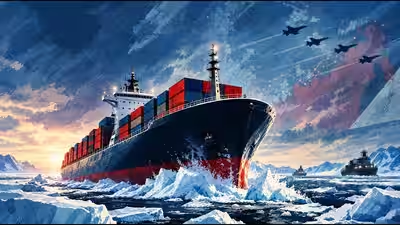
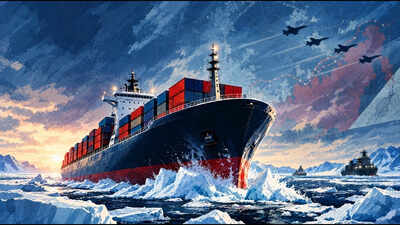
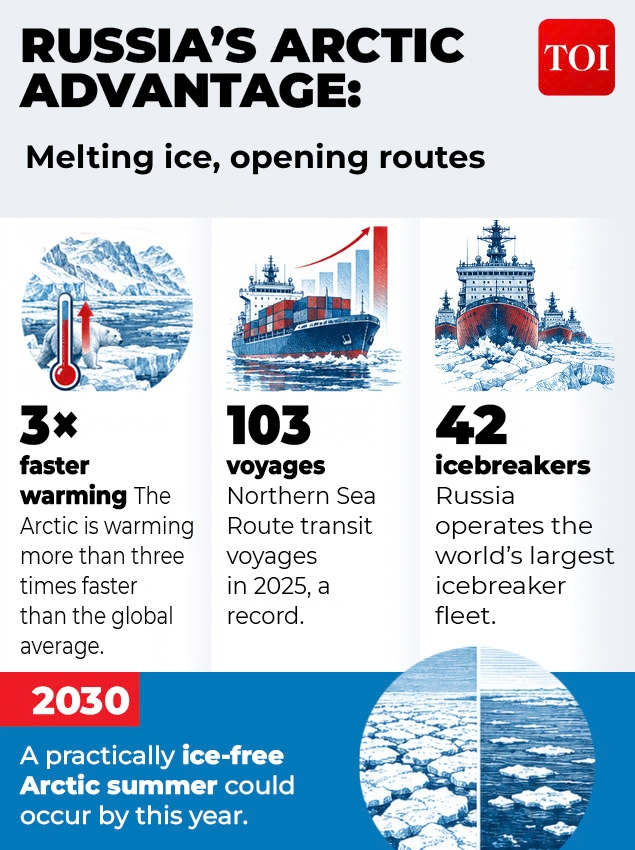
The Earth is heating up, but things may not go all south for Russia if it looks north.For most of the world, global warming is a growing calamity. But for Russia, the melting Arctic presents a more complicated picture. As rising temperatures threaten its environment and infrastructure, they could also open new shipping routes and access to resources long locked beneath the ice.The Arctic is warming more than three times faster than the rest of the world and may experience its first practically ice-free summer by 2030, according to the US department of defense’s 2024 Arctic strategy.This rapid transformation is reshaping the region’s strategic importance, as declining sea ice increases the viability of Arctic maritime transit routes and access to undersea resources.
How global warming could enhance Russian maritime navigation.
In 2025, commercial ships made more than 100 voyages along the Northern Sea Route and transported over three million metric tons of cargo, marking the highest figure on record.The frozen frontier is now becoming an increasingly accessible zone of geopolitical contest among major powers.
Nato 7 vs Russian Arctic fortress
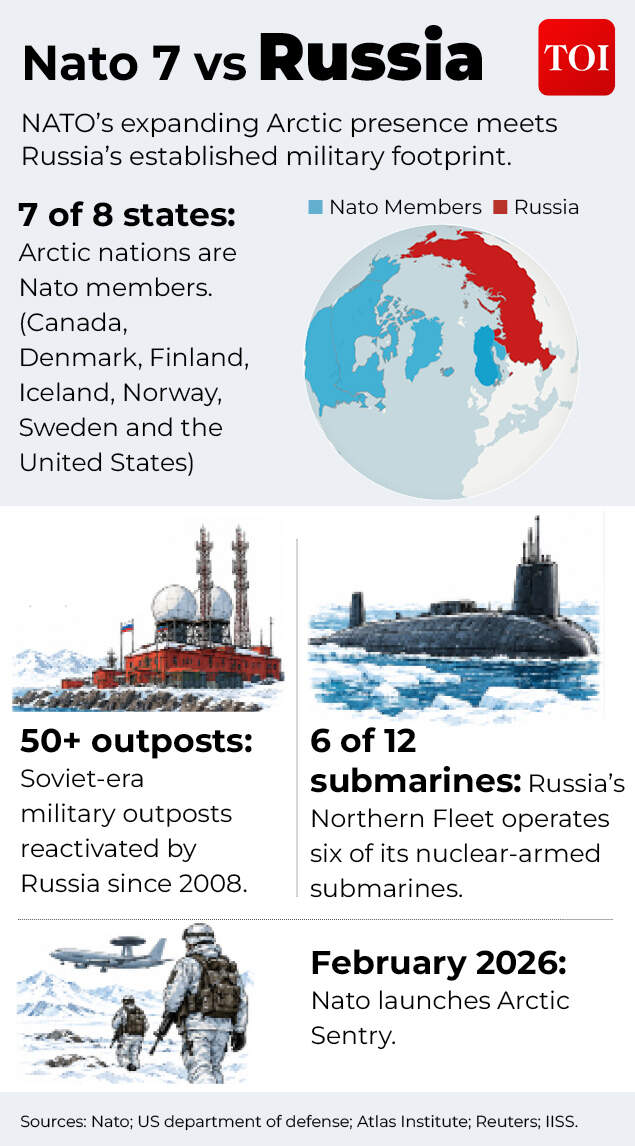
One of the Earth’s coldest regions is now becoming a military hotbed, with the US-aligned nations challenging Russia in a shared backyard.Speaking to the TOI, Prof Rajan Kumar, Professor at the School of International Studies, Jawaharlal Nehru University, pointed out the growing military tensions around the North Pole.“A key challenge in the Arctic is the growing militarisation and geopolitical contest as countries such as the US, Canada and Norway become more active around its rich resources”, Rajan said.Seven of the eight Arctic states, Canada, Denmark, Finland, Iceland, Norway, Sweden and the United States, are now Nato members (with Finland and Sweden joining in 2023 and 2024 respectively), greatly enhancing the alliance’s posture in the region.Only Russia remains outside the transatlantic alliance, creating what analysts describe as a “NATO 7 vs Russia” dynamic that has fundamentally altered Arctic security calculations.Moscow, on the other hand, maintains the largest Arctic territory and most developed regional military presence of all Arctic nations, as documented in the US department of defence Arctic strategy.
Russian dominance in the Arctic.
According to an analysis by the Atlas Institute, Moscow has reactivated more than 50 Soviet-era military outposts across the Arctic since 2008, and built up the capabilities of its northern fleet based near Murmansk.The Kola Peninsula hosts about two-thirds of Russia’s second-strike nuclear capabilities and is home to the northern fleet, which operates six of Russia’s 12 nuclear-armed submarines, according to Reuters reporting based on IISS Military Balance 2025 data.Russia has deployed advanced S-400 surface-to-air missile systems to strategic locations such as Franz Josef Land and Novaya Zemlya, significantly expanding its anti-access capabilities in the region.As per Reuters, the country hosts the world’s largest icebreaker fleet, consisting of 42 vessels that support the operation of the Northern Sea Route.NATO has responded to this changing landscape with significant institutional and military investments. In February 2026, the alliance launched Arctic Sentry, a multi-domain enhanced Vigilance Activity strengthening deterrence and defence across the Arctic and High North, according to NATO. The alliance also opened a third Combined Air Operations Centre in Bodo, Norway, in October 2025, and established Forward Land Forces in Finland in June 2026.The Greenland questionGreenland has emerged as a focal point of Arctic competition, with its location between Europe and North America making it strategically important for both Europe and North America in defence and space operations.US President Donald Trump’s interest in acquiring Greenland first became public in August 2019, but intensified significantly during his second term. In December 2024, President-elect Trump declared that “the ownership and control of Greenland is an absolute necessity”, AP reported.” The US laid its claim on Greenland because it saw the way the region’s politics was emerging”, Rajan said.“It wants to have a say in the region”, he added.After months of diplomatic tension, including Trump’s threats to use military force and impose tariffs on European nations, the US, Denmark and Greenland eventually signed a trilateral security agreement on 22 September 2026 at the UN General Assembly in New York.The agreement allows the US to “modernise and expand” operations at Pituffik Space Base (formerly Thule Air Base), establish two defence areas at Narsarsuaq and Mestersvig, and deploy the proposed “Golden Dome” missile defence system, according to CFR analysis.Yet, Russia’s growing military presence in the Arctic is only one aspect of the region’s changing strategic landscape. The warming that is making the Arctic more accessible also presents Moscow with economic opportunities and environmental challenges.
Boon and bane
For Russia, climate change can look like an opportunity as well as a threat.The idea that Russia could benefit from climate change emerged from climate-impact research and economic projections, then became part of Russia’s political and strategic narrative about the Arctic.
More to gain, more to lose.
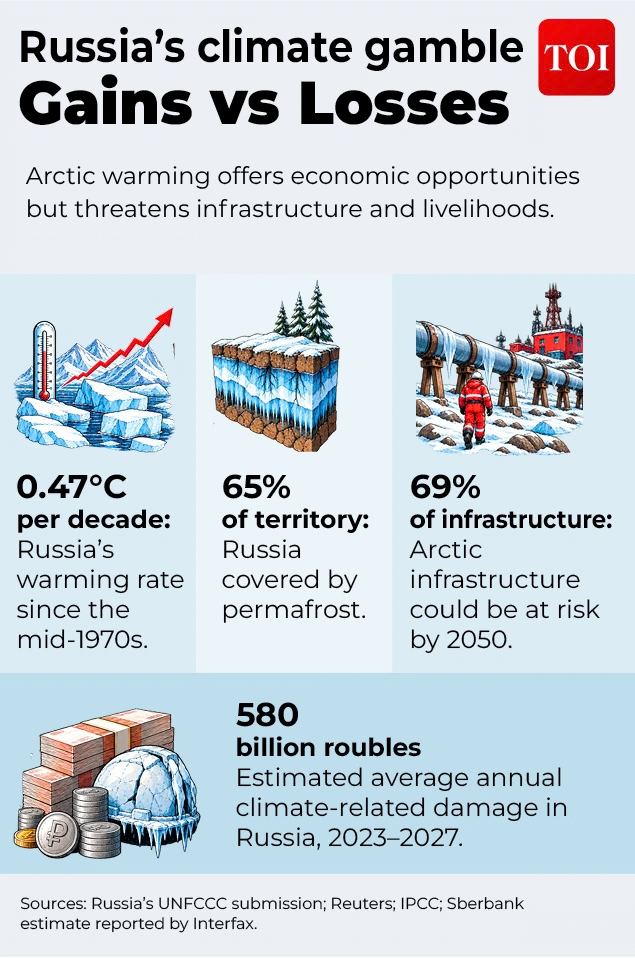
Its enormous northern territory, Arctic coastline and fossil-fuel reserves have encouraged hopes that warming could lower heating costs, expand agriculture and open new trade routes. Russia’s submission to the UN Framework Convention on Climate Change says the country has warmed by about 0.47°C per decade since the mid-1970s, roughly 2.5 times the global rate.The most visible opportunity is the Northern Sea Route along Russia’s Arctic coast. Retreating sea ice has shortened transit times and made the route more accessible, potentially helping Russia export oil, gas and minerals to Asian markets. However, more traffic also means greater risks from accidents, oil spills, black-carbon emissions, underwater noise and invasive species.Navigation remains difficult because of mobile ice, inadequate charting, costly insurance and limited search-and-rescue infrastructure.According to Professor Rajan: “While climate change initially offers Russia some economic advantages, there are significant risks involved, such as frozen bacteria and viruses being released, and (global) warming impacting the Siberian region, river systems, and permafrost.”So, while Russia gains in some ways, it will also incur losses due to global warming, Rajan said.Agriculture presents a similarly mixed picture. Warmer conditions could lengthen growing seasons and permit cultivation farther north. Yet temperature alone does not create productive farmland: many northern areas have poor soils, weak transport links and unstable ground.Meanwhile, Russia’s existing agricultural heartlands face worsening heat and water stress. The Moscow Times reported that summer rainfall in some southern regions fell 25 per cent between 1976 and 2022. Without stronger global mitigation, Krasnodar, Rostov, Stavropol, Astrakhan and Kalmykia could experience an additional 13–26 extremely hot days annually by mid-century.Permafrost thaw may impose the highest direct cost. Reuters reports that permafrost covers 65 per cent of Russia and supports homes and infrastructure used by more than 15 million people. A leading Russian permafrost scientist quoted by Reuters estimated that continued warming could cause seven trillion rubles, about $97 billion, in infrastructure damage by 2050. The Intergovernmental Panel on Climate Change (IPCC) projects that 69 per cent of fundamental Arctic infrastructure could be at risk by that year under a medium-emissions scenario, affecting more than 1,200 settlements, 36,000 buildings and four million people across the Arctic.Russia also faces an economic danger unrelated to physical warming: Global decarbonisation.The World Bank warns that declining demand for fossil fuels could reduce and destabilise Russian revenue from hydrocarbons and energy-intensive exports. It argues that Russia’s more durable opportunity lies in diversifying into renewable energy and other low-carbon industries rather than relying on continued fossil-fuel extraction.Russia could therefore secure limited gains from a warmer world, particularly in Arctic transport, heating and selected northern agriculture. But these benefits are conditional and uneven.Sberbank has estimated annual Russian climate damage could reach 580 billion rubles, or $6.7 billion, between 2023–2027.
Indian stakes in the Arctic
Russia’s efforts to turn a warming Arctic into an economic and strategic advantage also have implications for India. New Delhi’s 2022 Arctic Policy explicitly identifies the effects of melting ice on India’s economic, military and strategic interests, including global shipping routes, energy security and access to mineral resources.The policy rests on six pillars: Scientific research and cooperation; climate and environmental protection; economic and human development; transportation and connectivity; governance and international cooperation; and national capacity building.India is an observer in the Arctic Council and has established a research presence in Svalbard, including an atmospheric laboratory at Ny-Ålesund and a multi-sensor observatory in Kongsfjorden.Delhi’s policy also calls for greater participation in the Arctic Council and a better understanding of the region’s international laws, governance structures and geopolitics.But India’s interests extend beyond scientific research. The Northern Sea Route could offer an alternative to established shipping corridors during disruptions, although its distance from India and the challenges of Arctic navigation may limit its commercial appeal.“The Northern Sea Route could serve as an alternative if there are disruptions in the Suez Canal or the Red Sea. However, it is a much longer route for India compared with the Mediterranean route”, Rajan said.According to Professor Rajan, India could play a role, “either independently or in partnership with other countries”, in ensuring that the Northern Sea Route remains open and that no single country dictates access to it, in line with India’s stance on freedom of navigation.The rising mercury may be opening new routes across the Arctic, but as the ice melts away, it reveals a new contest over access, influence and control.