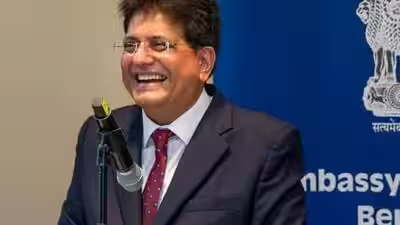
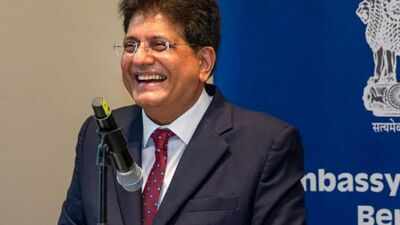
German companies are increasingly looking at India as a strategic base for manufacturing, research and development (R&D), and innovation, in addition to viewing it as an important consumer market, commerce and industry minister Piyush Goyal has said.Speaking to the media after completing his two-day visit, Goyal said he held several bilateral meetings with representatives of major German companies, including Siemens healthcare, Bertelsmann investment, Volkswagen and Skoda.“The CEOs echoed one message — German companies no longer see India only as a market, but as their partner, as a base for manufacturing, for research and development, for innovation,” he said.Goyal said the combination of German precision and research capabilities with India’s skilled workforce, talent and manufacturing potential could reshape global perceptions of the country. He also highlighted the opportunities arising from investments in India’s growth story.Around 2,000 German companies currently operate in India. The minister’s visit focused on exploring ways to expand trade and investment ties between the two countries, according to the news agency PTI.He said the bilateral relationship could facilitate not only trade in goods and services but also greater collaboration in talent development, innovation, co-creation, co-design, co-development and joint manufacturing.“The focus of this visit has been to translate this partnership to greater levels of investment, industrial cooperation, and research and development,” Goyal said.He added that the success of the India-European union free trade agreement (FTA) in the coming years would be reflected in increased business activity, new orders, higher investments and technology partnerships.Negotiations for the India-EU trade agreement were concluded in January. The pact is expected to be signed by the end of this year and could come into effect next year.
German companies plan to expand India operations
Goyal said German businesses were increasingly considering India as a manufacturing destination as they seek to lower costs and improve their competitiveness in international markets.“Today the greatest imperative before German industry is to cut costs and become more competitive in global markets. Therefore, they are looking at manufacturing in a much greater degree in India,” he said.He noted that German companies were also expanding their innovation and design activities in the country through existing centres and global capability centres (GCCs), which employ large numbers of skilled Indian professionals.According to Goyal, India has more than 2,100 GCCs employing millions of people. Their workforce ranges from a few hundred employees at smaller facilities to several lakh at larger centres.He said German companies were preparing for substantial expansions in India, with most planning to double or triple their operations over the next two to five years.Describing the level of interest among German businesses as significant, Goyal said deeper engagement could eventually lead to more joint innovation and product development.He also invited German research institutions to establish a stronger presence in India and take the partnership forward through greater scientific and technological cooperation.
India-EU FTA and CBAM
Goyal said the European union recognised India’s efforts to tackle climate change and its progress in meeting commitments under the Paris agreement, including achieving its intended nationally determined contributions ahead of schedule.He added that European countries were interested in collaborating with India on green hydrogen, financial assistance and other green initiatives.Addressing his comments on the EU’s carbon border adjustment mechanism (CBAM) at the Berlin global dialogue a day earlier, Goyal maintained that his remarks were based on facts. He also acknowledged that Europe had made considerable progress on environmental issues and said cooperation between Europe and India in this area was advancing rapidly.The minister had warned that the EU risked inviting “disaster” through the imposition of CBAM, questioning the historical responsibility of developed countries for climate change.“Who’s responsible for this (climate change) mess in the first place? Where did this ozone layer get damaged? Who sent all that carbon up there?” he had asked during the discussion.When another panellist responded that all countries shared responsibility, Goyal disagreed, pointing out that India accounts for around 17% of the world’s population but contributes less than 3% of global carbon emissions.Referring to the 2015 Paris agreement, he argued that developed countries, having benefited from decades of industrial growth, had agreed to bear a greater share of the burden and provide support to developing and less-developed nations.“Eleven years later, we haven’t seen a nickel or a dime of that. It’s all promises,” he said.Goyal also argued that European countries had contributed significantly to the climate crisis while relying on coal to maintain low energy costs during their industrial expansion.He stressed that India, meanwhile, was pursuing one of the world’s fastest-growing clean energy programmes.