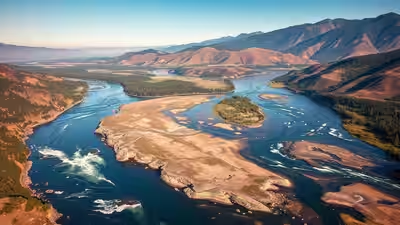
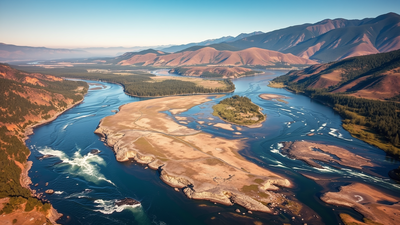
Removing four ageing hydroelectric dams from the Klamath River was always going to be a delicate undertaking, but one complication came from a source that had nothing to do with fish or river ecology at all: wildfire. The dams’ reservoirs had served for decades as a reliable water source for helicopters and fire crews battling blazes across the rugged, drought-prone Klamath Basin straddling the Oregon-California border. Removing that water meant the organisation overseeing the project had to build an entirely separate plan just to make sure regional firefighting capability would not be weakened at the exact moment the river itself was being restored to its natural course, all while the surrounding landscape continues facing its own worsening wildfire risk.
Why losing the reservoirs raised real firefighting concerns
According to the reports published by the Klamath River Renewal Corporation, residents near the four dams slated for removal voiced concerns about wildland firefighting efforts in the rural, mountainous watershed once the reservoirs disappeared, since crews battling wildfires had been taking water directly from those reservoirs for as long as the ageing dams had existed. The concern was straightforward: without a large, easily accessible body of standing water, aerial firefighting crews would lose a dependable dip point precisely in a landscape already considered highly vulnerable to fast moving wildfires.
How officials built a plan to keep firefighting capability intact
To address this, the Klamath River Renewal Corporation developed a dedicated Fire Management Plan working directly alongside CAL FIRE’s Siskiyou Unit and the Oregon Department of Forestry’s regional districts. According to the Klamath River Renewal Corporation’s own account of the plan, the fire plan was developed specifically to ensure that removal of the four lower Klamath River dams and their reservoirs would not reduce the region’s ability to effectively fight wildfires, and the plan has since been formally endorsed by fire agencies in both California and Oregon. Part of that plan involved identifying 96 separate aerial river access points along the river between Keno Dam and Interstate 5, locations where existing hydraulic conditions and vegetation clearings would allow helicopters to safely dip a snorkel or bucket into the water, with 41 of those points falling specifically within what had been reservoir footprints before removal.
What officials are doing to make sure those access points actually work
Simply identifying potential water access points on paper was not enough on its own, since restoring the river to a free-flowing state changes the physical landscape around those same locations. According to the Klamath River Renewal Corporation, restoration crews planned to plant vegetation at two aerial river access points within each former reservoir footprint in a way that would leave a wide enough berth for helicopters to safely operate, while also constructing a permanent dip tank near Copco Lake along with up to five additional portable dip tanks to further support aerial firefighting efforts once the reservoirs themselves were gone. This careful, deliberate re-engineering of specific stretches of the restored river reflects just how seriously fire agencies treated the loss of the reservoirs as a genuine operational risk rather than a minor inconvenience.
Why the wider Klamath Basin remains such a high wildfire risk area
The concern over firefighting water access sits within a much broader pattern of worsening wildfire activity across the entire Klamath Basin. According to a federal wildfire risk reduction announcement covering the region, catastrophic wildfires have damaged or degraded ecosystems and communities across five national forests within the Klamath Basin, a trend officials expect to continue as the regional climate grows hotter and drier. The same announcement noted that a changing climate’s effects on hydrology and wildfire activity are actively degrading fish habitat in the basin, including through post fire landslides, directly tying the region’s fire risk back to the same river restoration and salmon recovery efforts the dam removal project was designed to support in the first place.
How a single wildfire has already tested the restoration effort
The interaction between fire and the Klamath’s restoration is not merely theoretical, it has already played out directly on the ground. According to a research project summary published by the US Geological Survey’s Southwest Climate Adaptation Science Center, the 2022 McKinney Fire burned twelve kilometres of riparian habitat along the river, damaging populations of sandbar willow, a plant central to the Karuk Tribe’s traditional basketweaving practices, at the same time that decades of dam driven disruption to natural river flows had already reduced the willow’s abundance and made it harder to access. USGS-funded researchers are now studying, in coordination with the Karuk Tribe, exactly how dam removal, high-intensity fire, invasive species and active restoration work together to shape the willow’s recovery, using the timing of the broader dam removal project as a natural opportunity to track these combined effects as they unfold.
Why fire and river restoration are now inseparable parts of the same story
What emerges from these overlapping efforts is a river system where wildfire risk and ecological restoration cannot really be treated as separate problems any longer. Removing the dams addressed a longstanding ecological crisis, reconnecting salmon to habitat they had been cut off from for a century, but it also required fire agencies to rebuild, from scratch, the practical firefighting infrastructure the old reservoirs had quietly provided for decades. At the same time, the same fires the region remains vulnerable to are actively shaping how quickly and how well the restored river’s ecosystem, from salmon runs to culturally significant plants like the sandbar willow, is able to recover. The Klamath’s transformation, in other words, is no longer simply the story of dams coming down, it is increasingly the story of an entire river landscape learning to manage fire and water together, in a basin where both now shape the other’s future in ways researchers are still working to fully understand.