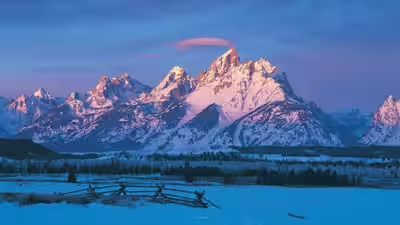
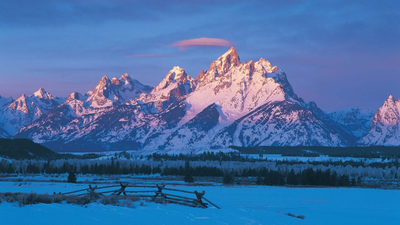
The Farmer’s Almanac has released its 2026–2027 winter forecast, predicting a “cold, snowy at times, and breezy” season for Wyoming and the Rocky Mountain region. However, local meteorologist Don Day is warning people not to put too much trust in such long-range forecasts released during summer.Speaking to Cowboy State Daily, Day criticised the methods used for making very early seasonal predictions. He called the approach “voodoo magic” and said people should be careful about believing detailed winter forecasts made in August.“I’m not going to follow the herd into slaughter this time,” Day said. “The Farmer’s Almanac does what the Farmer’s Almanac does. The National Weather Service will do what they do, and people on social media can post every computer model that they want, but I’m not going there yet.”Day says the main problem is that many of the atmospheric conditions that will shape winter have not developed yet. He also points to last year’s forecasting mistakes as a reason to remain cautious.
Lessons from a failed forecast
Day’s warning comes partly from what happened during the 2025–2026 winter. In August 2025, he predicted significant cold and snowfall across Wyoming. Instead, the state experienced a winter that was unusually warm and dry.“That’s the cautionary tale,” Day told Cowboy State Daily. “We had 90 blocking patterns this winter. Nobody anticipated that, and no models predicted it. Simply put, our models fail.”The blocking patterns were long-lasting areas of high pressure that pushed winter storms away from Wyoming. Snow and cold were instead directed toward the eastern United States, while much of the West experienced a long dry period.“This summer was a hangover from last winter, especially through July,” Day said. “Last winter, all our weather went north. A really strong El Niño can direct all the storms south. That is a concern.”By November 2025, the expected snowfall had not arrived. The following months also stayed warmer than normal and received less precipitation than usual.
A strong El Niño will shape the winter
The main influence on the 2026–2027 winter is expected to be a very strong El Niño developing in the Pacific Ocean. El Niño often brings more moisture and colder weather to some parts of North America, but Day says it is still unclear exactly where the storms will travel.“We’re definitely going to have this very strong El Niño,” Day said. “It’s going to be the dominant factor this winter, but it’s not the only one.”The biggest question is whether the storm track will pass through Wyoming or move around the state.“The El Niño can be so strong it shifts the storm track to our south,” Day explained. “The enhanced rain and snow you can get in the winter can bypass Wyoming. It can just miss.”If the storm track moves farther north, Wyoming could instead receive a lot of snow. But Day says it is too early to rely heavily on computer models or comparisons with past El Niño winters.“The north-south extent of the El Niño signal is a real concern I have,” Day said. “It’s really too early to glob onto and go all-in on either a model-driven forecast or what we would call an analog forecast of looking at El Niños from the past.”
Several atmospheric factors are changing
Day compares seasonal forecasting to a chess match because the conditions can change as winter approaches.The 2025–2026 winter began with a weak La Niña, while the coming winter will be dominated by a very strong El Niño. Another important factor, the quasi-biennial oscillation (QBO), was in an easterly phase last year but is expected to be in a westerly phase this winter.Temperatures at both the North and South Poles are also currently colder than they were at the same time in 2025.“What we can say about the upcoming winter is that it does not look like we have all of the big players that we had last winter,” Day told Cowboy State Daily. “El Niño is going to be the quarterback and head coach this winter, bar none. There are other players involved, but that’s why we’ve got to understand these players and those that aren’t going to come off the bench until a little bit later on.”
Long-range forecasts have limits
Even during normal El Niño winters, snowfall and precipitation are rarely spread evenly across Wyoming. High-pressure systems can become stuck over central Canada between December and February, creating long-lasting weather patterns that can produce very different conditions in different parts of the state.“If you take a critical look at El Niños in Wyoming, it’s extremely rare that the entire state benefits from it,” Day said. “If we do get into stubborn holding patterns, El Niños can be feast or famine, and Wyoming is a big state.”Because small changes in the atmosphere can make early forecasts inaccurate within weeks, Day plans to wait until around mid-to-late September before releasing his official winter forecast for Cowboy State Daily. By then, the effects of Pacific Ocean temperatures should be clearer.“I’m not going to include the Farmer’s Almanac,” Day said. “They’re either taking models verbatim, or they’re taking El Niños that have occurred in the past. These approaches aren’t necessarily wrong, but I don’t think that’s the right way to approach the winter forecast when we’re still on the backside of summer.”Day says people should remain skeptical of detailed winter forecasts released in August.“A lot of things that are going to drive this winter, in addition to El Niño, aren’t going to really start showing themselves until we get deeper into fall,” he said. “I am not going to go there yet. I’m not setting expectations. We need to be patient.”He added: “I don’t know what voodoo magic they use to get their forecasts. I don’t think we should be talking about any detailed winter forecast till maybe mid to late September. Until then, it’s not helpful for anybody.”