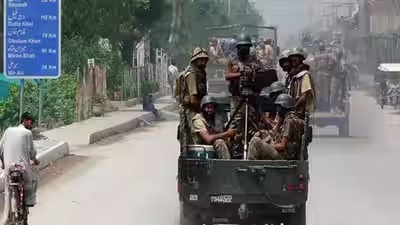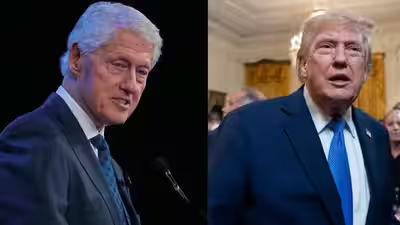
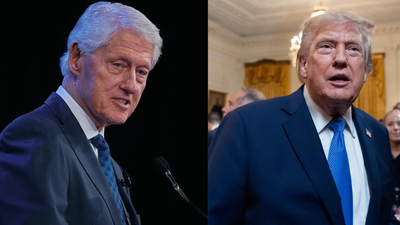
When then-US President Bill Clinton arrived in Islamabad, Pakistan, in March 2000, a decoy aircraft bearing Air Force One markings landed in view of the media, followed by a Secret Service agent resembling Clinton. An unmarked aircraft then landed, carrying the president, who disembarked from it.Susan Page, a White House reporter for USA Today at the time, was among a small group of people who knew about the operation.Before Clinton’s flight from India to Pakistan, White House officials summoned Page, who was then president of the White House Correspondents’ Association, for an off-the-record briefing. White House press and security officials told her about the operation, including Clinton’s location and the safety measures in place for journalists travelling with him, Page told The Washington Post in messages.The briefing meant that at least one journalist travelling with the presidential press corps knew that Clinton would not be aboard Air Force One.“They told me about the extraordinary security procedures being taken because of the dangers in flying there, including use of the decoy plane,” Page was quoted as saying by The Washington Post. “Of course, the dangers threatened the journalists covering the trip as well as President Clinton.”“I haven’t spoken about this episode before, because of the off-the-record ground rules of that discussion,” Page said through a text message. “But since more than a quarter-century has passed — and since the ruse became evident as soon as President Clinton disembarked in Pakistan — I think it’s OK for me to relay it now.”The White House press pool is a rotating group of journalists responsible for reporting on the president’s activities and sharing reports, photographs and video with the wider press corps. The formal system has been in place since 1937, although the White House first used a pool reporter in 1881 after President James Garfield was shot.Associated Press reporter Franklin Trusdell was stationed outside Garfield’s room, monitoring his condition and sharing updates with other journalists.The system is intended to ensure that a member of the press is present to observe the president’s movements and activities, providing the public with an independent account.
Trump left, others stayed
More than 25 years later, the White House faced a similar security challenge but handled the press differently. Last month, security personnel in Turkey secretly moved President Donald Trump from an aircraft marked as Air Force One to a smaller, unmarked Air Force plane using an airport catering truck. The operation was prompted by a credible Iranian threat to Trump, The Washington Post reported.More than 100 aides, officials and journalists remained aboard the larger Air Force One and continued flying towards Britain, most of them unaware that Trump had secretly switched aircraft on the tarmac, according to a US official.As the aircraft swap took place, reporters aboard the plane were instructed to keep their window shades lowered.Secretary of state Marco Rubio and treasury secretary Scott Bessent, who had accompanied Trump at the Nato summit in Ankara, were among those who stayed aboard the blue-and-white Boeing 747. Other White House staff, military personnel and members of the press also remained on the aircraft, most of them unaware of Trump’s whereabouts.
Trump acknowledges plane switch
US President Donald Trump has confirmed that he was moved to another aircraft while leaving Turkey last month, saying he followed instructions from the Secret Service and military after being told that the plane he had initially boarded faced a “greater risk”.“I go by Secret Service and the military. They wanted me to go on a different flight, a different plane… I do what they say… I guess there was a threat out there. I didn’t really ask too much about it. I get a lot of threats,” the US president said.“I think actually the plane that I flew on was at greater risk! I think it was at greater risk because that would be the plane, I think that they would be more likely to go for it,” Trump added.