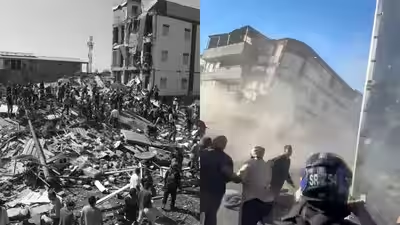
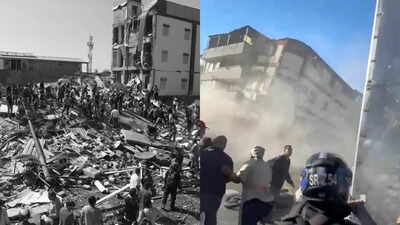
A powerful earthquake struck western Colombia on Monday, causing injuries and significant damage across several cities, including Quibdo, Pereira and Cali, while disrupting operations at multiple airports. The tremor was felt in the capital Bogota and as far away as neighbouring Venezuela and Ecuador.The earthquake caused significant damage across western Colombia with at least 47 dead with estimates stating that it could cross 1,000 in the coming days. 18 people have been reported dead in Pereira, according to the city’s mayor while at least three killed in Manizales, their mayor told Blu Radio, as quoted by Reuters. Meanwhile, one person died in Buenaventura, Colombia’s main Pacific port; while several people are trapped in building collapses. In Cali also, 20 buildings collapsed, with people reported trapped inside, the city’s mayor said.Later, 27 people in the Valle de Cauca department were reported dead, where Colombia’s third-biggest city, Cali, is located.Damage was reported at airports in Pereira, Manizales, Quibdo, Armenia, Cartago and Buenaventura, where air operations were suspended, Colombia’s aviation authority said.The United States Geological Survey (USGS) and Colombia’s geological service reported the earthquake at magnitude 7.4. The epicentre was near San Jose del Palmar, about 400 km west of Bogota, at a depth of 96 km (60 miles).Read more: Buildings collapse, panic grips residents as quake shakes Colombia – 10 visuals that capture horrorColombian President Abelardo de la Espriella said in a post on X that he will personally supervise recovery efforts and install an emergency center in San Jose del Palmar. “I have directly assumed leadership of the emergency response in San José del Palmar. I have ordered the establishment of a Unified Command Post to coordinate the attention to the damages and the affected individuals. I have requested from the director of the UNGRD a detailed report on the situation and the most urgent needs. I will also be personally in Pereira to accompany the affected people and verify the Government’s response,” he said (translated from Spanish)Choco Governor Nubia Carolina Cordoba-Curi said there were injuries and significant damage to buildings in the provincial capital, Quibdo, while authorities began assessing the impact. She also warned of possible aftershocks. “We have just experienced a major earthquake in the departmentof Choco. We are concerned about aftershocks. Although the epicenter was near San Jose del Palmar, there are injuries and significant damage to buildings in the capital, Quibdo. We are already carrying out a damage assessment and will issue the first official report shortly,” governor Nubia Carolina Cordoba-Curi said on X.
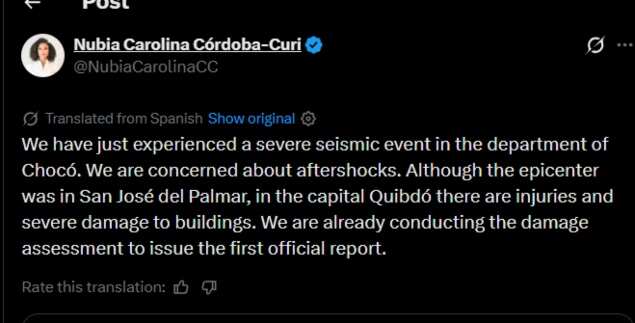
Governor of Chocó gives update on earthquake
Additionally, the governor of neighboring Risaralda province, Juan Diego Patino, told local Blu Radio there was “serious damage to some buildings” in Pereira, the provincial capital. “What has just occurred is very severe. The images are truly shocking, with people injured and building facades collapsed,” he said.Meanwhile, Bogota’s mayor, Carlos Galan, said on X there was no major damage in the capital.Five platoons of rescue soldiers are being deployed to areas across Colombia that may require attention following the earthquake this morning, the Colombian Army said in a post on X. “With specialized search and rescue capabilities in collapsed structures, our soldiers have high-precision technological means and canine binomials trained for the specific search for people.”“We keep our capacities available to respond in a timely manner and protect the lives of Colombians,” it added.More than 2 million people were exposed to very strong shaking during the earthquake in Colombia, according to the US Geological Survey (USGS). The shaking, rated 7 out of 10 on the USGS scale, could cause “considerable damage in poorly built structures” and slight to moderate damage to well-built buildings, reported CNN.Zarzal, Pereira and Armenia were among the most populated cities likely affected. USGS estimated the widespread damage could result in “significant casualties”, with roughly a one-in-three chance that fatalities could exceed 1,000.