

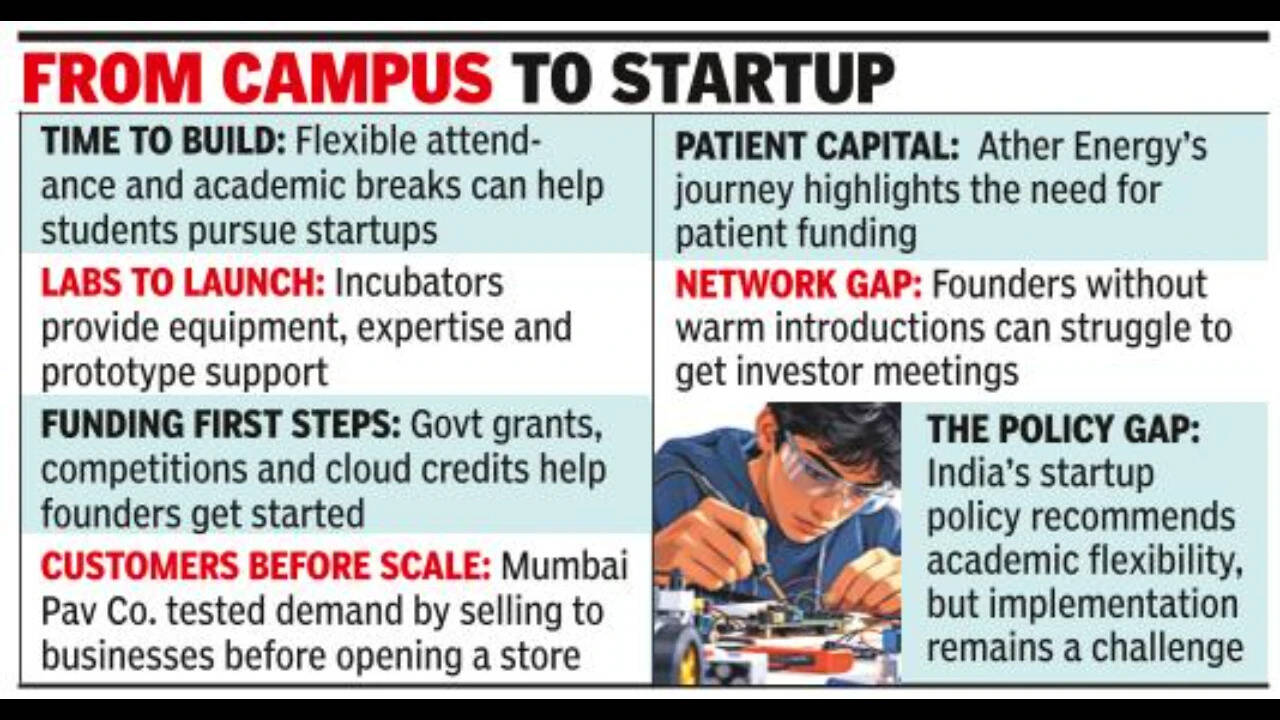
BENGALURU: Classrooms have been carved out of office space inside a WeWork building on Bannerghatta Road in Bengaluru. A postgraduate timetable runs from noon to 8 pm, fitting study blocks around time for building businesses. Shrey Doshi (25), a postgraduate alumnus, walks in with a blue drink. “That’s my product. Try it,” he says, before explaining the blue spirulina and tender coconut.This is Mesa School of Business, where students must build businesses and find paying customers. Elsewhere, engineering clubs and laboratories offer another route into entrepreneurship. Across campuses, the support founders need ranges from time away from classes to equipment, early funding and introductions to buyers.“The clearest difference comes from two things: time to build and access to infrastructure,” said Richa Bajpai of Campus Fund, which invests in student-led businesses. She cited BITS Pilani’s attendance flexibility and option to take time off to build as reasons it remained among the leading institutions supplying pitches to her fund. “Students who start companies still face rigid exam schedules and attendance rules that force a choice between their degree and their company,” she said.
Incubators also give young companies access to equipment they could not afford themselves,
Colleges also need to let students learn across disciplines, she added. For technical businesses, support can be tangible. IIT Jammu gave MachFly Aerospace labs, resources and early financial support to build its first prototype, Bajpai said. Incubators also give young companies access to equipment they could not afford themselves, professors with domain expertise and alumni with industry experience, she said.Bajpai points to govt grants, competitions and cloud credits as starting points for founders without family money or business connections. She also cited Human Biogenesis, whose founders came from humble backgrounds and started at BioNEST, IIT Guwahati’s incubator.The company has since completed clinical trials, raised aseed round and is moving into production, she said. At IIT Madras, director V Kamakoti described Centre for Innovation as “run by the student for the student”. Design clubs can feed into prototype development, with incubators, faculty and alumni supporting student teams. Citing Ather Energy’s journey, he spoke of “12 to 13 years of gestation” and the need for patient capital.Other businesses can test demand sooner. Campus Fundbacked Mumbai Pav Co began with Mesa classmates Tanay Agarwal and Jash Arora making food in another operator’s kitchen and selling to business customers before opening a store, Agarwal said. He already knew his family’s restaurant businesses; Arora brought culinary training. Access is uneven. Mesa’s advertised four-year undergraduate programme costs Rs 48 lakh, excluding accommodation and overseas immersions. It does not award a university degree.