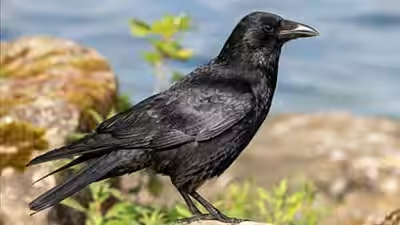
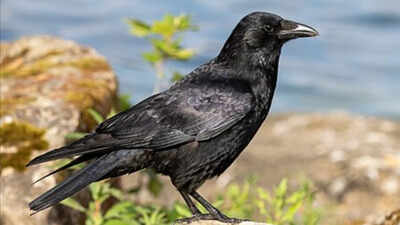
What goes through an animal’s mind when it sees something moving in front of it? Whether it is a bird spotting a potential meal, trying to avoid an obstacle while flying, or simply following the movement of another animal, its visual processing and ability to assess what it sees are crucial for making decisions about prey and possible threats. Sometimes, the difference between responding in time and missing an opportunity by a moment comes down to a fraction of a second.Researchers studying carrion crows have found that these birds make visual decisions at roughly twice the speed previously observed in humans and monkeys, taking just 235 milliseconds on average. This is a remarkable speed, particularly when compared with the time humans and other primates typically take to complete similar tasks.The findings come from a study published in the journal Science on October 22, 2026, titled “Ultrarapid decision-making in an avian brain.” Researchers Philipp Schmidbauer and Professor Andreas Nieder from the Institute of Neurobiology at the University of Tübingen in Germany investigated how quickly carrion crows could interpret visual information and make a decision based on what they saw.
A simple task that required a quick decision
To understand how the experiment worked and what the researchers concluded, first, imagine looking at a screen with dots in motion and being asked to decide which direction most of these dots are travelling towards: left or right? While the question is rather direct and simple, discerning the precise movement of the dots, let alone understanding the full pattern of their movement, can be quite a task. But this is essentially what the researchers asked the crows to do.The experiment involved two male carrion crows (Corvus corone) that were presented with moving dots on a touchscreen and had to determine whether the majority of the dots were moving towards the left or right. They indicated their response by pecking at a target on the corresponding side of the screen. The researchers also varied how clearly the dots indicated a particular direction, making some patterns easier to interpret than others. When the direction was relatively clear, the birds were not only remarkably quick but also accurate. Even when the patterns were more difficult to distinguish, their decisions were better than a random guess.
What happens inside a crow’s brain?
But the researchers were interested in more than simply finding out how quickly the birds could complete the task. They also wanted to comprehend what was really happening in the birds’ brains and how they arrived at their decisions. Therefore, to investigate this, the team recorded the activity of individual neurons in a region of the crow’s brain known as the nidopallium caudolaterale, which plays an important role in information processing and decision-making.One of the more fascinating findings was that the researchers could identify signals associated with the birds’ eventual choices just 70 milliseconds after the moving dots appeared on the screen. This was nearly 170 milliseconds before the birds even physically responded by pecking at their chosen target. To put it simply, their brains seemed to already be showing signs of which direction the crows would select long before the birds made their responses visible.As the birds continued to assess the pattern, the activity of the brain neurons was just as fascinating, as it gradually increased until it reached a threshold associated with making a decision. When the visual evidence was stronger, the birds had more information to work with, allowing their brains to arrive at a choice.This process of decision-making has already been observed in humans and other primates, where the brain gradually gathers sensory information before reaching a particular threshold and settling on a choice.
Quick decision-making
Birds and mammals have evolved very different brain structures, and one of the distinctions is that birds do not possess the same layered cerebral cortex found in mammals. The findings suggest that, despite their structural differences, birds and primates can rely on comparable underlying processes when it comes to making decisions.According to Professor Andreas Nieder, the neuronal activity observed in the crows was consistent with established models of decision-making in humans and non-human primates. The difference, however, was the remarkable speed at which the birds completed the task.These findings reveal to us that perhaps a lot more fast-paced thinking is happening behind those watchful eyes than science had previously asserted. And while scientists still have questions about exactly how the crow’s brain achieves this speed, the study adds another interesting piece to our understanding of how very different animal brains can arrive at surprisingly similar decisions, even if the speed may differ.