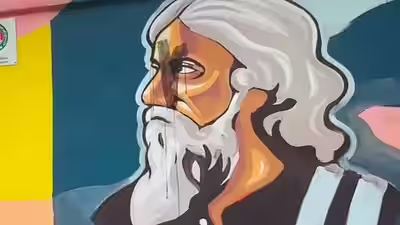
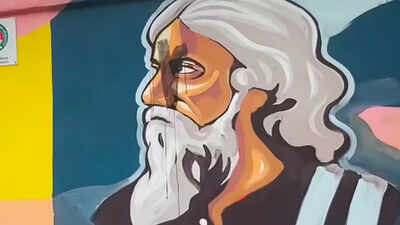
“Where the world has not been broken up into fragments by narrow domestic walls.”More than a century after Rabindranath Tagore penned these lines in Gitanjali, Marzia Khandaker Rimi, a senior leader of Bangladesh’s Rashtra Sanglap Forum, smeared black ink across his portrait in Dhaka, declaring that the poet was Indian and his image should be erased. Clearly, domestic as well as international walls exist, and going by the evidence, they may be hardening further, with prominent leaders of the July uprising expressing concern over growing Jamaat influence in the country.The Rashtra Sanglap Forum emerged after Bangladesh’s July 2024 uprising. On October 10, Rimi joined others outside Bangladesh Shilpakala Academy to protest what she called “Indian aggression”. She also alleged that Tagore mistreated Muslims while managing his family’s estates. Rimi was among four people subsequently arrested, including another leader of the forum, ANM Ayas. The incident has reopened old faultlines over what Tagore means to Bangladesh.On October 11, Nurul Haque Nur, Bangladesh’s state minister for expatriates’ welfare and overseas employment, described the defacement as a “communal Jamaati misdeed”. The prime minister’s political assistant, Rashed Khan, went further. He accused Jamaat of orchestrating the defacement and alleged that an adviser to its chief had financed materials used by the protesters.Bangladesh Jamaat-e-Islami assistant secretary general Ahsanul Mahboob Zubair demanded the withdrawal of the case and the immediate release of all four accused. He described the incident leading to their arrest as trivial and alleged that sections of the administration were using such cases to harass forces associated with the July uprising. At an October 14 court hearing, following a heated exchange, bail was rejected and the accused were sent to jail.
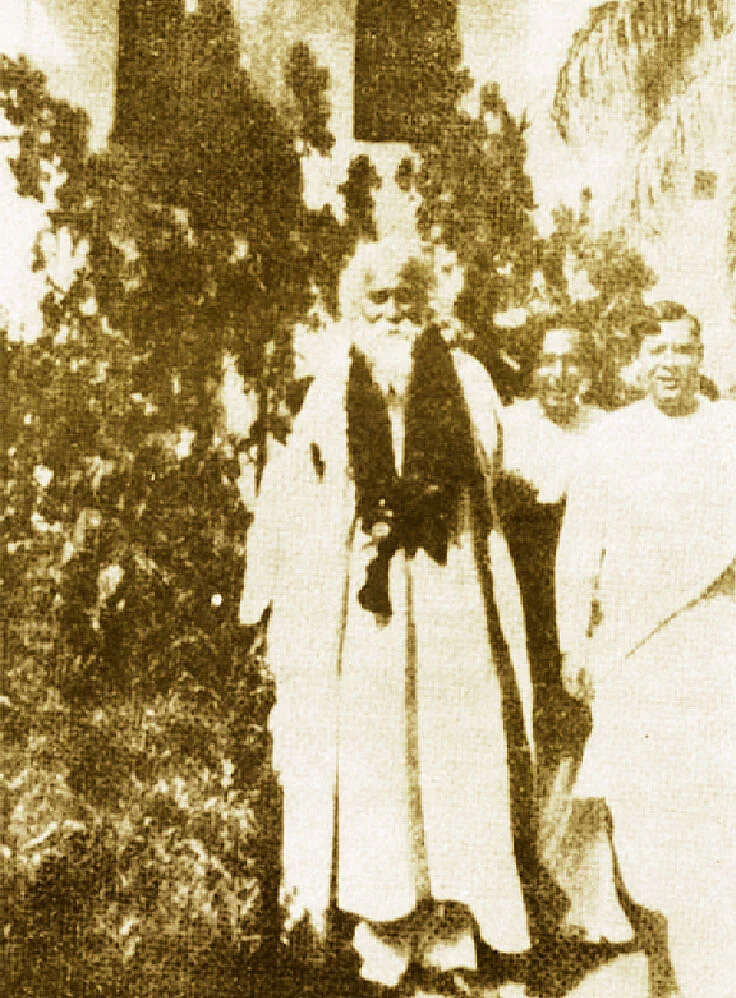
Rabindranath Tagore in Dhaka in 1926 (Wikimedia Commons)
The portrait that triggered the controversy was one of ten commissioned by Dhaka South City Corporation (DSCC) for a footpath beautification project. The others included Kazi Nazrul Islam, Satyajit Ray, Ishwar Chandra Vidyasagar and Zainul Abedin, the celebrated Bangladeshi artist who had defended Tagore during the East Pakistan era. On October 13, the corporation added portraits of Begum Rokeya Sakhawat Hossain, a pioneer of women’s education, and poets Jibanananda Das and Jasimuddin. It removed the portrait of singer and journalist Sanjib Choudhury.The attack itself was aimed at the man who wrote Amar Sonar Bangla, Bangladesh’s national anthem. Writer and journalist Amin Al Rashid, who researches the life and work of Jibanananda Das, sees the incident as part of a broader political development since the July 2024 uprising. He points to what he describes as attacks on Bangladesh’s Liberation War legacy, Sheikh Mujibur Rahman and the Constitution, alongside the growing influence of religious extremism.“Turning a poet who died before India and Pakistan even came into existence into a villain in today’s Bangladesh suggests a far-reaching political agenda,” he told TOI.Rashid questions whether the attack can be explained simply as opposition to India. Those involved, he notes, would themselves have sung Tagore’s Amar Sonar Bangla at school assemblies and studied his poems and stories.Concerns about Bangladesh’s political direction have also been voiced by Mahfuz Alam, a prominent leader of the July 2024 uprising and former adviser to Muhammad Yunus’s interim government. In a Facebook post on October 15, Alam warned that the country had boarded the train of far-right politics. Alam also accused sections of secular civil society of aligning with Jamaat-e-Islami and its student wing, Islami Chhatra Shibir, in opposition to the BNP, warning that they would eventually pay a political price for it. His remarks concerned Bangladesh’s broader political trajectory rather than the Tagore incident specifically.
Not the first attack on a cultural symbol
The Dhaka incident was not the first time Tagore’s image had been blackened in Bangladesh in recent years. In April 2025, a mural of the poet at Kumarkhali in Kushtia district was found defaced with black paint. It was subsequently restored by local authorities. Two months later, another controversy erupted at a site associated with Tagore. On June 10, 2025, a crowd stormed the Rabindra Kacharibari complex at Shahjadpur in Sirajganj district, damaging an auditorium, doors and windows.A more direct attack on a cultural institution occurred in December 2025. In the early hours of December 19, a mob stormed Chhayanaut’s cultural complex in Dhaka’s Dhanmondi, ransacking offices and classrooms, destroying musical instruments and books, and setting parts of the premises on fire. The attack occurred amid unrest following the death of political activist Sharif Osman Hadi. Some witnesses reported that attackers accused Chhayanaut of promoting Indian culture and argued that it had no place in Bangladesh.
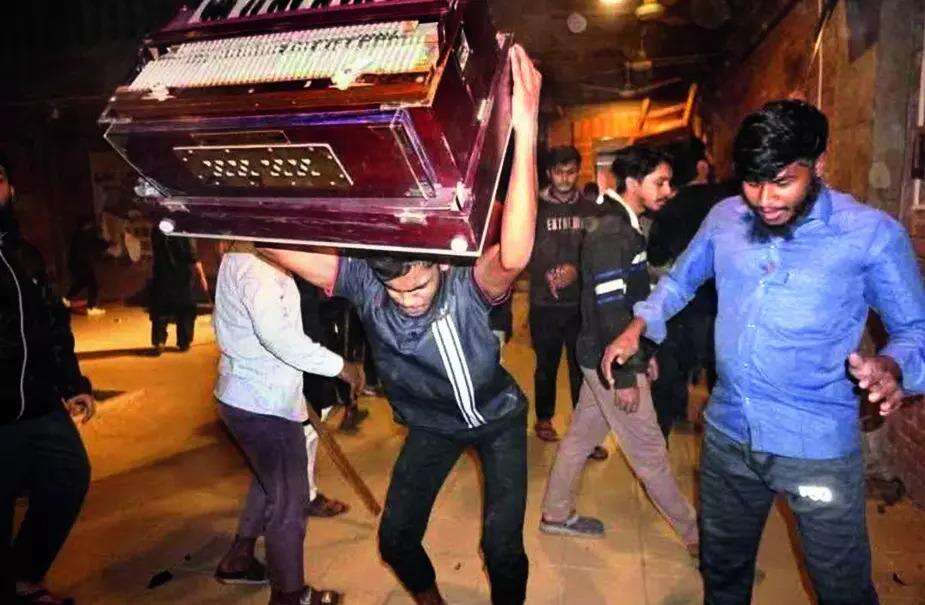
Chhayanaut, set up on Tagore’s centenary, was vandalised in Bangladesh (File Image)
The hostility towards Tagore has surfaced beyond Dhaka as well. On October 11, a day after the Segunbagicha incident, Hasibul Islam Maruf, president of the Chhatra Dal unit at Bandherhat Abdul Malek Ukil Degree College in Noakhali, posted a photograph on Facebook showing Tagore’s image beneath his feet. The district leadership of Chhatra Dal, the student wing of the Bangladesh Nationalist Party, issued him a show-cause notice and expelled him from his organisational position on October 13.
A division older than Bangladesh
Tagore’s legacy has long been contested, with many of his alleged actions and omissions coming under scrutiny. In 1905, Lord Curzon partitioned Bengal. Tagore opposed the division, joined the Swadeshi movement and composed Amar Sonar Bangla during the campaign. But many Muslims in eastern Bengal welcomed the new province of Eastern Bengal and Assam, believing it could improve their educational, administrative and political opportunities.Historian Semanti Ghosh examines these competing aspirations in Different Nationalisms: Bengal, 1905–1947 (Oxford University Press, 2016). She argues that Muslim support for partition cannot simply be dismissed as communalism. The political aspirations of eastern Bengal’s Muslims, she suggests, were not adequately accommodated within the anti-partition movement.Tagore’s detractors have long claimed that he opposed the establishment of Dhaka University, founded in 1921. A widely circulated allegation places him at a protest meeting in Calcutta on March 28, 1912. An investigation published by bdnews24 found that he was then at Shilaidaha, recuperating from illness, and wrote from there that day to educator Jagadananda Roy describing his health.Bangladeshi novelist and short-story writer Mozaffar Hossain recalls encountering an extraordinary rumour while growing up in the 1990s: that Tagore had secretly fed Kazi Nazrul Islam a poisonous fruit to drive him insane, supposedly to eliminate a literary rival and secure the Nobel Prize. The chronology alone demolishes the claim. Tagore won the Nobel Prize for Literature in 1913. Nazrul’s first published poem, Mukti, appeared in 1919.Hossain sees such stories as examples of how communal prejudice can survive despite readily verifiable facts. “The language of hatred does not follow logic,” he told TOI, arguing that hostility towards Tagore has often been shaped less by engagement with his writing than by attempts to set him against Nazrul.
When Pakistan tried to silence Tagore
After 1947, East Bengal became part of Pakistan, a state whose national identity was founded principally on religion. Its eastern wing, however, shared its language and much of its literary inheritance with West Bengal. In a 2008 study, scholar Anisuzzaman documents how sections of East Pakistan’s intellectual establishment questioned Tagore’s place in the new country’s culture. In 1951, poet and scholar Syed Ali Ahsan argued for a literary identity consistent with Pakistan’s Muslim character, even if that meant rejecting Tagore.Opposition was not limited to religious conservatives. Some Marxist intellectuals also criticised Tagore as bourgeois and insufficiently revolutionary. After the Bengali Language Movement of 1952, the poet’s music and literature increasingly became symbols of the cultural inheritance that Bengali-speaking Pakistanis sought to preserve. His birth centenary in 1961 was celebrated despite official resistance. Those celebrations helped give rise to Chhayanaut, now one of Bangladesh’s best-known cultural institutions.On June 22, 1967, information and broadcasting minister Khawaja Shahabuddin announced that songs considered inconsistent with Pakistan’s cultural ideology would not be broadcast, while the airing of other Tagore compositions would be reduced. The decision exposed divisions among East Pakistan’s intellectuals over whether Tagore was indispensable to their cultural identity.Hossain points to this episode as evidence that hostility towards Tagore did not begin with the latest political upheaval. He argues that communal prejudice has long influenced cultural debates in the region.“It is not new, but it has now taken a more organised form,” he says. In his assessment, political and religious antagonisms have increasingly entered artistic and literary spaces, making it harder to discuss cultural figures on the merits of their work.In 1968, Anisuzzaman edited Rabindranath, an anthology of 30 essays by East Pakistani writers and scholars. Zainul Abedin drew Tagore’s portrait for the book. The connection with the latest incident is striking. The same artist who drew Tagore’s portrait amid the 1967 controversy was among the cultural figures depicted alongside him on the vandalised Dhaka wall. In a 2025 paper in Ethnomusicology Forum, Sahana Bajpaie argues that performing Rabindra Sangeet helped articulate a cultural identity that could challenge the religious framework promoted by Pakistan’s rulers.Amar Sonar Bangla, written during the anti-partition movement of 1905, acquired a new political significance in East Pakistan. Filmmaker Zahir Raihan used it in his 1970 film Jibon Theke Neya, a satire widely understood as a critique of Pakistan’s political order. The song was performed at the swearing-in of Bangladesh’s provisional government on April 17, 1971, and became the national anthem after independence. Article 4 of the Constitution recognises its first ten lines as the anthem.
Turmoil in Bangladesh over Tagore
In a January 2026 paper in the International Journal of Asian Studies, Mohammad A Quayum describes Bangladesh’s politics as a recurring contest between ethnolinguistic and religious nationalism. Tagore has repeatedly been drawn into it. In 1979, during President Ziaur Rahman’s rule, Prime Minister Shah Azizur Rahman reportedly wrote to the Cabinet Division suggesting that the anthem be replaced with Prothom Bangladesh, Amar Shesh Bangladesh. Debates over the anthem have resurfaced in subsequent decades, including after the political upheaval of 2024.Not all of Tagore’s critics have argued from religion. Anisuzzaman records how Ahmed Sharif, a prominent secular intellectual, criticised Tagore in the 1980s over his social position and alleged conduct as a landlord. Other scholars challenged some of those allegations for lacking documentary support. Geography also complicates the idea of Tagore as an exclusively Indian figure. Born in Calcutta in 1861, he spent substantial periods at Shilaidaha in present-day Kushtia, managing his family’s estates. Nazrul, Bangladesh’s national poet, was born in what is now West Bengal.Jibanananda Das, whose portrait was added on October 13, was born and raised in Barisal in present-day Bangladesh but moved to Calcutta around the time of Partition in 1947. He died there in 1954. For Rashid, the larger question is whether modern national boundaries can reasonably determine which writers belong to a country’s cultural heritage.“Does Tagore belong only to India? He is not the property of any single country. He belongs to Bengalis across the world,” he says.
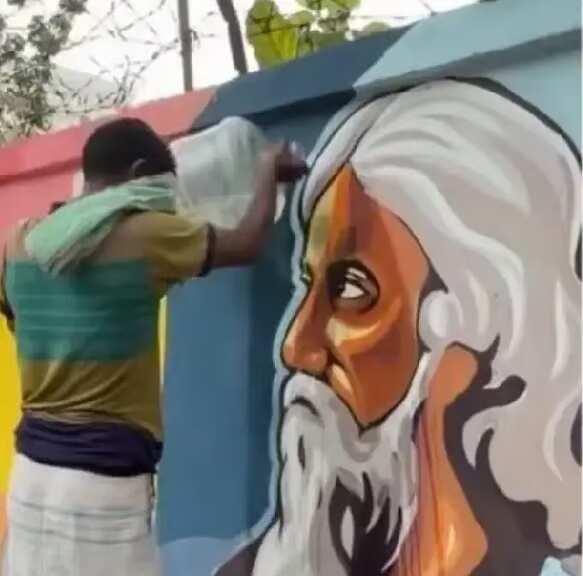
A rickshaw puller cleaned the image
The response in Dhaka to the defacement
Dhaka University teachers condemned the ink attack, and a group of 37 prominent citizens warned against the exploitation of religious sentiment to fuel unrest. Udichi organised a programme of music and poetry near the mural, beginning with Bangladesh’s national anthem. A rickshaw puller and a passerby helped wash the black ink from Tagore’s portrait.For Zahid Newaz Khan, chief executive editor of Channel i, that response says more about Bangladesh’s relationship with Tagore than the actions of those who targeted the mural. “Some misguided people committed this act, but there is a political agenda behind those instigating them,” he told TOI. Tagore, he argues, is deeply embedded in the country’s humanistic and cultural consciousness.“A few people smeared black ink on his portrait, but an ordinary rickshaw puller came forward on his own to wash it clean. That is the real Bangladesh.” Khan also draws a distinction between opposition to Indian government policies and hostility towards the poet.When Rimi called Tagore Indian, she was invoking a national boundary drawn after the poet’s death. He died in 1941, six years before the partition of British India and 30 years before Bangladesh emerged as an independent country.In Crisis in Civilization, written near the end of his life, Tagore had expressed a conviction that seems particularly fitting:“And yet I shall not commit the grievous sin of losing faith in Man.”The rickshaw puller just validated Tagore’s words.