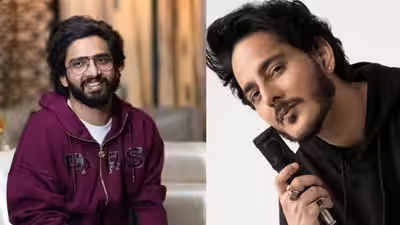

Amid the ongoing debate over music royalties triggered by Tanishk Bagchi‘s claims about the Saiyaara title track, composer-singer Amaal Mallik has shared a cryptic social media post that many believe references the larger issue. Although he did not name Tanishk or the film, Amaal suggested that the industry is only now acknowledging a problem he says he highlighted years ago.Sharing a selfie with a brief note, Amaal wrote, “People in the music industry waking up 10 years too late. Where were you in 2015 when I was fighting the system alone :).”His remarks come as conversations around royalty payments have resurfaced following Tanishk Bagchi’s allegation that he is yet to receive ₹8 lakh in royalties for the Saiyaara title track. Yash Raj Films has since denied any wrongdoing, stating that royalties have been distributed equally among the song’s three composers in accordance with their contracts and that all collaborators have been paid as agreed.Amaal has long been vocal about the financial challenges faced by composers and lyricists despite the commercial success of their music. Earlier this year, in March, he spoke at length about how India’s royalty system continues to leave creators with only a small share of the revenue generated by their work.“There is royalty system implemented from 2020. Javed Akhtar sahab fought very hard for it. Actor feels that if they are standing in a song so the song will be a hit. That is only 50% true. The rest 50% credit goes to lyric writer, music composer, director and then last comes to singer. Singers are important, but they are not the creators of the song. These four pillars of the sound are all needing rights of the song. Music producers don’t have right to their songs but in the west that category also has rights to the song,” he said.To illustrate his point, Amaal referred to his hit song ‘Sooraj Dooba Hai’ from the 2015 film Roy, starring Ranbir Kapoor, explaining how little the creators ultimately earned compared to the song’s long-term commercial value.“As an Indian system, we are very much behind the west. Because Taylor Swift has master royalties, she could buy back the album and release it in her own way. Like for the song, Sooraj Dooba Hai, I got Rs 8 lakh, and I gave everything in that. I had to run my house, make this song. It would have taken Rs 10 lakh max. The song was made in Rs 8-10 lakh,” he said.He further claimed that while the song went on to generate enormous revenue over the years, the creators did not benefit proportionately.“My understanding is on an average in the last 12 years, the song has made Rs 65 crore, I had reviewed this 7 years back. Now, it would have made Rs 100 crore. Now, the song which was made in Rs 10 lakh has earned Rs 100 crore and what they would have given us was Rs 15-20 lakh. This includes everything – the engineer, the place, the food – everything, but not royalty,” he added.Amaal also explained how production expenses significantly reduced his own earnings from the project. “I paid my team in that amount. After paying for everything, I get salary of Rs 75,000 to Rs 1.5 lakh after doing one song,” he said.The renewed discussion comes after Tanishk Bagchi alleged that ₹8 lakh in royalties for the Saiyaara title track remained unpaid. In response, Yash Raj Films maintained that all financial obligations had been fulfilled.“Saiyaara title track was a beautiful collaboration between three composers (Tanishk Bagchi along with Faheem Abdullah and Arslan Nizami). We are deeply thankful for their brilliance in creating a timeless song that has touched a million hearts. Royalties for the title track have been shared and will continue to be shared by YRF equally between all three composers as contractually agreed by all, including Tanishk. YRF has paid every collaborator their due, as per contract, all within mutually agreed terms & time,” a YRF spokesperson said.