The Big Bang, which gave birth to the universe, is one thing, but could a similar cataclysmic event unfold again if an asteroid came racing towards our planet? While the thought might sound like something straight out of a science-fiction film, researchers working on planetary defence have been exploring myriad possibilities to prevent such a catastrophe. One of these involves using a nuclear explosion, not necessarily to blow an asteroid into pieces, but to push it away from its predicted path. What new research has found is rather intriguing: even such a powerful intervention could depend on getting one rather important detail right. Which side of the asteroid should be hit?Recently, researchers at Sandia National Laboratories have developed a new simulation that examines how asteroids respond to nuclear-generated X-rays. Their findings suggest that the direction from which the radiation strikes an asteroid could change the effectiveness of its deflection by almost five times. The research, published in the journal Icarus, also highlights how the irregular shapes of these space rocks could make planetary defence a far more complicated exercise than previously understood.
Why would scientists use a nuclear explosion to stop an asteroid?
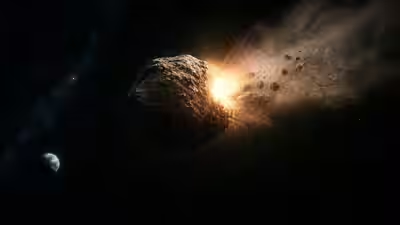
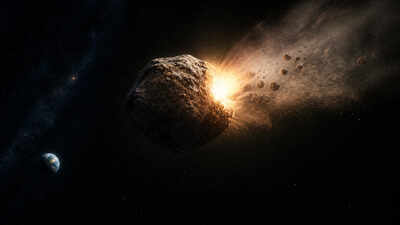
The idea of sending a nuclear device towards an asteroid might immediately bring to mind images of an enormous explosion tearing a space rock apart. However, that is not quite what researchers are trying to achieve. The objective is to alter its trajectory just enough to ensure that it does not collide with Earth.One proposed method involves detonating a nuclear device at a carefully calculated distance from an approaching asteroid. The explosion would release an intense burst of X-rays, which would heat the asteroid’s surface and cause some of its material to vaporise. When this material is released from its surface, a recoil effect would ensue, giving the asteroid a push in the opposite direction. Even a relatively small change in its movement could become significant over time, potentially allowing the asteroid to pass Earth rather than collide with it.The challenge, however, lies in predicting just how much of a push an asteroid would need. Unlike the smooth, round objects often used in simplified scientific calculations, asteroids have uneven surfaces, ridges, depressions and rather unusual shapes. This means that the same burst of radiation could produce different results depending on where it strikes.
Hitting the wrong side could change everything
To understand this better, physicist Nathan Moore and his colleagues at Sandia National Laboratories developed a new model to study how asteroids respond to X-ray bursts. Their simulations revealed that changing the direction of the radiation could make a considerable difference, even when researchers were working with the same simulated asteroid.In one instance, the asteroid’s speed changed by 3.9 millimetres per second when the X-rays struck it from one direction. When the radiation came from another direction, the change was just 0.8 millimetres per second. This amounted to a nearly fivefold difference in the resulting deflection velocity.The researchers also found that the effects were not limited to the direction in which an asteroid moved. Its rotation could be affected as well. For another simulated asteroid, the change in rotational speed varied by a factor of 17 depending on the direction from which the X-rays arrived. Therefore, an asteroid’s shape determines how different parts of its surface receive the radiation, how much material is vaporised and how the resulting force ultimately affects its movement and rotation.
A new model that moves beyond spherical asteroids
For a long time, modelling asteroid deflection involved a difficult compromise. Researchers could either account for the complicated shapes of asteroids or carry out highly detailed calculations of the physical forces involved. Combining both required computing power that was not readily available.Moore and his team worked towards overcoming this limitation by bringing together two simulation systems used at Sandia for different kinds of physical problems. The resulting algorithm is reportedly more than 1,600 times faster than the earlier approach, allowing researchers to study realistic asteroid shapes while retaining a high level of detail in their calculations.The work also builds on an earlier experiment conducted using Sandia’s Z machine, which demonstrated for the first time that X-rays could deflect a small piece of asteroid material. The next question was whether scientists could use similar calculations to understand how an entire asteroid might behave.With the new model, researchers can use detailed three-dimensional images captured during spacecraft flybys to reconstruct an asteroid’s shape. They can then simulate an X-ray burst while adjusting factors such as the strength of the explosion, its distance from the asteroid and the direction from which the radiation arrives. The software also produces heat maps showing how much material could vaporise across different parts of the surface.
There is still a long way to go
While the findings offer a better understanding of how a nuclear deflection mission might work, the researchers are not suggesting that scientists can now confidently redirect any asteroid heading towards Earth.For one, the current model can only account for the breakup of rocks on an asteroid’s surface. It cannot yet accurately predict whether the entire asteroid could fracture under the force of an explosion.But there are a lot of practical difficulties at hand. Firstly, the model requires reasonably accurate information about an asteroid’s shape from different directions. Secondly, if a potentially dangerous asteroid were discovered on a collision course with Earth, obtaining detailed observations may not be possible in the limited time available. Lastly, even positioning a nuclear device at the ideal distance and on the correct side of an asteroid could pose a challenge of its own.