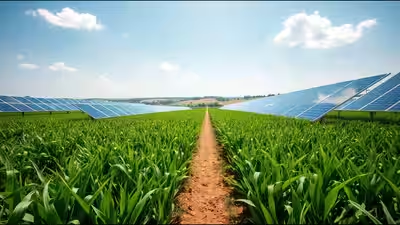
A family farm in Longmont, Colorado has turned part of its land into a working example of how solar power and agriculture can share the same ground. Byron Kominek, owner of Jack’s Solar Garden, covered roughly five acres of his family’s 24-acre property with 3,276 solar panels, mounted high enough to allow crops to keep growing underneath. The panels generate around 2 gigawatt-hours of electricity a year, which Kominek sells to a nearby utility for extra income as farmers across the region deal with rising power costs, persistent drought and increasingly hot growing seasons. What makes the project unusual is that the panels are not simply generating power over empty land. The shade they cast is helping heat-sensitive crops survive conditions that would otherwise damage them.
Why this Colorado farm decided to combine solar panels with crops
Kominek’s farm sits at the centre of what has become the largest commercial agrivoltaics research site in the United States, a term used to describe farmland that produces both crops and solar electricity on the same plot. The project brought together researchers from the National Renewable Energy Laboratory, Colorado State University and the University of Arizona, who use the site to study the microclimates created underneath solar panels and how those conditions affect plant growth. According to the National Renewable Energy Laboratory’s own account of the project, the site offers the most comprehensive agrivoltaics research setup in the country while also delivering food access and educational benefits to the surrounding community.
How solar panels create cooler microclimates for crops
The panels at Jack’s Solar Garden are mounted on a single axis tracking system, meaning they shift position through the day to follow the sun. As they move, the shadow beneath them shifts too, and rainwater collects along each panel’s lower edge, breaking up what was once a uniformly sunny, dry field into a patchwork of different growing conditions. Before the solar array was installed, every part of the field received roughly the same amount of sunlight and moisture. Now, some patches stay cooler and slightly damper than others, giving farmers more flexibility in what they can grow and where.
Which crops are benefiting most from the shade
Among the plants thriving under the panels are flax, which germinates best at around 65 to 70 degrees Fahrenheit, and clary sage, which tends to wilt once temperatures climb past 95 degrees. Both crops struggle in direct, unshaded heat during Colorado’s peak summer months, but the partial shade cast by the solar array keeps conditions closer to what these plants need to thrive. Crop cultivation on the site is led by Sprout City Farms, which grows produce beneath the panels in partnership with the research teams studying the project, while Audubon Rockies has planted more than 3,000 native perennials around the array’s perimeter to support pollinators.
What the research says about combining farming and solar power
A peer-reviewed case study on the project, titled Developing Crop-Based Agrivoltaic Systems: A Case Study of Jack’s Solar Garden and published in the Journal of Agriculture, Food Systems, and Community Development, examined why a farmer might choose to build a crop-based agrivoltaic system and what challenges come with developing and maintaining one. The researchers found that combining crops with solar panels can serve as a workable compromise between farmers and local governments, while also delivering a wider set of benefits to the surrounding food system. The study placed particular emphasis on the role of public-private partnerships in making projects like this succeed, along with lessons that could guide other farmers considering similar systems.
Why this model could matter for farms elsewhere
The panels at Jack’s Solar Garden are mounted at heights of roughly six and eight feet, leaving enough clearance underneath for people, vegetation and everyday farm activity to continue relatively undisturbed. Colorado State University researchers, including doctoral student Matthew Sturchio, have used the site to study how solar shading affects not just individual crops but broader ecosystem functions, from soil health to pasture grass to insect activity beneath the panels. As drought and rising temperatures continue to squeeze farm output across the American West, projects like this one suggest that solar panels do not have to compete with agriculture for land. Instead, farms may be able to use the same acre to do two jobs at once, producing food that is more resilient to heat while also generating clean electricity and a steady stream of income for the people running the land.