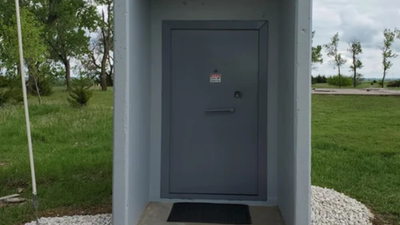
A former Cold War missile installation in Kansas, designed to protect a nuclear weapon deep underground, is being offered for $1.6 million after its launch control centre was converted into living space. According to Realtor.com, which reported on the listing on October 17, 2026, the North Star Missile Silo near Carlton spans 18.2 acres and contains a 182-foot-deep silo, steel blast doors and a two-storey command centre. The property is listed for $1,600,500, with approximately 2,500 square feet of finished space in the former launch control centre.The property, also identified as Atlas F Site 550-4, offers a glimpse into the infrastructure built during a period when the United States and the Soviet Union were locked in a nuclear arms race. What was once a military installation designed for a strategic weapon has since been adapted for private use, with a living area, kitchens, bedrooms and modern utilities occupying part of the underground complex.
From nuclear installation to underground home
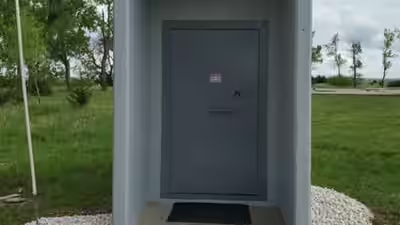
The North Star Missile Silo’s original structure was built around the demands of nuclear-era military readiness. Its website describes a silo measuring 52 feet across and 182 feet deep, with reinforced concrete walls six feet thick. Heavy steel blast doors and underground passages connect different parts of the complex, including the launch control centre. These specifications are published on the property’s own website and should be understood as its stated dimensions and features.The launch control centre has been converted into approximately 2,500 square feet of living space. According to Realtor.com, a 40-foot tunnel connects it to the silo. The finished area includes an open-plan living room and dining area, two kitchens, two bedrooms and two bathrooms, arranged across two levels.The conversion was not completed when the current owners acquired the property. Listing agent Ali Schneider of Real Broker told Realtor.com that the sellers had owned the company that held the property and had used the site as a rental. Schneider said it was not habitable when they bought it, but they subsequently finished the interior and made it functional.The property is equipped with 200-amp electrical service and metered water supplied through a rural district system. Its specifications also list separate sewer systems for the surface and underground areas, a humidity-control system, a mobile-phone signal repeater and access to high-speed fibre internet.Above ground, the 18.2-acre parcel is enclosed by barbed-wire fencing and accessed through a wide driveway from a paved road. A solar-powered, seven-foot chain-link gate with a remote keypad controls the entrance. The site also has an aluminium carport and a concrete pad with utility connections that could accommodate a recreational vehicle, according to the listing.
A remnant of the Cold War missile programme
The installation’s history is tied to the Atlas F intercontinental ballistic missile programme. Atlas missiles formed part of the United States’ early land-based nuclear deterrent, developed as Washington and Moscow competed to build weapons capable of striking targets across continents.The Military Standard’s history of Atlas F Site 550-4 identifies it as a launch facility associated with the 550th Strategic Missile Squadron and Schilling Air Force Base in Kansas. Its records state that the site became operational in 1962 and was deactivated on March 25, 1965. The squadron itself was discontinued later that year.Atlas F installations were designed to house and support missiles in hardened underground facilities. Their engineering reflected the military’s effort to protect strategic weapons and supporting equipment from attack while maintaining the ability to launch them when ordered. The sites included more than the missile shaft alone: access passages, control areas, utilities and support infrastructure were also essential to their operation.The Atlas system’s active service was relatively brief. By the mid-1960s, the United States was moving away from its first-generation Atlas missiles towards newer missile systems. The deactivation of the Kansas installation marked the end of its role as an operational launch facility, although the physical structures remained.
What the $1.6 million listing offers
The present-day property combines the remains of that military infrastructure with features intended for contemporary use. The listing describes room for gardening, agriculture and grazing, along with potential space for solar panels or wind turbines. Its elevated setting is advertised as offering views extending roughly 20 miles, while the fenced boundaries provide privacy.Schneider told Realtor.com that possible future uses discussed for the site include an off-grid conference venue or wedding venue. There has also been discussion about converting the silo into condominiums, although these are possibilities rather than approved projects or confirmed plans. The agent said she hoped the next buyer would preserve its history and continue using it as a rental.The property’s unusual design may attract buyers seeking a distinctive residence, private retreat or investment project, but its underground structures also present considerations beyond those of an ordinary home. Prospective buyers would need to assess the condition of the silo, the suitability of the converted space, the maintenance requirements of the underground systems and the permissions needed for any proposed change of use.