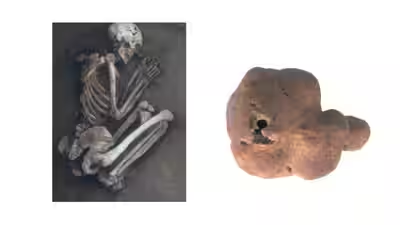
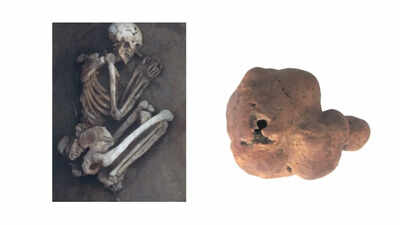
Meeting your daily water intake and not holding back your pee are two things you must have been told to do to avoid developing painful kidney stones. But with access to modern medicines and medical procedures today, it is difficult to imagine what a man suffering from a kidney stone more than five millennia ago might have had to endure. While archaeology has opened gateways to understanding ancient arts, crafts and ways of living, one discovery is now offering researchers a glimpse into a much more painful aspect of the past. A urinary stone, preserved alongside the remains of a Bronze Age man, has prompted researchers to consider the pain and medical challenges he may have endured more than 5,300 years ago.A grape-sized stone, believed to have formed inside the urinary system of a Bronze Age man, has been identified among the remains from his burial in southwestern Russia, near the Black Sea. The size of the stone, however, is only one aspect of this intriguing discovery. What makes the finding particularly remarkable is the rare mineral identified within the stone, which has helped researchers theorise that the man was likely living with a chronic bacterial infection. The condition may have caused him considerable pain during the final years of his life.According to a report published by Live Science dated November 3, 2026, the findings come from an investigation of an Early Bronze Age burial, with scientists suggesting that the stone was likely a urinary stone resulting from a long-standing urinary tract infection.
A discovery that emerged during laboratory examination
The remains belonged to a man who was between 40 and 49 years old when he died approximately 5,300 years ago. He was buried in a kurgan cemetery in the Stavropol Upland region of southwestern Russia, at a burial site associated with the Steppe Maikop archaeological horizon.A kurgan is an ancient burial mound traditionally constructed by covering a grave with a large mound of earth. During the excavations, archaeologists came across a catacomb burial containing the man’s skeleton, with a flint arrowhead also discovered near his pelvis. However, the stone that would eventually become the focus of the research was not immediately recognised as an important archaeological finding.It was only during the subsequent examination of the collected remains in the laboratory that researchers noticed an unusual object among a collection of the man’s hand bones. The brownish, rounded object had several protrusions and measured approximately 2.1 centimetres in diameter, making it roughly the size of a grape.
What the mineral revealed about his health
To understand the composition of the stone in greater detail, the research team used several scientific techniques to examine it. Initial X-ray fluorescence analysis revealed that calcium and phosphorus were among its principal components, while X-ray powder diffraction helped identify the different crystalline structures present within it. This also revealed the presence of whitlockite, a relatively rare calcium-containing mineral found in kidney, bladder and prostate stones. Whitlockite is also associated with bacterial infections. Carbonate-containing hydroxyapatite was another significant finding among the minerals present in the stone.Researchers also found that the stone lacked calcium oxalate and uric acid, compounds commonly associated with other types of urinary stones. Its mineral composition instead pointed towards an infectious origin, suggesting that the man had been experiencing a chronic infection affecting his urinary or reproductive system.
A difficult life on the ancient steppe
The discovery also adds to what researchers have learnt about the man’s physical condition. An examination of his skeleton revealed that he had a muscular build, but his bones also carried evidence of considerable physical strain. Researchers identified degenerative changes affecting several parts of his body, including his spine, shoulders, hips, hands and feet. They also identified multiple healed fractures, including injuries to his right shoulder, ribs and forearm. These findings suggest that his life involved considerable physical activity and the demands of the society in which he lived.People belonging to these ancient steppe communities worked with cattle and heavy wagons, often travelling across open landscapes. Such activities could place considerable pressure on the body, and the injuries preserved in the man’s skeleton offer a glimpse into the physical demands of everyday life during this period.One question that remains unanswered is whether the condition ultimately contributed to his death. If the stone had obstructed the ureter, one of the tubes connecting the kidneys to the bladder, it could have prevented urine from passing normally. Such an obstruction can lead to kidney swelling and further infections, potentially progressing to sepsis. In the absence of modern antibiotics and medical intervention, these complications could have been life-threatening. Nevertheless, researchers cannot establish whether this happened in his case.For a man who lived around 5,300 years ago, the stone may have been a source of persistent discomfort that those around him could neither identify nor treat. Today, however, the very object preserved alongside his remains has allowed researchers to understand something about his health that would have otherwise been lost to history.