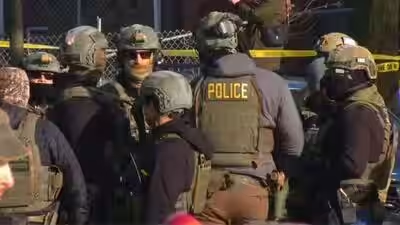
A 19-year-old hiker spent a cold and windy night trapped on a narrow cliffside ledge in Texas’ Big Bend National Park after strong winds forced a military rescue helicopter to cancel its first attempt to reach him. Emergency dispatchers received a distress call at 11:36 pm on Sunday, 8 March, from a solo hiker stuck in steep terrain high in the Chisos Mountains, according to a statement from the National Park Service (NPS). The man had left the marked trails and become trapped on a narrow rock ledge near the Window View area. He could not climb back up or safely make his way down in the dark. Park rangers hiked into the rugged area during the early hours of Monday, 9 March, and managed to make voice contact with the teenager. However, the steep drops and loose rocks made it too dangerous for ground rescuers to reach his exact location without help from an aircraft.
High winds force helicopter to abandon rescue
Because of the steep landscape and difficult access, Big Bend National Park officials requested a helicopter equipped with rescue hoisting equipment from the Texas Department of Public Safety (DPS) and the Texas Army National Guard. A UH-60 Black Hawk helicopter crew took off from Austin to help rescue the hiker, according to local news outlet KSAT 12. When the aircraft reached the Chisos Basin early Monday morning, strong and changing winds began pushing it around near the canyon walls. The wind conditions quickly became too dangerous for the pilot to carry out a precise rescue using a hoist. The operation could have put both the helicopter crew and the stranded hiker at risk. The Black Hawk crew therefore stopped the attempt and returned to a nearby staging area to wait for the weather to improve. While the helicopter waited, ground rescuers stayed near the edge of the cliff. They kept watch over the hiker and tried to keep him calm. Temperatures in the high desert mountains fell to between 40 and 48 degrees Fahrenheit (around 4 to 9 degrees Celsius), and the teenager had only limited clothing to protect himself from the cold.
Second helicopter attempt succeeds
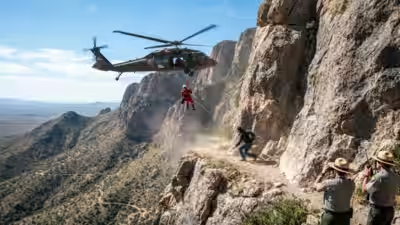
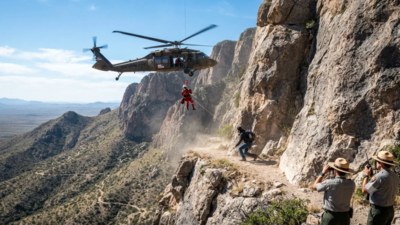
After the winds became weaker later on Monday morning, the Texas Army National Guard helicopter crew returned to the Chisos Mountains for another rescue attempt. Using a cable attached to the helicopter, rescuers lowered a specialist onto the narrow ledge. The specialist secured the 19-year-old in a rescue harness before lifting both of them safely into the hovering Black Hawk. According to the National Park Service, the teenager was flown to a nearby landing area, where park emergency medical technicians checked his condition. Despite spending nearly 12 hours exposed to the weather on the cliffside, he suffered no serious physical injuries. Park officials did not reveal the hiker’s name. “This incident highlights the critical importance of staying on designated trails and checking weather forecasts before heading into the backcountry,” Big Bend National Park Deputy Superintendent Rick Gupman said in the agency’s press release. “Our rangers and partners at the Texas Army National Guard and Texas DPS showed tremendous skill and coordination under very challenging conditions.”
Dangerous terrain in the Chisos Mountains
Big Bend National Park covers more than 800,000 acres in West Texas, along the Rio Grande. The park has major changes in elevation that can catch inexperienced hikers by surprise. The Chisos Mountains rise sharply above the surrounding Chihuahuan Desert, creating local weather conditions that can change quickly. Even when the valleys are calm, strong winds can suddenly sweep through the canyons. According to Outside Online’s coverage of search and rescue operations, becoming “cliffed out” is a common danger in desert mountain parks. Hikers sometimes leave marked trails to find better views or take shortcuts. However, they can end up on steep, crumbling rock ledges that are easy to climb down but extremely difficult to climb back up. Search and rescue teams in Big Bend carried out dozens of operations over the past year. Many involved visitors who became lost or trapped after underestimating how difficult the Chisos Mountains can be to explore. Park guidelines advise hikers to carry extra warm clothing, a headlamp, enough water and a fully charged mobile phone or satellite communication device, even when going on short day hikes.
Multiple agencies work together in remote rescues
Rescue operations in remote parts of West Texas often depend on cooperation between federal park officials and state military units. Big Bend National Park is several hours away from major cities, hospitals and helicopter bases. This means state rescue helicopters sometimes have to travel hundreds of miles just to reach the park. In its report on the rescue, the Texas Military Department said its aviation crews regularly train for high-altitude rescues and hoist operations in narrow spaces. This training helps them support civilian emergency services in difficult areas such as the Big Bend region. After medical staff checked him on Monday afternoon, the 19-year-old hiker was released at the scene without needing to be taken to a hospital. Park rangers did not close any trails during the rescue, and normal visitor access to the Chisos Basin resumed shortly after the Black Hawk left.