
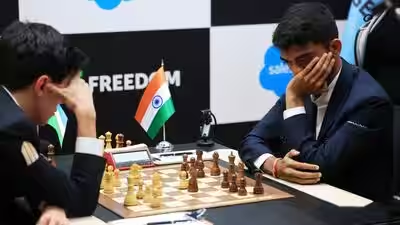
Uzbekistan’s Javokhir Sindarov made an interesting observation about Indian chess players when asked about the psychological state of his opponent, D Gukesh, after their opening game of the FIDE World Championship in Geneva ended in a drwa on Tuesday. “I saw that all the players from India are always meditating,” Sindarov said, adding that he had noticed the habit while playing against Gukesh, R Praggnanandhaa and Arjun Erigaisi.The remark came during the post-match press conference after defending champion Gukesh, playing with black, drew the first game against the Uzbek challenger. The two players were also asked about how they read each other’s behaviour at the board, with Sindarov pointing to Gukesh closing his eyes and Indian players meditating.“I do it in every tournament; it’s not just here. And also, I saw that all the players from India are always meditating, which for me is okay. I played many times with Arjun, Pragg, and Gukesh; maybe not many, but whenever we meet, he is also meditating. So nothing special here,” Sindarov said.Gukesh, meanwhile, said the two players had similar habits and that their actions at the board were not necessarily signs of nerves.“I don’t know, maybe there were a little bit of nerves also, but I think both of our habits are similar. In general, he taps his foot or shakes his leg, and I close my eyes, in any tournament, not just the match. It’s just how we behave at the board,” the Indian said.On the board, Gukesh had to work his way back after Sindarov gained a small advantage in the early stages. The Indian chose the Berlin Defence against Sindarov’s Ruy Lopez, and was under some pressure before the game moved into a queen-less middle game.Sindarov had better-placed pieces and a slightly better pawn structure for a period, but the Uzbek sacrificed a pawn to open up the position. Gukesh, however, found the right moves despite being short of time. At one point, the Indian appeared to have a chance to take control, but Sindarov held his position and repeated the moves.The position was repeated five times before the players agreed to a draw. A threefold repetition is usually enough to claim a draw.Asked how it felt to finally play after all the build-up to the championship, Gukesh said the actual game was the easiest part of the process.“That was the easiest thing, to actually go and play the game, because there’s so much thinking, so much work to do before that. Once you get to the game, you know, it’s like your home.”He also said he was not worried despite getting into time trouble, as he had already considered his next moves.“I thought I was always under control, not in a place where I really needed to be worried. When I got into time trouble, I had already thought about the next few moves, what I was going to play soon. I was happy that I managed to spend some time, find a good solution, and the moves after that were pretty easy.”The two players will contest 14 classical games, with the first to reach 7.5 points winning the title. If the scores are level after 14 games, shorter-format games will be played to decide the champion. Gukesh will have the white pieces in the second game.The time control allows 120 minutes for the first 40 moves, with 30 seconds added for every move from move 41. Players cannot agree to a draw before 40 moves, although a game can end earlier through threefold repetition or stalemate.The total prize fund for the match is USD 2.5 million. Each win is worth USD 200,000, with the remaining amount to be split equally between the players. If the match goes to tie-breaks, the winner will receive USD 1.3 million and the runner-up USD 1.2 million.