
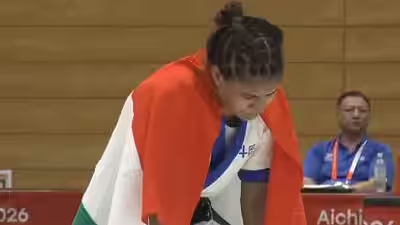
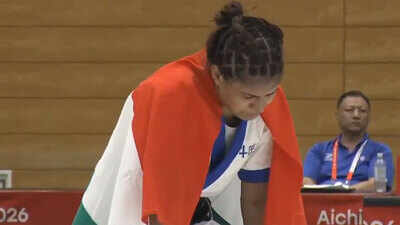
NEW DELHI: The medal will go down in Indian sporting history. The manner in which it arrived, however, left Suchika Tariyal in tears.Twenty-four years after an episode of eve-teasing at the age of 12 prompted her to learn how to fight, the 36-year-old from Haryana became India’s first Asian Games medallist in mixed martial arts on Monday. But instead of walking away celebrating a landmark achievement, Tariyal was left shattered on the mat after a dramatic semifinal ended in a draw — only for the winner to be determined by a 700-gram difference in the fighters’ morning weights.Tariyal and Singapore’s Hui Hoon Teo had fought through regulation time and an additional one-minute round without either establishing a decisive advantage. The bout was initially awarded to Teo. The Indian camp challenged the decision, after which the result was changed to a draw.Then came the tiebreak.MMA Sports Federation president Nikhil Kunde told PTI that the winner was determined on the basis of the athletes’ morning weigh-in, with Teo around 700 grams lighter than Tariyal. The Singaporean was therefore declared the winner 2-0 and advanced to the gold-medal bout, while Tariyal received bronze.For Tariyal, it was a particularly painful way for her gold-medal hopes to end.She had believed she had done enough to win. Teo had the better of the opening period, but Tariyal fought back strongly in the second. Neither could establish clear superiority in the additional round, although Tariyal managed to take her opponent down just as the buzzer sounded.When the final decision was announced, Tariyal struggled to contain her emotions. She broke down in tears on the mat as her coach tried to console her. She did not immediately go across to shake hands with Teo or the referee.The disappointment was understandable. A few moments earlier, the Indian camp had succeeded in getting the initial verdict changed to a draw. Yet the revised result still did not take Tariyal into the final. A difference of roughly 700 grams ultimately separated the two fighters.And yet, history had already been made.MMA is making its Asian Games debut at Aichi-Nagoya 2026, and Tariyal’s bronze is India’s first-ever medal in the discipline. Her achievement also adds another chapter to one of the most unusual combat-sports journeys in the Indian contingent.
From an incident at 12 to the Asian Games podium
Tariyal’s journey into combat sports began not with dreams of an Asian Games medal, but with a desire for self-defence.At 12, after experiencing eve-teasing, she decided she wanted to learn how to fight. She took up judo and gradually transformed that initial need for protection into a competitive sporting career.Judo became her foundation. She trained at the Jawaharlal Nehru Stadium and later at the Dada Dev Mandir Centre in Palam before honing her skills at the Sports Authority of India centre in Bhopal.The journey eventually produced eight national judo titles and international success. She won gold at the 2019 Commonwealth Judo Championships and the 2019 South Asian Games, besides winning silver at the 2018 Commonwealth Judo Championships. She represented India at the 2022 Commonwealth Games in Birmingham in the women’s 57kg category, narrowly missing a medal.But judo was only the beginning.Tariyal moved into kurash and represented India at the 2023 Asian Games. She also took up Ju-Jitsu, eventually becoming world champion in the Adults Ju-Jitsu Contact Female 63kg category at the 2024 JJIF Ju-Jitsu World Championships.Her relationship with MMA had begun earlier, with a debut victory in 2017. She then spent seven years away from the sport while continuing her career in other combat disciplines.When she returned to professional MMA in 2024, she did so with the experience of a fighter who had already spent years building different parts of her game.She made her professional comeback at BRAVE CF 92 in Bahrain in December 2024 and won. Her subsequent MMA career included national titles and bronze medals at the Asian Mixed Martial Arts Championships in 2026.That multi-discipline background became central to her Asian Games campaign.
Judo, Ju-Jitsu and MMA come together
Tariyal’s MMA style was built around the skills she had accumulated over the years — takedowns, grappling, ground control and submissions.Before the Asian Games, she underwent a six-week preparation camp in Mumbai under coaches Nikhil and Sushobhan. She had spoken about how her coaches would wait for her through Mumbai’s traffic so she could complete her training and continue refining her techniques.Her preparation showed when she stepped into the Asian Games cage.In Sunday’s quarterfinal, Tariyal defeated Mongolia’s Altanchimeg Baigalmaa 2-0 in the women’s traditional 60kg category to reach the semifinals. The victory guaranteed India its first medal in MMA because both losing semifinalists received bronze.It was a moment Tariyal had waited years for.“It took me a lot of time to reach here. There is a lot of hard work — first judo, then other games and now MMA,” she had said after reaching the last four.On Monday, she came within one step of turning that historic bronze into a shot at gold.Instead, the semifinal became a contest decided not simply by what happened inside the cage, but by what the morning weigh-in showed.
A historic medal, with a bitter aftertaste
There is no taking away what Tariyal has accomplished.She has become India’s first Asian Games MMA medallist at an edition in which the sport itself is making its debut. At 36, she has added another major milestone to a career that has crossed judo, kurash, Ju-Jitsu and professional MMA.But the circumstances of the semifinal mean the bronze is unlikely to feel complete to her immediately.The Indian challenge had changed the original decision. The bout had become a draw. Tariyal had fought back after losing the opening period and forced the contest into an additional round.Yet the final tiebreak went against her because she was heavier by approximately 700 grams.So the fighter who once took up judo simply because she wanted to learn how to defend herself now stands on an Asian Games podium — but with the memory of a final that was within reach and slipped away on the narrowest of margins.The bronze is historic. The heartbreak is equally real.