
For most visitors, Omaha Beach appears much as any broad stretch of northern European coastline might. The tide advances and retreats, families wander across the sand, and the horizon seems distant and quiet. History is present, certainly, but it tends to exist in visible forms: memorials, museums, rows of graves, and carefully preserved photographs. The landscape itself often appears unchanged by the events that made it famous.Yet coastlines have a way of holding on to fragments of the past. Not in the dramatic sense suggested by folklore, but through ordinary physical traces that survive far longer than expected. Decades after Allied troops stormed the beaches of Normandy during the Second World War, part of that story remains mixed into the shoreline itself. Tiny metallic particles, almost impossible to spot without specialised equipment, still sit among the grains of sand.Their presence offers a different perspective on remembrance. Instead of documents, monuments or eyewitness accounts, it is geology that provides the evidence. A handful of beach sand collected years ago has revealed that some remnants of the fighting never truly disappeared.
Scientists found something strange in sand from Omaha Beach, France
As reported by The Sedimentary Record research, the discovery did not emerge from a major archaeological project. It began with a routine visit during a geological field trip in France in 1988. A small quantity of sand was collected from Omaha Beach and later taken back for examination. For a long period, the sample attracted little attention. Only when it was studied under magnification did something unusual begin to stand out. Mixed among the expected grains were dark particles that looked different from the surrounding material.Beach sand is rarely uniform. It often contains fragments of shells, pieces of rock and minerals transported from distant locations. These particles, however, seemed to belong to another category entirely.
Evidence of explosions hidden in the sand of Omaha Beach
A closer examination showed that the dark spots in the soil were actually pieces of metal and not sediments. Many contained high concentrations of iron and reacted to magnetism. The fact that they had unusual shapes was another indication that their creation had been very dramatic. Unlike sediments, which usually get worn down and smoothed out over time, some pieces had very angular forms that are characteristic of fragmented metals. It became clear what had happened there in the end.When munitions explode, the pieces of metal fly off and disperse around the vicinity. The bigger ones are often removed from the site; the smaller ones remain as is and become integrated into the surroundings. The pieces were then washed away and spread across the shore by the action of the waves and tides.
The long shadow of D-Day
Omaha Beach occupies a distinctive place in the history of the Normandy landings. The University of Texas, Austin reveals on 6 June 1944, Allied forces launched one of the largest amphibious military operations ever attempted. Thousands of troops came ashore across several sectors of the French coast as part of the effort to establish a foothold in occupied Europe. The fighting at Omaha proved particularly costly. Strong defensive positions overlooking the beach created severe difficulties for the advancing troops, and casualties mounted rapidly during the opening hours of the assault.Much of the visible evidence of that day disappeared long ago. Damaged equipment was cleared away, temporary structures vanished and the coastline resumed its ordinary rhythms. The metallic grains suggest that complete removal was never possible.
Microscopic fragments hidden in plain sight within the sand
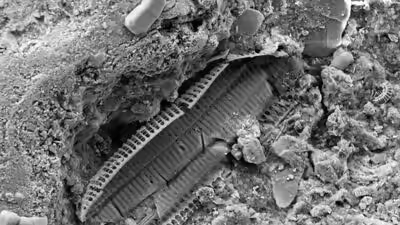
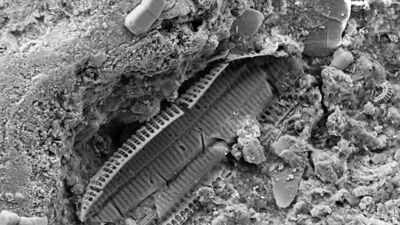
The fragments identified in the sand were remarkably tiny. Some measured little more than dust-like specks, while even the largest were only a few millimetres across. Their size helps explain why they remained undetected for so long. A person could walk across the beach countless times without noticing them. Even when present in measurable quantities, such particles blend naturally into the surrounding sediment.Alongside the metal fragments were other unusual features. Tiny rounded beads composed of iron and glass appeared within the sample. These are thought to have formed under intense heat, possibly during explosions powerful enough to melt materials before they cooled and solidified again. Such microscopic objects act almost like snapshots of extreme conditions. They preserve evidence of temperatures and forces that existed only briefly before disappearing.
Why even a 4% share of metal is geologically significant
The proportion of metallic debris within the examined sample reached roughly four per cent. On paper, that may not sound especially high. Viewed from a geological perspective, however, it is significant. Beaches are constantly reshaped by waves, currents and storms. Sediment is sorted, transported and mixed over time. Against that background, finding a noticeable concentration of wartime material more than eighty years after the fighting remains striking.That figure should not be treated as a precise measure for the entire beach. Conditions vary from one location to another, and a sample collected elsewhere could produce different results. Coastal environments are dynamic rather than fixed. Still, the concentration was large enough to leave little doubt about the source.