
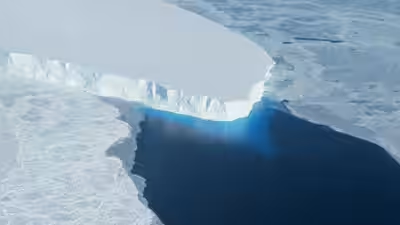
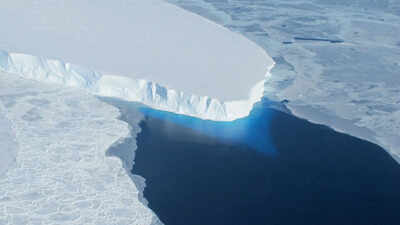
Scientists are checking if an underwater curtain is what will keep an Antarctic glacier from slowly melting due to warm water. The proposal is to install an underwater curtain about 80 kilometres long and up to 150 metres high in front of the Thwaites Glacier in West Antarctica. Between January and March 2026, an expedition went to the Amundsen Sea to collect data to check if the idea will hold up.
Why an underwater curtain?
The goal of the project is not to block the ocean, but to divert the warmer part of the current that currently melts the glacier from below. Thwaites loses mass mainly where the relatively warm ocean water reaches the floating base of the glacier, eroding the structure from the base. Thus, the choice for a submerged barrier.Anchored on the seabed of the Amundsen Sea, the flexible structure would work by elevating or redirecting the warm current before it reaches the ice base. The proposal does not foresee a total closure of the passage. The curtain would allow cold water and marine organisms to pass, acting only on the warmer part of the deep current circulating in the region.Titled the Seabed Curtain Project, the dimensions are what have gained attention in the proposal. The curtain would be about 80 kilometres long and up to 150 metres high, installed at a depth of approximately 650 metres. Eighty kilometers is equivalent to the distance between medium-sized neighbouring cities, but here it is in a straight line and at the bottom of the sea. The height is also not modest. One hundred and fifty meters corresponds to about 50 floors, a measure that would need to remain stable under permanent currents and ice impact.
An expedition for the future
Currently, the structure does not exist and may never be built. The project is a proposal that is undergoing early-stage research, focusing on materials, anchoring and prototype testing. Between January and March 2026, an expedition from the South Korean polar institute KOPRI installed autonomous ocean moorings in the channel connecting Pine Island to Thwaites, in the Amundsen Sea. These devices measure the environment for long periods. The moorings record temperature, salinity, currents, and turbulence, essential data to understand the behaviour of the warm water mass hitting the glacier. Continuous measurements will allow scientists to know where the warm current passes, with what intensity and at what depth, which would determine if and where a barrier would make a difference.Another front of the fieldwork dealt with the foundation. In January 2026, researchers aboard the South Korean ship RV Araon mapped a submarine elevation in the region to assess if it would serve as a stable base for the structure. An 80-kilometre curtain needs a bed capable of sustaining permanent anchorage, and the Antarctic seabed is irregular, sedimentary, and subject to iceberg scraping.Part of the tests takes place far from Antarctica, in the Arctic. Researchers compared two fjords in Svalbard, in the Norwegian archipelago, to observe in nature the effect that the curtain would try to produce. The comparison is ingenious precisely because nature has already done the experiment. The Van Mijenfjord has an underwater threshold that naturally limits the entry of warm water, while a neighbouring fjord does not have this barrier and presents warmer waters.In practice, one of them has long lived the proposed scenario. The natural threshold mimics the long-term effect that an artificial curtain would have, allowing the study of consequences without building anything.
A decision for September
The report of this comparison between the fjords of Svalbard is scheduled for September 2026. The document should provide the first realistic measure of the concept. The comparison between an environment with a natural barrier and another without it indicates how much such a structure can hold back warm water and what changes in the surroundings.The project also works with a longer-term deadline. The team set up a three-year research program to design curtains and anchoring systems, define materials and test the technology, as well as discuss the governance of the intervention.The work brings together institutions from various countries with teams linked to universities such as Cambridge, Chicago, New York and Dartmouth among others. There are also polar research centres and engineering companies. The group includes the Alfred Wegener Institute, NIVA, Aker Solutions, and the Arctic Centre of the University of Lapland.The released estimates put the cost of the project between US $40 billion and $80 billion, depending on the final design adopted. The economic argument used by proponents of the idea compares with the avoided loss. The justification presented is that the expense would be less than the climate damage associated with sea level rise, a calculation that depends on long-term projections.Thwaites is known as the “doomsday glacier” for its contribution to sea level rise and the role it plays in holding back the ice from the interior of the continent. Estimates cited in surveys about the region indicate significant weight. The glacier would account for about 4% of the annual sea level rise on the planet, on its own, thus the proposed project.