
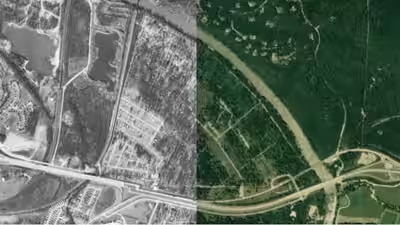
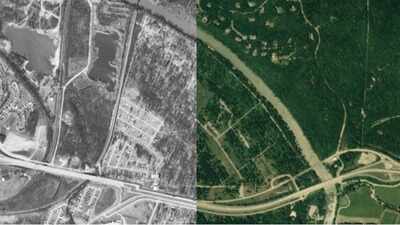
At times, things go wrong even when you try with all your might to ensure they are right. It was in the 1970s, that Times Beach, a small town in Missouri, attempted to solve a common problem for dirt roads by spreading residual oil to reduce dust. Years later, it was discovered that some of that material contained dioxin, a highly toxic substance that would trigger the permanent relocation of the Times Beach population. The situation escalated further after a severe flood of the Meramec River in December 1982. With the town flooded and contamination already identified, federal authorities advised residents not to return.Oil used to remove dustTimes Beach was located in St. Louis County, approximately 20 miles — about 32 kilometres, southwest of St. Louis. Its unpaved streets were treated with residual oil as a way to control dust raised by traffic. According to historical information published by the U.S. Environmental Protection Agency (EPA), the oil haulier Russell Bliss was hired in the early 1970s to remove waste from a chemical plant in Verona, also in Missouri.Some of this waste contained 2,3,7,8-tetrachlorodibenzo-p-dioxin, known as TCDD, a form of dioxin. Bliss mixed the material with the waste oil that was ultimately applied to control dust. The EPA notes that the contaminated mixture was spread across more than 25 locations in Missouri, including dirt roads, horse trails, and Times Beach. The agency classifies the dioxin involved in the incident as highly toxic and associates exposure with various health damages.
Signs of damage
The first severe signs appeared far from Times Beach. In 1971, over 40 horses died at Shenandoah Stables, one of the properties where Bliss had spread the material. Birds, dogs, and cats were also found dead, and a six-year-old girl became seriously ill. Subsequent investigations linked these incidents to dioxin.In March 1982, the EPA received records from the then Centres for Disease Control (CDC), related to dioxin contamination in Missouri and began to develop plans for analysing various locations in the state.In November of that year, Times Beach was alerted to the possibility that its streets might also be contaminated. The EPA started collecting and analysing soil samples.It was precisely at this moment that a natural emergency made the situation even more severe. In December 1982, a record flood struck the Meramec River. Times Beach was inundated, and its residents had to leave their homes. The contamination was not caused by the flooding: oil containing dioxin had already been applied on the streets years earlier. Authorities feared that the water could further spread the contaminated material throughout the municipality.Given this risk, the EPA and CDC recommended that Times Beach not be inhabited again.
A permanent relocation
The situation took a definitive turn on February 22, 1983. On that day, the EPA, the Federal Emergency Management Agency (FEMA), and the state of Missouri announced resources for the permanent relocation of Times Beach residents.The official EPA statement released in February 1983 stated that the decision came after the CDC analysed extensive soil samples and concluded that the contamination posed a continuing threat to the health of residents.Approximately 255 samples collected after the flood were analysed. In streets, shoulders, and ditches, the concentrations found varied from non-detectable levels to 100 parts per billion. Some backyards and one residence exhibited concentrations greater than 1 part per billion and less than 5 parts per billion.The then EPA Administrator, Anne M. Burford, announced the transfer of US$ 33.1 million from the Superfund to FEMA to fund the relocation. The state of Missouri would participate in implementation and bear 10% of the costs, according to the rules established for the operation.The EPA’s retrospective indicated that Times Beach had more than 2,000 residents and that the plan involved the purchase of about 800 residential properties and 30 commercial establishments.
An incineration built on the former town
However, removing the residents did not solve the contamination. In 1988, the EPA approved a temporary incinerator in Times Beach to treat contaminated materials from both the former town and other locations in eastern Missouri.Two years later, in 1990, an agreement established responsibilities for decontamination. Contaminated soil from other sites would be excavated and transported to Times Beach, while remnants of the former city, including structures and debris, would also be part of the cleanup process. Full-scale operation of the incinerator began in March 1996 and continued until June 1997.The numbers recorded by the EPA show the scale of the operation. In total, 265,354 tons of dioxin-contaminated materials from 27 sites in eastern Missouri were treated. Of this total, 37,234 tons came from Times Beach itself. Therefore, the more than 265,000 tons often associated with the case were not originally concentrated only within the city. The remainder was transported from other contaminated points in the region for treatment at the incinerator installed there.The historical report from the EPA on the removal of Times Beach from the Superfund priority list also states that the solid waste resulting from incineration was deposited on-site after tests confirmed that the required treatment levels had been achieved.
Then a town, now a park
After the completion of decontamination, Times Beach underwent a radical transformation. Houses and other structures were demolished, residents and businesses were relocated, and the land underwent restoration efforts.In September 1999, Missouri announced the opening of Route 66 State Park, located precisely in the area previously occupied by Times Beach. The EPA reported that the park occupies 409 acres, about 1.65 square kilometres, and was named after the historic Route 66 that runs through the region.On September 25, 2001, Times Beach was officially removed from the National Priorities List, the federal list of priority sites under the Superfund program. The EPA and the state of Missouri concluded that the site no longer posed a significant threat to public health or the environment and that no further remediation measures were necessary.Today, the space preserves remnants of Times Beach and also serves as a reminder of one of the most significant environmental episodes ever faced in America.