
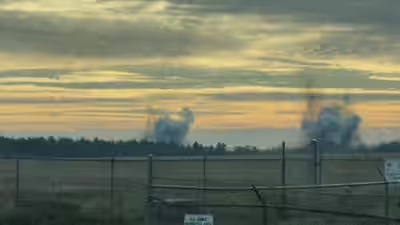
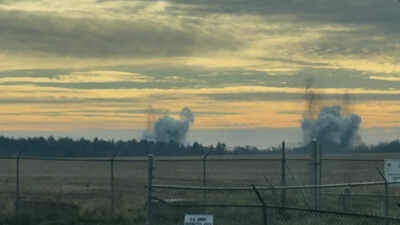
The US military has described the controlled detonation of nearly five tonnes of toxic explosives in Iowa as a “huge success”, after the operation sparked widespread concerns over potential health and environmental risks among residents.Smoke was seen rising shortly after 9 am local time (2 pm GMT) on Wednesday as the US Army detonated the volatile explosives at an ammunition plant near Middletown. Officials later said the risk from the operation had been reduced to “as close to zero as is absolutely humanly possible”.The blast followed weeks of uncertainty, public protests and legal challenges, with the Army repeatedly postponing the operation over concerns about possible lead contamination.In an update on Wednesday evening, the Army said the Federal Emergency Management Agency (FEMA) had issued an “all clear” around the ammunition plant. It also reported no airborne lead detection following the explosion.US President Donald Trump welcomed the outcome, saying mitigation efforts had exceeded expectations.“The Army’s controlled, mitigated detonation exceeded all expectations and was a HUGE success,” acting US Army Secretary Adam Telle wrote on social media.
Officials report no airborne lead after explosion
The explosives, which had been stored for around 20 years, contained lead azide, a highly volatile compound that had deteriorated through a process known as recrystallisation. This made the material increasingly vulnerable to accidental detonation through friction or movement.The US Army had warned residents about the possibility of exposure to toxic lead dust before the operation. Lead exposure poses serious health risks, particularly for children and pregnant women, and no level of exposure is considered safe.Environmental Protection Agency administrator Lee Zeldin said that all agency air monitors continued to report zero detection of airborne lead in the hours following the blast.The Army said post-detonation surface sampling was underway and that the results would be made public once testing was complete.FEMA administrator Cameron Hamilton said additional resources and testing would be provided in the coming days and weeks.
Residents relieved but calls for more testing
The explosion brought relief to several residents who had spent days preparing for the operation.Middletown Mayor Rodney Johnson told the BBC that he was relieved after watching the blast from his workplace, around eight miles from the site. He also monitored a camera at his home, located about a mile from the ammunition plant.“We did not feel anything. We did not see anything,” he said.Resident Sandy Mabeus, who lives around eight miles away, said her family had shut the windows and garage, brought their outdoor cat inside and watched the explosion through three separate livestreams.“We did not feel or hear a thing here,” she told the BBC, adding that she had to check the videos to make sure the explosion had actually taken place.Iowa farmer David Vandenberg, who lives about 20 miles from the site, said he heard a rumble around 9 am but neither saw nor smelled anything. Officials had collected samples from his yard and pond ahead of the detonation.He said he expected further testing but was pleased that the explosion appeared to have remained contained.Illinois Governor JB Pritzker also said his state was seeing little to no impact from the blast. Illinois shares a border with Iowa, with the detonation site located around 10 miles away.However, concerns over the operation have not entirely subsided. Iowa governor-elect Rob Sand called for further testing and transparency, criticising the chaotic preparations ahead of the explosion.He said residents affected by the operation must receive immediate assistance.
Legal challenges delayed Army operation
The Army had faced significant opposition from residents and politicians over its plans to destroy the ageing explosives.The detonation was scheduled and postponed several times in recent weeks as officials prepared for colder winter temperatures and assessed the risks.Authorities had introduced an optional evacuation zone and advised residents to shelter in place ahead of the explosion.Legal challenges were also filed seeking to stop the operation on environmental and public health grounds. However, an appeals court on Monday overturned an earlier decision that had halted the detonation.While acknowledging the concerns raised by residents, the court concluded that the danger posed by an accidental explosion was greater than the risks associated with the controlled blast.