
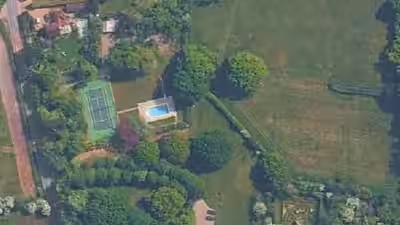
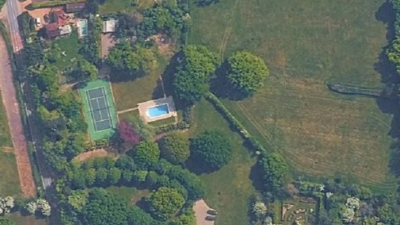
A 95-year-old widow has been left facing a legal bill exceeding £1 million after the High Court rejected her latest attempt to recover the costs of a decade-long dispute with her neighbours over a small strip of garden land in Kent, UK.Mary Egan challenged an earlier ruling that required both sides to pay their own legal expenses, arguing that she had largely won the original case and should not be held responsible for the enormous costs. However, Mr Justice Tappin dismissed her appeal, leaving the previous costs order unchanged.The dispute involved businessman Neil Morgan, 65, and his wife Fiona, 61, who live next door to Egan in Sissinghurst, near Tunbridge Wells. The disagreement centred on approximately 45 square metres of grass, trees and scrub along a boundary measuring around 60 metres, according to The Independent.Despite the limited size of the disputed area, the neighbours spent years in court, with Egan claiming to have accumulated more than £1 million in legal fees.
How a garden fence triggered a decade-long legal battle
The disagreement began in 2015 when the Morgans installed a new fence between their property and Egan’s land. Her lawyers alleged that the couple had entered her property without permission, removed the existing wooden fence and installed replacement structures on her side of the boundary.The dispute escalated after Egan removed one of the fences. The Morgans subsequently erected another structure, leading them to sue her for the cost of the damaged fence.Egan filed a counterclaim, accusing her neighbours of trespassing and asking the court to establish the boundary along the middle of a line of trees and hedges.At a trial in Maidstone County Court in 2021, Recorder John Dagnall rejected the Morgans’ claim over the damaged fence and found that they had trespassed by installing the structures. Egan received £2,600 in damages.However, the judge refused her request to have the third fence removed. Instead, he allowed it to remain and recognised its position as the new boundary, awarding her a further £3,250 in damages instead of the injunction she had sought.
Why Egan argued her neighbours should pay her legal costs
The financial consequences became a separate dispute after the original proceedings. In 2024, Recorder Dagnall ordered both parties to cover their own legal expenses, describing the outcome as effectively a “score draw”.The Morgans had initially accumulated legal costs running into six figures but represented themselves for much of the later proceedings. Egan, meanwhile, retained lawyers throughout the case, leaving her with a bill exceeding £1 million.Her barrister, Daniel Petrides, argued during the appeal that she had emerged as the successful party because the Morgans’ claim against her had been dismissed and the court had recognised their trespass.He also highlighted Morgan’s conduct during the proceedings, including offensive remarks directed at Egan, lawyers and members of the judiciary. Morgan had previously described one judge as “not fit to judge vegetables at a village fete”, according to arguments presented in court cited by The Independent.Petrides said the behaviour had increased the cost of the litigation and argued that the Morgans should have been ordered to pay Egan’s expenses.Morgan, who represented himself and his wife during the appeal, disputed that interpretation. He maintained that the central issue had always been the location of the boundary and that Egan had failed to secure the outcome she originally wanted.He argued that the decision allowing the third fence to remain was a significant victory for the couple. Morgan also said they had been provoked into responding to criticism during the dispute.
What the High Court said about the £1m dispute
Dismissing Egan’s appeal, Mr Justice Tappin acknowledged that Morgan’s language towards opposing lawyers, their staff and court officials was unacceptable. However, he found no reason to overturn the original judge’s assessment of how that behaviour should affect the allocation of legal costs.“While I entirely agree with the appellant that the use of abusive language towards opposing lawyers and their staff, or towards judges and court staff, is deplorable and unacceptable,” he said, the way the original judge had dealt with the matter did not make his decision wrong.The High Court also upheld the earlier judge’s decision to consider Egan’s failure to establish that the boundary ran through the middle of the hedge. That had been a central part of her case, despite her success on other issues.Mr Justice Tappin highlighted the disproportionate resources spent on the dispute, noting that the land had little practical or financial value.He said the case had resulted in an “expenditure of time, cost and energy wholly out of proportion to the financial value of the area of land in dispute.”The judge noted that the neighbours had been involved in litigation over the 45-square-metre strip since 2016, with Egan claiming legal expenses of more than £1 million.