
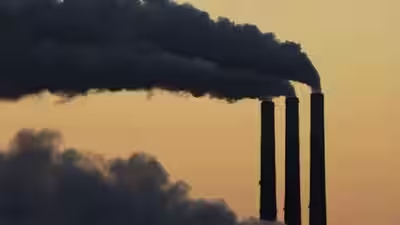
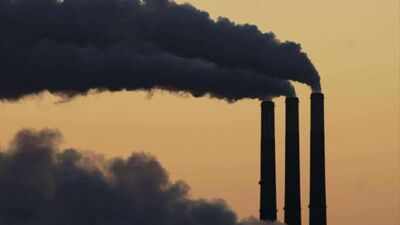
An effort by American power companies to reduce local air pollution in the 1970s ended up creating a much wider environmental crisis, turning a local health problem into a continent-wide acid rain emergency. By building huge smokestacks to send coal emissions away from nearby towns, power companies pushed sulfur dioxide and nitrogen oxides into high-altitude winds. Instead of removing the pollution, the strategy carried these harmful chemicals hundreds of miles downwind, bringing acidic rain to forests, lakes and communities far from the power plants. Data collected in a major government investigation by the United States Government Accountability Office (GAO), titled Air Quality: Information on Tall Smokestacks and Their Contribution to Interstate Transport of Air Pollution (GAO-11-473), shows how the rapid spread of these giant structures changed air chemistry across North America.
The rise of the giant chimneys
In 1970, the United States had only two industrial smokestacks taller than 500 feet. By 1985, the number had risen to more than 180 as power companies worked to meet new ground-level air quality standards under the Clean Air Act. Instead of installing expensive scrubbers or other filtering systems at the source, electricity producers turned to a method known as dispersion. Tall stacks allowed coal-fired power plants to meet National Ambient Air Quality Standards around the plant by releasing their emissions far above ground level. According to historical research published by the US Environmental Protection Agency (EPA) through its National Center for Environmental Publications (NEPIS), scientists soon realised that releasing pollution at greater heights changed how power plant emissions moved and reacted in the atmosphere. When released from shorter stacks, sulfur dioxide (SO₂) and nitrogen oxides (NOₓ) generally settled on nearby land or reacted close to the ground. When released from heights of 500 to 1,000 feet, however, the pollutants entered stronger and faster winds higher in the atmosphere.
Exporting pollution across state lines
Once carried into the upper troposphere, the harmful gases could travel much farther and remain in the atmosphere for longer. Sunlight, moisture and oxygen transformed SO₂ and NOₓ into sulfuric and nitric acids. These acidic compounds travelled across large regions before falling as acid rain, snow and fog. In many cases, they damaged ecosystems in states that produced little of the original pollution. The GAO report found that tall smokestacks were heavily concentrated along major industrial areas. About one-third of all US stacks measuring more than 500 feet were built in just five states around the Ohio River Valley, a major centre for coal-fired power generation. Because of prevailing winds, emissions from power plants in Illinois, Indiana, Ohio, Pennsylvania and West Virginia travelled east and north. The resulting acid rain lowered the pH of freshwater lakes in New York’s Adirondack Mountains and New England. It also removed important nutrients from forest soils and killed red spruce trees at higher elevations. In Canada, pollution from American power plants travelled long distances and made thousands of lakes in Ontario and Quebec more acidic. The problem led to major diplomatic disputes between Washington and Ottawa during the 1980s.
Congressional intervention and legacy controls
As officials recognised that tall smokestacks were simply moving pollution from one state to another, Congress amended the Clean Air Act in 1977 to limit their use as a main way of meeting pollution rules. Section 123 of the Act introduced Good Engineering Practice (GEP) limits for stack heights. The rules discouraged utilities from building stacks taller than needed to prevent local aerodynamic downwash. Despite the changes, many older tall smokestacks continued operating for decades without modern pollution controls. The GAO found that even by the late 2000s, 56 percent of coal-fired boilers connected to tall stacks did not have flue gas desulfurisation scrubbers to remove sulfur dioxide. Another 63 percent lacked advanced controls for nitrogen oxides. Most of these uncontrolled units were built during the construction boom before 1980. To deal with the continued movement of pollution across state lines, federal regulators eventually moved from rules on stack height to strict limits on emissions. The Acid Rain Program, created under the Clean Air Act Amendments of 1990, pushed power companies to install pollution-control equipment or switch to coal with lower sulfur content. The programme eventually cut regional sulfur emissions by more than 80 percent, showing that effective pollution control requires capturing harmful emissions at the source rather than simply sending them higher into the atmosphere.