
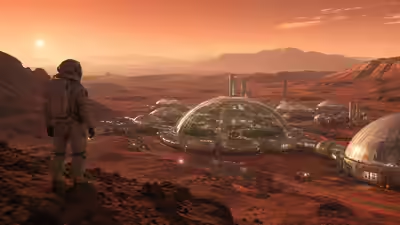
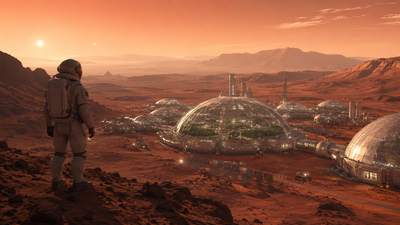
Building a city on Mars has long been a symbol of human ambition, but the practical reality behind it is far more complicated than the dream suggests. A recent preprint study led by Serena Suriano explores one of the biggest hidden challenges: where the construction materials will actually come from. Mars does have iron, but it lacks many of the specialised elements required for advanced manufacturing, such as boron and molybdenum. Without these, building durable infrastructure becomes extremely difficult. Because of this limitation, researchers are increasingly looking beyond Mars itself and turning their attention to the Main Belt asteroids as a possible supply source.
Why Mars looks rich in resources but actually is not
Mars often appears rich in resources when viewed from a distance, but its geological history tells a different story. Unlike Earth, it did not experience long-term tectonic activity capable of concentrating valuable minerals into accessible deposits. As a result, most of its metals are widely dispersed rather than available in concentrated ore veins.Iron is abundant and gives the planet its distinctive red appearance. However, iron alone is not enough for building a functioning industrial base. Advanced construction requires a range of alloying elements that are either scarce or extremely difficult to extract on Mars. Experts suggest that while early settlements may rely on local resources for basic survival, large-scale development will quickly run into material shortages.This creates a fundamental bottleneck. A Mars colony may be able to sustain life, but not necessarily expand into a fully developed city without importing materials from elsewhere according to the study published under Cornell University, titled, ‘Asteroid Mining to Sustain a Mars Colony: A Logistics Point of View’.
How the asteroid belt could become a resource hub for Mars missions
To address this gap, the study proposes a bold idea: use the Main Belt asteroids as a source of industrial materials. These asteroids, located between Mars and Jupiter, contain both metallic and volatile-rich bodies. Metallic asteroids can provide iron and nickel, while carbon-rich asteroids contain water and compounds that can be used to produce fuel.At first glance, this approach seems efficient. In practice, it depends heavily on orbital mechanics, which makes the process far more complex than simply flying to a nearby space rock and returning with cargo. Every journey requires careful alignment between planetary positions, fuel availability, and spacecraft capability.The researchers reportedly identified a small number of asteroid pairings that could work within realistic energy limits. Even so, the system would operate on very long timescales, with each supply cycle taking years rather than months.
How a Starship-like spacecraft could handle asteroid mining missions
The study models its logistics around a spacecraft similar in capability to SpaceX’s Starship. This theoretical vehicle has a large payload capacity but is still constrained by the laws of rocketry. Much of its mass is dedicated to fuel rather than cargo, a limitation driven by the well-known rocket equation.Fully fuelled, such a spacecraft could achieve a delta-v of around 6.4 km/s. This is significant, but not enough to complete a full mining and return mission in a single trip across the asteroid belt. Most viable routes require considerably more energy, often pushing beyond what a single fuel load can support.Because of this, the study suggests a multi-stop system. The spacecraft would first travel to a metallic asteroid to collect materials. It would then proceed to a second asteroid rich in water and hydrocarbons, where it could refuel by producing propellant in space. Only after this second stop would it return to Mars orbit with its cargo.
Slow reality of producing fuel in space
One of the most challenging aspects of this system is in-situ propellant production, or ISPP. This process involves extracting water from asteroids and converting it into usable fuel. While the concept is well understood, the practical rate of production is extremely slow. Some estimates suggest production rates of only a few kilograms per day under current assumptions. At that speed, refuelling a large spacecraft could take many years. In extreme cases, full refuelling cycles could stretch into centuries if no improvements are made.This creates a major bottleneck in the system. Even if the spacecraft and asteroid routes are viable, the refuelling process alone could dominate mission timelines.
Why asteroid mining may take decades, not years
Despite the difficulties, the study does not dismiss the idea. Instead, it frames asteroid mining as physically possible but heavily constrained by time, energy, and current technology levels. Over a long enough timeframe, a single spacecraft operating continuously could deliver significant amounts of material to Mars, potentially around a few hundred tons over decades.There is also the possibility that future propulsion systems, such as solar electric engines or solar sails, could improve efficiency and reduce travel times. However, experts caution that these technologies are still developing and may not be ready for large-scale interplanetary logistics within the near future.In the end, the vision that emerges is not one of rapid expansion, but of slow accumulation. A Mars city, if it ever becomes real, may depend less on dramatic breakthroughs and more on steady, patient supply chains stretching across the solar system.