
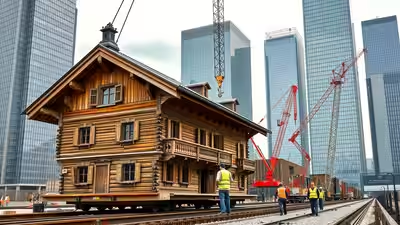
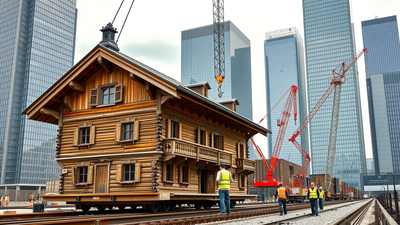
While most countries knock down old structures that stand in the way of new development, Switzerland has quietly built a reputation for doing the opposite. Instead of demolishing historic buildings that block railway lines, roads or new construction, Swiss engineers often lift them onto rails or rollers and physically move them to a new spot nearby. It sounds almost unbelievable, but this practice has been used for decades across the country, saving everything from churches to farmhouses to massive industrial landmarks. One of the most striking examples is a 19th-century brick building in Zurich that weighed thousands of tonnes and still ended up rolling gently to safety.
Why Zurich’s 19th-century MFO building was moved instead of destroyed
The clearest example of this approach is the former administrative building of the Maschinenfabrik Oerlikon, known locally as the MFO building, in the Oerlikon district of Zurich. Built in 1889, the 80-metre-long brick structure once served as the headquarters of one of Switzerland’s most important industrial companies, which later grew into engineering giants like ABB. When Swiss Federal Railways planned to expand the tracks at Zurich Oerlikon station in the early 2000s, the building stood directly in the path of two new platforms and was slated for demolition. Local residents and heritage groups pushed back, arguing that the building was one of the last physical reminders of the area’s industrial past.
How a feasibility study helped save a historic Swiss building
Rather than simply rejecting the demolition plan, the city of Zurich commissioned architecture firm Müller and Truniger to study whether the building could actually be relocated instead. Their feasibility study, described on the firm’s own project page, concluded that shifting the entire structure to a new site just outside the railway perimeter was both technically possible and economically reasonable. Based on this, the local government agreed to contribute land and funding toward the project, and after years of planning, the move finally went ahead in 2012. According to an official statement from the City of Zurich, the building had stood in the same spot for 130 years and had become a genuine symbol of the neighbourhood, which is why the council chose to fund its rescue rather than let it disappear.
How Zurich’s historic MFO building was shifted 60 metres without damage
Moving something the size and weight of the MFO building is not as simple as dragging it across the ground. Engineers first had to support the entire structure on temporary steel props while the original foundation walls were removed and replaced with new concrete beams. Steel rails and rollers were then installed underneath the building, allowing hydraulic presses to slowly push it along a fixed track. The building travelled around 60 metres westward at a painfully slow pace of just over a millimetre per second, meaning the entire journey stretched across roughly 17 to 19 hours. Once it reached its new foundation, the building settled into place accurately to within just a few millimetres, an extraordinary feat of precision for something so large and old.
Why Switzerland moves historic buildings instead of demolishing them
The MFO relocation was not a one off stunt. Switzerland has moved several historic buildings over the decades, including old farmhouses, a stone bridge era church and other brick structures that stood in the way of new infrastructure. Specialist relocation firms, often family-run businesses based in smaller Swiss towns, have built up decades of expertise in this niche field of engineering. Around 75,000 buildings across Switzerland currently hold formal historic protection status, and moving a structure is sometimes seen as a more practical solution than trying to redesign an entire road or railway project around it. Where demolition would erase a piece of local identity permanently, relocation allows communities to keep their landmarks while still accommodating modern development needs.
A different way of thinking about old buildings
What makes the Swiss approach stand out is not just the engineering itself, but the mindset behind it. Rather than treating old buildings as obstacles to progress, cities like Zurich have increasingly tried to integrate historic structures into new development plans, even when that means going through the expensive and complicated process of physically relocating them. The MFO building today stands just 60 metres from its original spot, surrounded by newer offices and apartments, functioning as a quiet reminder of Oerlikon’s industrial past. For a country known for precision engineering, moving an entire building without so much as cracking its brick facade might just be one of its most fitting achievements.