
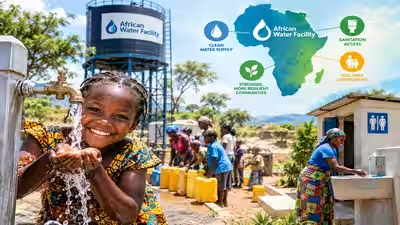
Since 2006, the African Water Facility has provided grants and other support for 148 water and sanitation projects across Africa. The facility says those projects have improved access to water supply for 23.2 million people, provided sanitation access to 11.3 million people and equipped 2 million hectares with irrigation. It has provided €220 million in grants and helped mobilise €2.1 billion in downstream investment, according to the African Development Bank. The figures were highlighted at a water and sanitation investment event during the bank’s 2025 Annual Meetings in Abidjan, as the facility prepared to enter a new 2026-2030 strategy period. The programme’s work spans project preparation, investment planning and support for water and sanitation infrastructure, with its financing designed to help projects move towards implementation.
How the African Water Facility prepares water and sanitation projects
The African Water Facility is a project preparation fund focused on water and sanitation in Africa. It provides grants, technical assistance and investment support to governments and works with partners on water projects. The facility is an initiative of the African Ministers’ Council on Water and is hosted and managed by the African Development Bank. Although the facility was established in 2004, it became operational in 2006, when it funded its first project to support the creation of the Volta River Basin Authority.Since 2006, the facility says it has provided €220 million in grants across 148 projects and mobilised €2.1 billion in downstream investment. Its current pipeline was valued at €90 million in the figures presented at the 2025 Annual Meetings and was expected to benefit 15 African countries. The facility’s role is concentrated on project preparation, helping governments develop projects and strengthen the conditions needed to attract larger sources of financing. At the May 2025 Annual Meetings event, African water-sector officials and experts also discussed project bankability, financing mechanisms, private-sector participation and partnerships as continuing challenges for the sector.
What the facility’s projects have delivered
The figures reported by the African Development Bank cover several parts of the water sector. The facility says its projects have improved access to water supply for 23.2 million people and provided sanitation access for 11.3 million people. They have also equipped 2 million hectares with irrigation. These figures describe the cumulative results reported for projects supported by the facility since 2006.The wider health implications of water, sanitation and hygiene are documented in independent research. A 2023 study published in The Lancet, titled Burden of disease attributable to unsafe drinking water, sanitation, and hygiene in domestic settings: a global analysis for selected adverse health outcomes, estimated that 1.4 million deaths and 74 million disability-adjusted life-years could have been prevented through safe water, sanitation and hygiene in 2019 across four health outcomes examined by the researchers. The study estimated that 69% of diarrhoea, 14% of acute respiratory infections and 10% of undernutrition were attributable to unsafe water, sanitation and hygiene under its methodology. The figures were global estimates for 2019 and were not specific to projects supported by the African Water Facility.Research has also examined the relationship between sanitation and education. A 2017 systematic review titled Effects of sanitation on cognitive development and school absence: A systematic review identified 17 studies. It found some evidence of an association between household sanitation and improved cognitive outcomes, but rated the overall evidence as having poor methodological quality, while findings on school absence were mixed and uncertain. Another 2017 study, Sanitation and Education, published in the American Economic Journal: Applied Economics, found that school latrine construction substantially increased enrolment among pubescent-age girls, particularly when sex-specific latrines were provided. The study also found benefits for younger children, while noting that latrine construction did not increase academic test scores.
The African Water Facility’s new 2026-2030 strategy
The facility’s next phase is set out in its 2026-2030 strategy, which places greater emphasis on preparing investment-ready projects, mobilising financing and expanding partnerships. The strategy identifies project preparation as a central priority and calls for high-quality, bankable project pipelines capable of attracting larger downstream financing. It also places emphasis on innovative and blended financing approaches, private-sector engagement and institutional capacity.The strategy also includes a stronger focus on sanitation. The Africa Urban Sanitation Investment Initiative, or AUSII, operates as a dedicated urban sanitation financing window within the African Water Facility. Its stated objective is to increase the scale and impact of investment in urban sanitation by helping create financing options and an enabling environment for projects. The initiative has been piloted in seven countries: Uganda, Kenya, Zambia, Ghana, Mauritania, Côte d’Ivoire and Togo. Its work includes developing sanitation master plans, investment planning, inclusive on-site sanitation and faecal sludge management.AUSII was created to address the financing and preparation of urban sanitation projects, with the facility describing bankable project development and catalytic investment as part of its approach. The initiative’s longer-term targets include preparing 50 sanitation projects and providing 15 million people in African urban areas with access to safely managed sanitation and hygiene services. It also aims to mobilise additional commercial and concessional finance for sanitation projects.The African Water Facility entered the 2026-2030 strategy period with a focus on expanding the number of projects that can move from preparation to implementation and attracting additional sources of financing. Its record since 2006, measured through 148 supported projects, 23.2 million people with improved water supply access, 11.3 million with sanitation access and 2 million hectares equipped with irrigation, provides the baseline for that next phase.