


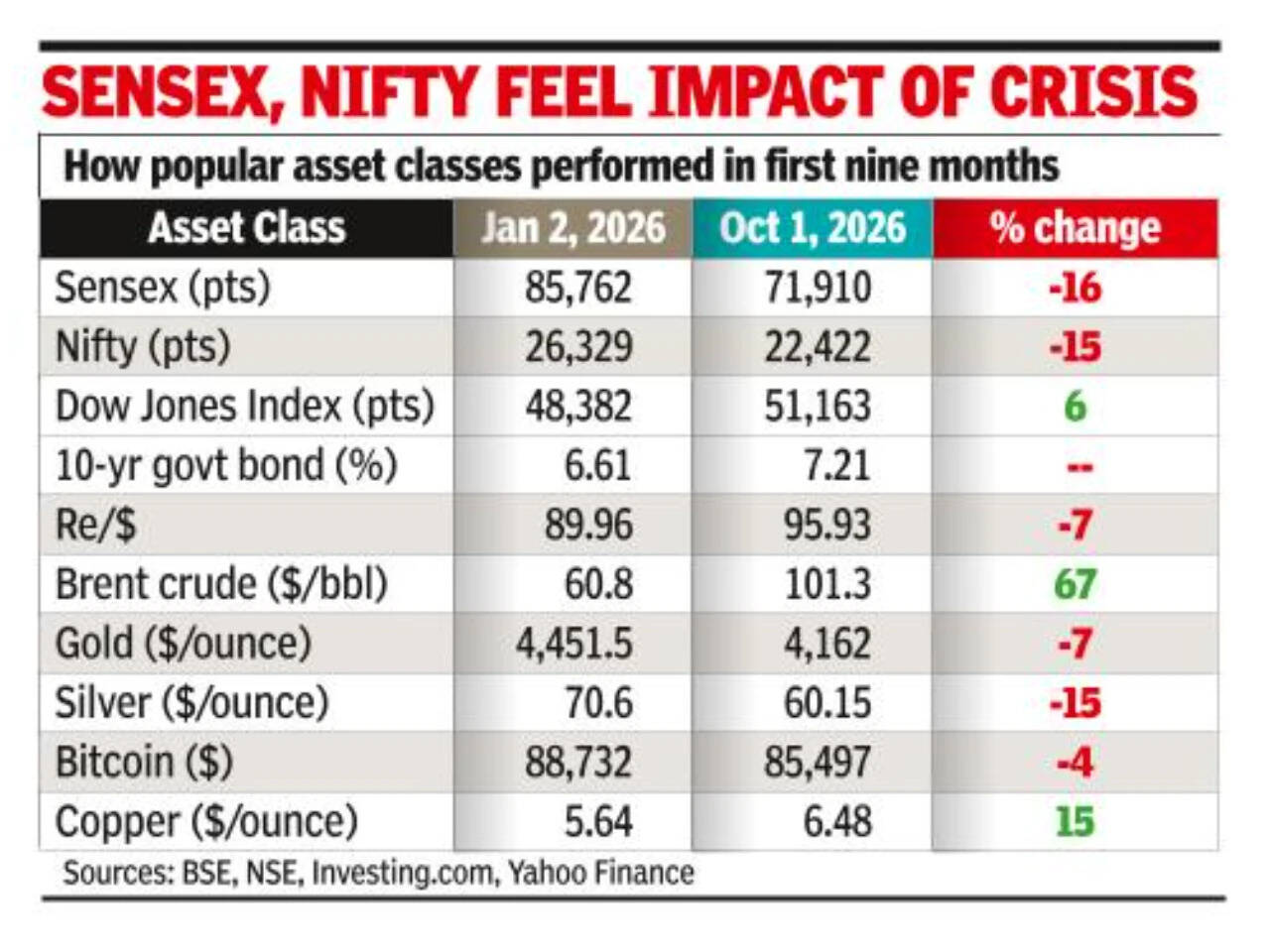
MUMBAI: Nine months into 2026, most asset classes in the domestic market are signalling red in their respective year-to-date return columns.Data shows that so far this year, while sensex has given a negative return of 16%, Nifty has returned 15% in the red. In the bond segment also, with yields rising, investors have seen negative returns in their portfolio.Internationally, gold and silver prices have given negative returns. Although the rupee has weakened 7% so far in the year, domestic returns are in low single digits in gold and negative in silver.Only investors in crude oil have made good money—thanks mainly to the US-Iran war in the Persian Gulf that has led to a 67% gain in Brent crude. Outside of the popular assets, copper has given a smart return. The red metal has jumped from the $5.6/ounce level at the start of the year to the $6.5 level now, a 15% return. Looking ahead, inflationary expectations due to rising crude oil prices and, along with them, a weak rupee, could spook investors.A recent report by SBI Mutual Fund warned that inflation was a unifying macro theme of the year. For one, a delayed monsoon and lingering weather effects have depressed sowing activity and lifted food price risks, posing near-term challenges for rural incomes, the report said.

The fund house also pointed out that input costs—from power and fuel in cement, to needle coke in electrodes, to milk procurement, freight, labour and packaging—are broadening rather than easing.“These pressures are already driving selective price hikes across FMCG, food diagnostics, consumer staples and several industrial categories. The ability to pass on these costs varies widely by sector. Fertilisers, agrochemicals and speciality chemicals face the most severe cost mismatches, with fertiliser economics particularly dependent on additional subsidy support as subsidy rates have not kept pace with raw material inflation. The world is in an inflationary boom, not yet an inflationary bust. A further rise in oil, or high bond yields starting to hurt growth, could tip it into a bust,” the report said.On the equities front, the fund house’s asset allocation framework continues to favour a 60:40 equity–fixed income allocation (versus a 50:50 benchmark). “It projects an early-teens equity CAGR at the large-cap index level over three years. Historically, a low level of market polarisation supports a tilt towards large caps.” On the debt side, the report said that the shorter end of the yield curve is offering relatively attractive opportunities, meaning investments in short-term papers are better bets than medium- or long-term ones.In the short run, RBI policy decision will be the key domestic trigger, with pressure to support the rupee and contain imported inflation strengthening expectations of a rate hike, said Vinod Nair, head of research, Geojit Investments. “With corporate earnings for Q2 expected to be softer than Q1, sentiment is likely to remain fragile. A meaningful de-escalation in West Asia could trigger a sharp relief rally. Until then, investors should stay selective, favouring earnings visibility.”