
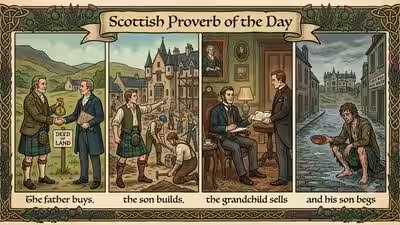
Four generations. Four decisions. One family’s fortune built, expanded, squandered and ultimately lost.This old Scottish proverb tells an entire family saga in a single sentence. The first generation works hard to acquire something valuable. The next strengthens it. The third slowly begins to sell what earlier generations created. By the fourth, nothing remains, leaving the family to start again with empty hands. Although the proverb speaks about money and property, its deeper message is about responsibility, discipline and the choices every generation makes with what it inherits. More than a warning about wealth, it is a timeless reminder that success survives only when each generation earns the right to pass it on.
Scottish proverb of the day
“The father buys, the son builds, the grandchild sells and his son begs”
What the proverb actually means
The proverb lays out four generations, each one representing a different stage in a family’s rise and eventual fall. The first generation buys, laying the actual foundation through determination, sacrifice and careful planning. The second generation builds on top of it, expanding what they inherited through hard work and genuinely sound decisions.The third generation starts selling instead. Rather than creating anything new, they slowly work through everything earlier generations spent years building up. By the fourth generation, there is nothing left. Without assets, savings or real opportunity, the family effectively finds itself starting again right back at the bottom.None of this is meant as a prediction that every family will follow exactly this path. It is really a warning that wealth, knowledge and opportunity can disappear surprisingly fast once a generation starts taking it for granted.
A pattern that shows up across many different cultures
What makes this proverb genuinely interesting is how many different cultures have landed on almost the exact same idea, independently, in their own language. Americans say “shirtsleeves to shirtsleeves in three generations.” In Japan, the phrase is “rice paddies to rice paddies in three generations.” In England, it becomes “clogs to clogs is only three generations.” In China, there is a version that translates directly as “wealth never survives three generations.“That kind of pattern showing up again and again, across cultures with no real connection to each other, suggests something genuinely true about human nature rather than a coincidence specific to Scotland alone. Building something valuable seems to be only half the actual challenge. Protecting it across generations turns out to be considerably harder.
Why this old Scottish saying still lands today
Even though the proverb comes from a very different era, its message still feels remarkably familiar. Around the world, there are countless real stories of businesses built from nothing by one generation, expanded successfully by the next, and eventually lost entirely because a later generation never learned to value what they had actually inherited.The same pattern shows up beyond money too. Families can pass down strong traditions, solid values or a genuinely respected reputation, only for all of it to fade quietly if nobody afterward makes the effort to actually protect it. Success, in other words, was never really permanent on its own. Every single generation carries its own share of the responsibility, and simply inheriting something valuable has never guaranteed it stays that way.
Five timeless lessons hiding inside this proverb
- Building wealth is only ever the beginning. Creating something valuable takes real effort, but protecting it afterward requires just as much commitment, if not more. Financial security, a thriving business, even strong family traditions, all of it needs continuous care if it is going to survive being passed down.
- Every generation shapes what comes after it. The proverb shows that each generation inherits real opportunity, but it also inherits real responsibility alongside it. Decisions made today quietly shape children and grandchildren in ways that are not always visible right away.
- Never treat success as something permanent. Prosperity has a way of creating a false sense of security. This saying is a reminder that real achievements can quietly disappear once people assume they will simply last without any attention, planning or discipline behind them.
- The greatest inheritance is not always money. Property and wealth genuinely matter, but qualities like honesty, hard work, education and financial discipline are usually the actual foundation that lets later generations succeed at all. Without those qualities in place, even considerable wealth rarely lasts very long.
- Think carefully about the legacy you are actually leaving. Everyone leaves something behind for whoever comes next, whether that is financial security, real knowledge, family tradition, or simply an example of how to actually live. The proverb is really asking people to think honestly about what kind of inheritance their everyday decisions are quietly building right now.
How this proverb can guide everyday life right now
This old saying feels especially relevant at a time when financial planning matters more than ever. Rising living costs, shifting job markets and general economic uncertainty have pushed plenty of families to think more carefully about saving, investing and actually preparing for what comes next.The proverb suggests that thinking long term genuinely matters. Rather than focusing purely on immediate reward, people tend to benefit from considering how today’s choices might ripple forward into future generations, whether that means teaching children real financial responsibility, actively preserving family traditions, or investing in education rather than short-term comfort.Its lesson clearly reaches beyond money too. Relationships, trust and reputation are all genuinely their own kind of wealth, and all of them need real care to survive intact. A supportive family, a genuinely respected name, or simply a family tradition of helping other people, all of it can become an inheritance just as meaningful as any amount of property or savings.
Why its message still matters now
Even in today’s world of booming businesses, inherited wealth and instant success stories, this proverb feels surprisingly current. Around the world, many family fortunes have followed exactly this pattern. One generation spends decades building a successful business or securing financial stability. The next expands it. Later generations, having never experienced the struggle that created it, gradually consume rather than create until little remains.The same cycle appears outside money too. Families can inherit trust, reputation, traditions or even valuable life lessons, only to lose them when nobody takes the responsibility of preserving them. The proverb reminds us that every inheritance, whether financial or personal, survives only if someone chooses to protect it.
Learning from this proverb
This Scottish proverb is not really about money. It is about stewardship.Every generation receives something from the people who came before, whether it is wealth, knowledge, opportunities, values or simply a better starting point in life. What ultimately defines a family is not what it inherits but what it leaves behind.“The father buys, the son builds, the grandchild sells and his son begs” reminds us that success is never permanently owned. It must be earned, protected and strengthened again and again. The greatest legacy is not the size of an inheritance but the wisdom, discipline and character that allow future generations to create even more than they received.