
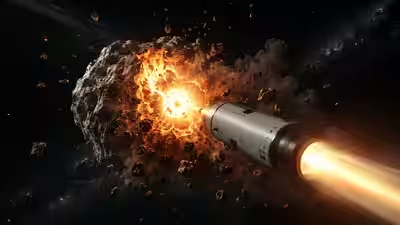
An asteroid roughly the size of a football field could cause catastrophic damage if it struck a populated area, making planetary defence a problem scientists cannot afford to treat as science fiction. Now, researchers have simulated one of the most dramatic possible responses: using a nuclear warhead to disrupt a threatening asteroid. Published in The Planetary Science Journal, the study titled ‘Nuclear Mitigation of Hypothetical Asteroid Threats in Smoothed Particle Hydrodynamics’ examined what would happen if a 1-megaton nuclear device were used against a 160-metre-wide asteroid, roughly 525 feet across. Led by astrophysicist Isaiah Santistevan of Lawrence Livermore National Laboratory, the research tested three different scenarios to understand whether the asteroid could be broken apart and whether its fragments would still pose a threat to Earth. The simulations suggest that nuclear disruption could be highly effective in two of the three scenarios, offering scientists another potential option for dealing with an asteroid discovered too late for a gentler deflection.
Scientists tested whether a nuclear blast could stop a 160-metre asteroid before it reaches Earth
Not every asteroid heading towards Earth would require an explosive response. The ideal planetary-defence scenario would be to detect a dangerous object far enough in advance to change its trajectory by a tiny amount. Even a small alteration, made years before an expected impact, could allow an asteroid to pass harmlessly past Earth rather than striking it. The problem is that not every potentially dangerous asteroid will be discovered with that much warning. Some objects can be difficult to detect, particularly dark asteroids that reflect little sunlight, while a relatively short warning time could leave scientists with far fewer options. A 160-metre object is large enough to cause devastating regional or urban damage if it reaches the ground. That makes the question explored by the new study particularly important: if humanity discovers a large asteroid on a collision course and conventional deflection is no longer practical, could a nuclear device break it into pieces that no longer strike Earth as one enormous body? The researchers’ simulations were designed to explore precisely that last-resort possibility rather than suggest that nuclear weapons should be the first choice for planetary defence.
Scientists modelled how a nuclear explosive device (NED) could break apart the asteroid
The researchers modelled a 1-megaton nuclear explosion interacting with a 160-metre asteroid under three different conditions. The aim was to examine the asteroid’s physical disruption, the direction in which material would move and the resulting change in velocity. Their results indicate that disruption was highly likely in two of the three scenarios. That distinction is crucial because simply breaking an asteroid apart does not automatically make Earth safe. A poorly managed fragmentation could turn one large impactor into numerous smaller objects that still intersect Earth’s path. The study therefore focused not only on how much of the asteroid could be disrupted, but also on how the resulting material would move. In the favourable scenarios, the simulations indicated that the asteroid could be sufficiently disrupted to reduce the threat posed by the original body. However, the researchers could not follow the fragments indefinitely. The computational demands were enormous: one of the longest simulations covered only about 145 milliseconds of physical time yet required 59 days to run across 1,680 processors. That limitation means the researchers could not establish the ultimate long-term fate of every fragment after disruption.
Nuking an asteroid would be a last-resort planetary defence option
The study does not mean that scientists have decided to blow up threatening asteroids whenever one is discovered. In fact, the most desirable strategy would usually be to detect an asteroid early and gently alter its trajectory. Nasa’s DART mission demonstrated that a spacecraft can deliberately alter an asteroid’s motion by striking it, providing real-world evidence that kinetic impact can work as a planetary-defence technique. A nuclear option becomes more relevant when an asteroid is discovered late, is sufficiently large, or presents circumstances in which a conventional impactor cannot provide enough of a trajectory change. There is also an important difference between Hollywood-style asteroid destruction and the physics being investigated by researchers. The objective is not necessarily to make the asteroid disappear in one spectacular explosion. Instead, a nuclear detonation could disrupt the object and alter the motion of its material, potentially preventing a single massive body from reaching Earth. The new simulation therefore adds another piece to the planetary-defence toolkit, while also revealing how much remains unknown. Before such a strategy could ever be considered operational, scientists would need to understand the asteroid’s composition, structure, trajectory and the long-term behaviour of any fragments produced by the disruption. The research shows that a nuclear response may be physically plausible in some scenarios, but it is very much a contingency plan for an exceptionally dangerous situation, not a replacement for early detection and conventional asteroid-deflection methods.