
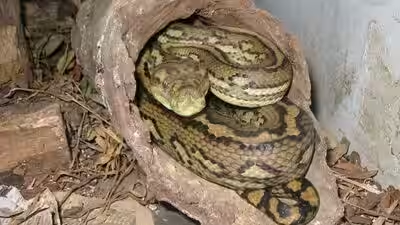
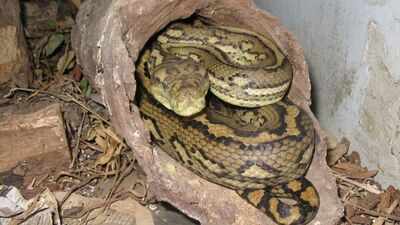
Researchers recorded 37 carpet pythons during a study of snake populations in northern Australia. The surveys covered a 28.8 km transect through woodland and rainforest in the Lockerbie Scrub, at the northern tip of Cape York Peninsula. Between 2013 and 2016, the team detected the snakes during nocturnal road surveys and other encounters.According to research published in the Australian Journal of Zoology titled ‘Notes on the natural history of the carpet python (Morelia spilota) at the northern tip of Australia’, all recorded carpet pythons were found in woodland, although rainforest accounted for 30% of the survey transect. The study examined 37 individual carpet pythons and recorded 40 capture events.
How researchers found all 37 carpet pythons in Cape York woodlands
The researchers surveyed 20.1 km of woodland and 8.7 km of rainforest along the Lockerbie Scrub transect. Between May 2013 and October 2016, they drove slowly along the route at night, beginning at 7.30 pm and usually finishing by 10 pm. Of the 37 carpet pythons (with a total of 40 capture events) examined, 23 were found during systematic surveys and 17 through opportunistic encounters. All were recorded in woodland, with none found in the rainforest.The researchers compared this result with the availability of each habitat along the transect. Their analysis found a significant difference between the observed habitat use and the expected distribution.
Study records differences in the average size and weight of carpet pythons
The researchers found more males than females among the 37 carpet pythons examined. The sample included 22 males and 15 females, with most individuals measuring relatively small body sizes. Male snakes had an average snout-to-vent length of 98.1 cm, compared with 73.7 cm for females.Their average body mass was also higher, at 352 g compared with 91.8 g in females. Statistical analysis showed that males weighed more than females even when their body lengths were taken into account. However, the researchers noted that the small sample size limited conclusions about differences in overall body length. Removing the largest male also made that difference statistically insignificant.
Two rodent samples helped researchers examine the diet of carpet pythons
The study included two available diet samples from the carpet pythons. One female measuring 77 cm in snout-to-vent length contained a small unidentified rodent. A male measuring 150 cm contained an adult Cape York melomys, identified by its scientific name Melomys capensis. Researchers also examined two specimens through dissection to investigate reproductive maturity.A female measuring 142 cm and weighing 392 g had corpora lutea in her ovary, indicating a recent reproductive event. A male measuring 150 cm and weighing 1,100 g had convoluted efferent ducts, indicating the presence of sperm. These observations provided information about the diet and reproductive biology of the population.
What did recaptured carpet pythons reveal about their growth rates
Researchers recaptured only three of the 37 carpet pythons during the study. Two snakes, initially measuring 77 cm and 102 cm, were found again after 57 and 59 days, respectively. Neither had increased in size, and both had lost body mass. One lost 13 g, while the other lost 42 g. A male measuring 142.5 cm was recaptured 848 days after its initial capture. During that period, its snout-to-vent length increased by 33.5 cm, and its body mass rose by 366 g. Based on this observation, the researchers estimated an annual growth rate of approximately 14.4 cm in snout-to-vent length.